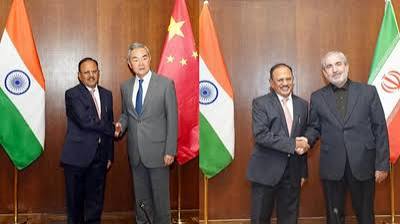
India and Iran held high-level security talks during the 16th BRICS National Security Advisers' Meeting in New Delhi. Led by NSA Ajit Doval and Iran's Ghadir Nezamipour, the discussions focused on regional stability in the Middle East, maritime trade safety, and long-term infrastructure cooperation at the strategic Chabahar Port
India, Iran Hold Security Talks Amid Middle East Tension at BRICS
High-level dialogue in New Delhi focuses on regional stability and trade corridors following the recent formal de-escalation framework.
NEW DELHI — India and Iran conducted high-level security talks on Monday to assess the evolving security architecture in the Middle East, convening on the sidelines of the 16th BRICS National Security Advisers' (NSAs) Meeting. The bilateral session, hosted by Indian National Security Advisor Ajit Doval, focused heavily on stabilizing regional supply lines and evaluating the economic implications of the recent 14-point de-escalation memorandum signed between Washington and Tehran. The diplomatic meeting comes at a critical time for New Delhi, which is working to manage its strategic ties with the United States while seeking to protect its energy import routes and multi-million dollar investments in Iran's maritime transit corridors.
Strategic De-Escalation Realities Shape Subcontinental Diplomacy
The security dialogue in New Delhi represents the first major diplomatic interaction between Indian authorities and senior Iranian representatives since the June 17 peace understandings brokered in Switzerland.
Indian National Security Advisor Ajit Doval met with Iranian official Ghadir Nezamipour, the Deputy Secretary for Defence Affairs of Iran's Supreme National Security Council, to review the practical enforcement of the regional peace framework.
According to external ministry records, the primary objective of the dialogue was to gauge how the easing of geopolitical tensions will impact energy shipping safety across the critical Strait of Hormuz.
Indian manufacturing and energy sectors suffered supply disruptions during the recent weeks of friction in the Middle East.
The security teams focused on finalizing operational parameters to ensure uninterrupted maritime commercial shipping, while also evaluating structural timelines for the potential relaxation of Western financial sanctions on Iranian crude oil exports.
Reviving Economic Corridors and Port Investments
Beyond immediate maritime security, the bilateral discussions prioritized long-term logistics infrastructure, focusing extensively on the commercial expansion of the Chabahar Port in southeastern Iran.
Securing the Chabahar Gateway
India's long-term involvement in the development of the Chabahar port has faced persistent challenges from cross-border sanctions and regional security alerts. The New Delhi meeting allowed both nations to outline immediate technical objectives:
Contractual Safeguards: Re-validating the 10-year long-term operational lease agreement signed between India Ports Global Limited (IPGL) and the Port and Maritime Organisation of Iran.
Rail Connectivity: Accelerating the construction of the Chabahar-Zahedan railway line to connect Indian transit networks directly with landlocked Central Asian markets.
Banking Channels: Evaluating alternative, non-dollar clearing mechanisms to handle port container duties and warehousing tariffs without triggering compliance violations.
Broadening the BRICS Consensus
The security chiefs also leveraged the broader BRICS framework to establish a common approach to transnational threats. Meeting alongside representatives from Russia, Brazil, South Africa, and China's Foreign Minister Wang Yi, the delegates reviewed the outcomes of the joint working groups on counter-terrorism and the secure utilization of information and communication technologies.
Official Sources Section
The agendas, diplomatic itineraries, and strategic parameters detailed in this report are compiled directly from media logs issued by the Ministry of External Affairs (MEA), India, alongside corporate briefings published by the Islamic Republic of Iran's Embassy in New Delhi. Additional multilateral framework details conform to the official thematic outlines issued for the 16th BRICS National Security Advisers' Meeting.
Official Statements
"National Security Adviser Ajit Doval met Ghadir Nezamipour, the deputy secretary for defence affairs of Iran's Supreme National Security Council, on the margins of the BRICS NSAs' meeting," stated Ministry of External Affairs spokesperson Randhir Jaiswal in an official statement detailing the diplomatic engagements. "The two leaders comprehensively reviewed the ongoing situation in West Asia, evaluated current cooperation parameters under the expanding BRICS platform, and discussed avenues to strengthen India-Iran bilateral ties."
"Amid a transforming and volatile world with many security challenges on the rise, BRICS countries standing at the forefront of the Global South are committed to safeguarding world peace," noted Chinese Foreign Ministry Spokesperson Lin Jian regarding the broader regional meetings. "The current sessions provide an essential platform for consultation and cooperation on contemporary issues having global as well as regional significance."
Why It Matters
For global energy consumers and manufacturing logistics networks, the high-level security talks between India and Iran offer an important indicator of stabilizing supply lines in the Middle East. If the current de-escalation trend holds, the revival of the International North-South Transport Corridor (INSTC) could significantly reduce shipping transit times between South Asia and Europe, bypassing congested traditional maritime channels.
For institutional investors and international infrastructure developers, the stabilization of the region could unlock frozen logistics projects across Central Asia. A predictable security environment around the Chabahar Port enables international shipping conglomerates to commit long-term capital to regional warehouses, free-trade zones, and multi-modal transport networks, reducing overall cross-border trade friction.
Key Facts at a Glance
The Dialogue: India's NSA Ajit Doval held high-level security talks with Iran's Ghadir Nezamipour in New Delhi.
The Platform: The bilateral consultation occurred on the sidelines of the 16th BRICS National Security Advisers' Meeting.
Core Topics: Discussions centered on the security situation in the Middle East, energy transit, and bilateral infrastructure.
Infrastructure Target: Reviewing execution milestones for the Indian-operated Chabahar Port and regional rail links.
FAQ Section
What was the primary goal of the India-Iran security talks in New Delhi?
The meetings were arranged to review the security situation in the Middle East, assess maritime safety in trade corridors, and discuss bilateral cooperation under the expanding BRICS platform.
Who represented the two countries during these high-level talks?
India was represented by National Security Advisor Ajit Doval, while the Iranian delegation was led by Ghadir Nezamipour, Deputy Secretary for Defence Affairs of the Supreme National Security Council.
How does the recent US-Iran understanding impact Indian economic interests?
The initial de-escalation framework helps reduce energy market volatility and lowers security risks for Indian shipping vessels traversing the Strait of Hormuz and the wider Arabian Sea.
What specific infrastructure project was highlighted during the bilateral meeting?
The two sides reviewed progress on the strategic Chabahar Port in Iran, which serves as India’s primary logistics gateway to landlocked Central Asian economies.
Source: Ministry of External Affairs of India Press Portal, Embassy of the Islamic Republic of Iran, New Delhi, BRICS 2026 Secretariat Official Readouts.