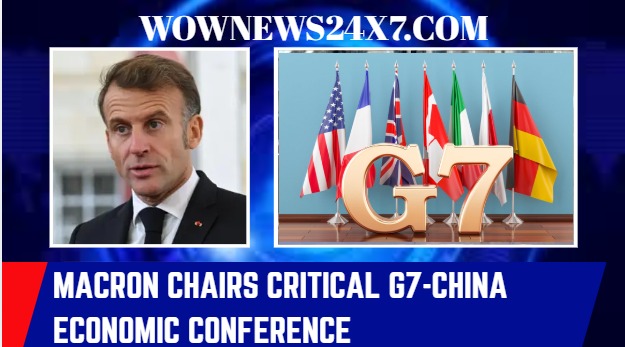
French President Emmanuel Macron is chairing a video conference this Thursday between G7 nations, China, and the IMF to address growing global trade imbalances. The summit aims to move past recent protectionist tensions and establish a framework for coordinated economic cooperation ahead of next week's G7 leaders' meeting in France.
French President Emmanuel Macron will chair a critical video conference this Thursday, June 11, 2026, bringing together leaders from the G7 nations, China, and the International Monetary Fund (IMF) to address intensifying global trade imbalances. The initiative, orchestrated by France in its capacity as the G7 presidency holder, aims to shift the current trajectory of international trade from one of increasing fragmentation and confrontation toward a framework of collaborative dialogue.
The virtual summit serves as a strategic precursor to the upcoming G7 leaders' summit, scheduled to take place in Evian-les-Bains next week. By facilitating a direct channel between the G7 and Beijing, the French government hopes to mitigate the economic friction caused by divergent trade practices, excessive industrial overcapacity, and the weaponization of economic tools that have disrupted global markets throughout 2026.
Diplomatic Strategy and Economic Goals
The conference arrives at a time of strained economic relations, particularly between the United States and China. Recent discussions among G7 finance leaders—most notably in Paris last May—have focused on leveraging data from the International Monetary Fund (IMF) to highlight the negative impacts of China's aggressive export-driven growth model. U.S. Treasury Secretary Scott Bessent has previously emphasized the need to confront Beijing with empirical evidence of how "massive export pushes" in high-end goods, such as electric vehicles, threaten to overwhelm Western domestic industries.
However, Paris is advocating for a more nuanced approach. French officials have signaled a desire to move beyond "finger-pointing," instead pushing for a coordinated economic strategy that accounts for the legitimate grievances of all parties. France’s broader economic objective, as articulated by Finance Minister Roland Lescure, is to achieve sustainable global growth by addressing the "unsustainable" nature of current trade imbalances.
Addressing Global Structural Issues
The trade imbalances at the center of Thursday’s discussion are multi-faceted, stemming from a combination of insufficient investment within the European Union, high consumption patterns in the United States, and significant industrial overcapacity in China. Diplomats involved in the preparations suggest that the conference will provide a forum to discuss these structural issues without resorting to the "law of the jungle" that has increasingly characterized 2026 trade relations.
While some European Commission officials have expressed reservations about the format of the meeting—questioning whether the G7 is the appropriate venue for such a broad economic reset—Macron remains committed to maintaining an open dialogue with Chinese President Xi Jinping. The French presidency aims to prevent the global trade order from collapsing entirely into a system of protectionist tariff walls and tit-for-tat sanctions.
Official Sources
The Elysee Palace confirmed on Wednesday that the conference would proceed on Thursday, emphasizing a "new willingness" on the part of major global powers to participate in coordinated economic steps. Official records from the G7 finance meetings held in Paris in May 2026 and reports from the International Monetary Fund (IMF) regarding global trade stability were cited as foundational data for the upcoming discussions.
"According to officials, this conference demonstrates a new willingness among China, the United States, and Europe to engage in coordinated economic steps rather than relying solely on coercive trade policies."
Why It Matters
For global businesses, investors, and consumers, the outcome of this summit could prove pivotal in determining the future of cross-border commerce. If successful, the dialogue may pave the way for a more predictable trade environment, potentially reducing the reliance on abrupt tariff hikes and export controls that have recently hampered sectors ranging from automotive manufacturing to defense. Conversely, a failure to reach a consensus could signal a prolonged period of economic fragmentation, further isolating major economies and increasing the cost of goods for households worldwide.
Key Facts at a Glance
Event: Video conference involving G7 nations, China, and the IMF.
Chair: French President Emmanuel Macron.
Primary Objective: To address global trade imbalances and industrial overcapacity.
Date: Thursday, June 11, 2026.
Context: Precedes the G7 leaders' summit scheduled for next week in Evian-les-Bains.
FAQ
Why is Emmanuel Macron hosting this meeting?
France currently holds the G7 presidency and has made reducing global economic imbalances a primary objective of its term, advocating for dialogue over confrontation.
What is the role of the IMF in these talks?
The IMF provides the objective data and analysis regarding trade imbalances and global economic health that G7 leaders are using to frame their negotiations with China.
How does this impact the ongoing US-China trade tensions?
The conference attempts to provide a multilateral platform to resolve issues that have otherwise led to bilateral tariff wars and export restrictions between Washington and Beijing.
Will this summit lead to immediate policy changes?
While immediate breakthroughs are rare in such high-level forums, the meeting is intended to lay the groundwork for more cooperative trade policies at next week's G7 summit.
Source: [suspicious link removed], Reuters, International Monetary Fund (IMF), Munich Security Conference Report 2026