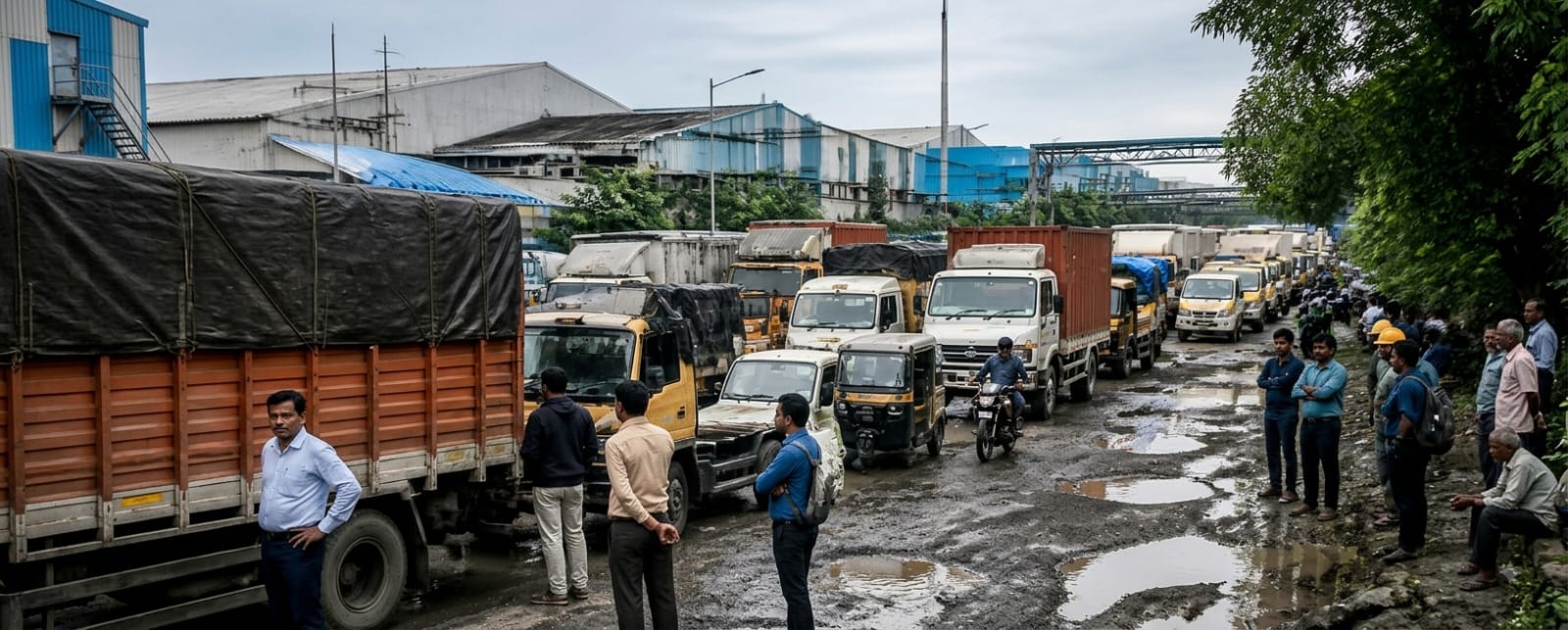
The Maharashtra government has formed a 14-agency committee headed by the Pune District Collector to address severe road damage and traffic congestion in the Chakan industrial belt. Operating on a 10-month deadline, the panel aims to fix logistics bottlenecks after 20 manufacturing firms threatened to relocate operations.
MUMBAI, August 17, 2026 — The Maharashtra government has formed a high-level committee to resolve severe infrastructure defects, potholed roads, and persistent traffic congestion in the Chakan industrial belt near Pune. The Government Resolution (GR) was issued by the Planning Department on August 14 following explicit directions from state leadership to prevent companies from relocating operations to other regions.
The intervention comes after executives from at least 20 manufacturing firms announced plans to shift factories out of the Chakan Maharashtra Industrial Development Corporation (MIDC) area to Khandala, citing severe operational disruptions. The threat posed a direct risk to nearly ₹1,000 crore in annual business and roughly 4,000 local jobs. The Chakan industrial belt houses approximately 3,000 corporate units spanning automotive, heavy manufacturing, and logistics sectors.
Panel Composition and Immediate 10-Month Mandate
The newly constituted committee is chaired by Pune District Collector Jitendra Dudi, with Pimpri-Chinchwad Commissioner of Police Vinoy Kumar Choubey serving as co-chairperson. The panel brings together 14 separate government departments and public agencies to streamline inter-agency execution.
Participating bodies include the Public Works Department (PWD), MIDC, Pune Metropolitan Region Development Authority (PMRDA), Pune Municipal Corporation (PMC), Maharashtra State Road Development Corporation (MSRDC), National Highways Authority of India (NHAI), and Pune Zilla Parishad. Industry representatives from the Mahratta Chamber of Commerce, Industry and Agriculture (MCCIA) and the Chakan Industrial Association have also been integrated into the panel.
The state administration has mandated a strict 10-month deadline for planning, approvals, multi-agency coordination, and project execution.
Action Plan for Infrastructure Upgrades
Deputy Chief Minister Eknath Shinde directed participating agencies to deploy advanced technology for immediate road repair and pothole filling across freight routes. Simultaneously, the committee will draft an integrated master plan to expand traffic capacity and modernize local support structures.
Road Network Overhaul: Complete structural repairs and road widening along primary industrial corridors, connecting routes, internal hub roads, and freight service lanes.
Traffic Management: Redesigning critical bottlenecks, installing smart signals, creating designated heavy-vehicle parking zones, and establishing alternative logistics routes.
Industrial Support Infrastructure: Expediting MIDC land allocations for support services, including dedicated police stations, medical facilities, and high-voltage power substations.
City Planning: Approving the long-delayed Chakan City Development Plan to manage urban spillover and workforce housing needs.
To address administrative bottlenecks, the state established a dedicated Industry Grievance Redressal Cell at the Pune District Collectorate to resolve pending statutory permits and operational complaints.
Statements From Authorities
"Maharashtra is the industrial engine of the country, and the real strength of this engine lies in industrial belts such as Chakan and Talegaon."
— Eknath Shinde, Deputy Chief Minister of Maharashtra
"I have not come here for petty remarks or nitpicking. I truly want to deliver justice to the industrialists. Everything is necessary, but priority will be given where there is an emergency."
— Uday Samant, Maharashtra Industries Minister
Economic Implications for Businesses and Logistics
The rapid intervention aims to restore supply chain efficiency for original equipment manufacturers (OEMs) and auto-component providers operating in North Pune. Logistics operators routinely face delays of two to four hours on short transit segments due to heavy axle traffic mixed with commuter congestion.
By establishing unified governance across MIDC, PWD, and NHAI roads, the state seeks to prevent capital flight, safeguard existing manufacturing investments, and maintain industrial confidence across the Chakan-Talegaon manufacturing cluster.
Key Facts at a Glance
Governing Body: High-level committee co-headed by the Pune District Collector and Pimpri-Chinchwad Police Commissioner.
Timeline: 10-month hard deadline for full implementation of road and traffic solutions.
Economic Scale: Protects an industrial cluster housing nearly 3,000 units, preventing the relocation of 20 major plants.
Participating Agencies: 14 government bodies alongside local industrial associations.
Grievance Support: Dedicated Industry Grievance Redressal Cell established at the Pune Collectorate.
Frequently Asked Questions
Why did the Maharashtra government form a panel for Chakan?
The panel was established to fix severe road degradation and persistent traffic snarls after 20 manufacturing companies threatened to shift factories out of the industrial belt.
Who is heading the Chakan infrastructure committee?
The committee is headed by Pune District Collector Jitendra Dudi as chairperson and Pimpri-Chinchwad Police Commissioner Vinoy Kumar Choubey as co-chairperson.
What is the deadline for completing the infrastructure fixes?
The state government set a strict 10-month deadline from the issuance of the Government Resolution for complete execution and grievance resolution.
Which official bodies are involved in the execution?
Fourteen departments are involved, including MIDC, PWD, PMRDA, NHAI, MSRDC, PMC, Zilla Parishad, and local police.
Sources: Government of Maharashtra Official Release, Maharashtra Industrial Development Corporation (MIDC), Planning Department, State Government Resolution Desk