The Government of Maharashtra and Paani Foundation have officially launched the statewide Farmer Cup 2026. Scaling up to all 351 blocks, the initiative leverages 18,000 farmer groups to drive climate-resilient practices, reduce input costs, and promote digital farming tools to secure rural livelihood stability.
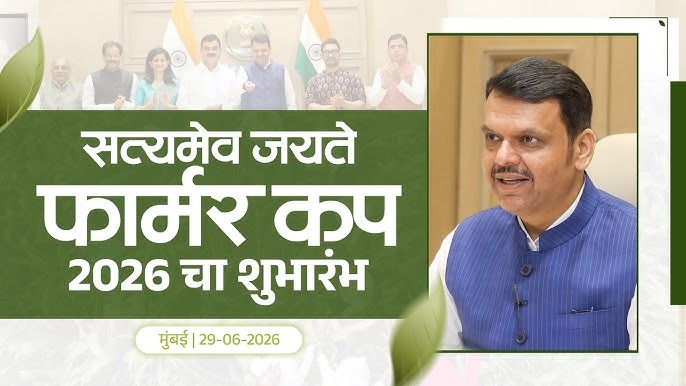
MUMBAI — The Government of Maharashtra, in an institutional collaboration with the Paani Foundation, has officially launched the "Satyamev Jayate Farmer Cup 2026". The massive rural development initiative was formally inaugurated by Chief Minister Devendra Fadnavis at the Varsha residence in Mumbai. Marking a major policy shift toward agricultural collectivization, the 2026 edition scales the competition from its previous footprint of 46 talukas (blocks) to a statewide movement encompassing all 351 blocks across 34 districts in Maharashtra.
Scaled Expansion of Collective Farming
The Satyamev Jayate Farmer Cup, which originated in 2022 as a localized pilot project, incentivizes farmers to form cohesive groups to apply scientific, water-efficient, and climate-resilient practices. By gamifying sustainable agriculture, the initiative motivates smallholders to optimize input costs and manage crop volumes collectively.
According to data presented by the state's Department of Agriculture, more than 18,000 farmer groups have registered for the Farmer Cup 2026. This grassroots mobilization has been facilitated through a joint training ecosystem setup over the past several months. Under this framework, Paani Foundation and state agricultural extension networks conducted rigorous residential workshops, preparing over 35,000 farmers and 1,000 state-level field officers to manage local implementation.
Along with the competition's launch, Chief Minister Fadnavis unveiled the "Smart Sheti App," a dedicated digital platform designed to provide real-time crop intelligence, localized weather advisories, and direct coordination mechanisms for registered farmer groups.
Economic Impact on Rural Livelihoods
Official assessments from past iterations of the Farmer Cup highlight substantial economic benefits generated by shifting away from isolated cultivation methods.
State evaluations from previous phases revealed significant financial milestones:
Yield Enhancement: Competing farmer groups achieved an average 71% increase in the production of key regional cash crops, including soybean, cotton, and maize.
Input Cost Reduction: Collective procurement strategies for seeds, fertilizers, and bio-inputs saved participating groups a combined total of INR 1,584 crore.
Labor Efficiency: Shared labor models (shramadaan) minimized reliance on commercial hiring, reducing operational costs by approximately INR 6,000 per acre.
The state government's structural push aligns with efforts by UMED under the Maharashtra State Rural Livelihoods Mission (MSRLM). This collaboration places specific focus on landless women and female agricultural workers by enabling them to form distinct farming collectives. To bolster this, the administration announced plans to introduce a dedicated Women Farmers Bill in the state legislature to formally recognize female farmers' statutory property rights and access to institutional credit lines.
Official Sources Section
The operational targets, performance parameters, and institutional details mentioned in this report are based on official public releases issued by the Directorate General of Information and Public Relations (DGIPR), Government of Maharashtra, and the multi-district program disclosures compiled by the Paani Foundation.
Quote Section
"According to officials, the Farmer Cup 2026 has transitioned from a localized competition into a comprehensive public movement for rural transformation. The current mobilization of 18,000 agricultural groups forms the blueprint to bring over 5 million farmers into integrated collective farming networks over the medium term."
Why It Matters
For small and marginal farmers, individual vulnerabilities to erratic monsoons, market price volatility, and escalating fertilizer costs frequently lead to severe debt cycles. Collectivization through the Farmer Cup allows smallholders to pool land parcels, achieve greater negotiation leverage with bulk crop buyers, and invest in shared irrigation machinery. For consumers, this large-scale transition supports supply chain stability for essential food crops and expands the production of lower-chemical, sustainably grown produce across metropolitan markets.
Key Facts at a Glance
Geographic Scale-Up: Expanded to cover 351 blocks across 34 districts in Maharashtra for 2026.
Current Participation: Over 18,000 farmer groups have officially registered to compete.
Core Objectives: Promote water efficiency, lower input costs, and build climate resilience.
Digital Support: Introduction of the Smart Sheti App for peer-to-peer data sharing and guidance.
Past Performance Benchmark: Previous group farming participants cut per-acre labor costs by INR 6,000.
FAQ Section
Q1: What exactly is the Satyamev Jayate Farmer Cup?
A: It is an incentive-driven corporate-civic competition created by the Paani Foundation where groups of farmers compete on key parameters like reducing farming costs, increasing yield quality, improving soil health, and practicing water-efficient agriculture.
Q2: How does group farming benefit a farmer with very small landholdings?
A: Group farming allows smallholders to pool resources. Instead of purchasing seeds or renting equipment individually, farmers make bulk transactions to get significant discounts while combining their labor to minimize production expenses.
Q3: Who funds and provides technical mentorship for this initiative?
A: The project is co-driven by the Maharashtra Department of Agriculture and state universities, working alongside the Paani Foundation and supported by civic foundations including India's major industrial philanthropy groups.
Source: