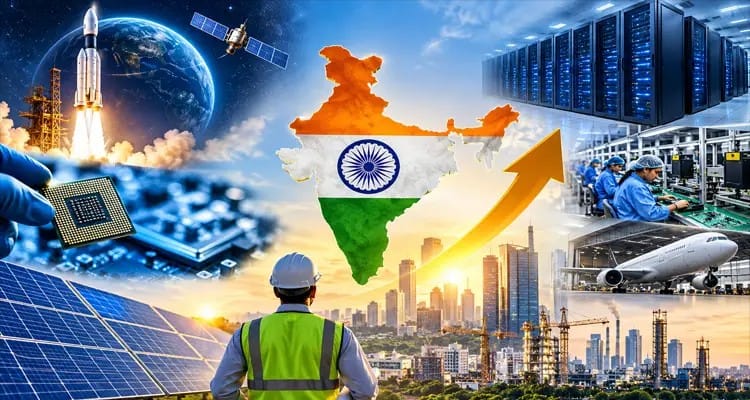
India's industrial economy is accelerating through high-growth opportunities in aerospace, electronics, CDMO, and auto ancillary sectors. Backed by strong export demand, government incentives, and technological upgrades, these industries are positioning the country as a vital hub for global manufacturing and advanced engineering solutions.
NEW DELHI - Driven by aggressive supply chain realignments, government-backed production incentives, and rising domestic capabilities, India's industrial landscape is entering a critical expansion phase. According to September 2026 economic briefings and industry data, future wealth creation and manufacturing momentum are shifting decisively toward high-complexity domains. Analysts note that this strategic pivot moves the country beyond basic assembly, establishing domestic firms as essential nodes in global value chains spanning defense electronics, precision components, advanced drug manufacturing, and next-generation mobility systems.
Aerospace and Defense Electronics Expansion
The aerospace and defense electronics segment is witnessing unprecedented scale, propelled by increasing indigenization mandates and global Original Equipment Manufacturer (OEM) diversification. Domestic Electronics Manufacturing Services (EMS) providers are securing major contracts for cockpit avionics, flight control electronics, radar systems, and space payloads.
Market intelligence reports indicate that the broader Indian EMS market is projected to reach substantial scale by the early 2030s, supported by robust order books from international aerospace giants. Companies specializing in high-reliability sub-assemblies are scaling up operations to meet stringent global standards, turning India into an export-oriented hub for aviation technology.
Electronics, Semiconductors, and CDMO Momentum
Simultaneously, the electronics manufacturing and Contract Development and Manufacturing Organization (CDMO) sectors are capturing significant global market share. Backed by phased manufacturing programs and targeted production-linked incentive (PLI) schemes, the country has accelerated its transition from an import-dependent consumer market to an advanced production base.
In the pharmaceutical and chemical CDMO spaces, Indian firms continue to secure long-term outsourcing contracts from Western biotech and pharma giants. This trend is driven by competitive R&D capabilities, stringent compliance frameworks, and global efforts to de-risk supply dependencies away from traditional manufacturing hubs.
Auto Ancillary Evolution and Mobility Shift
India's auto ancillary sector has crossed critical valuation milestones, supported by robust vehicle production volumes and rising content-per-vehicle metrics. Traditional component makers are successfully navigating the transition toward electric vehicles (EVs) and hybrid platforms by scaling up production of electrical systems, wiring harnesses, lightweight castings, and precision chassis components.
Furthermore, export demand from international automotive groups is surging, with component shipments on track to approach major historic targets as global automakers integrate Indian suppliers into their worldwide manufacturing networks.
Economic Impact and Investment Outlook
For institutional investors, enterprise leaders, and policymakers, these four sectors represent the cornerstone of India's next industrial wave. By moving up the technological value chain, domestic enterprises are insulating themselves against cyclical domestic consumption shocks while tapping into high-margin global export markets. Continued capital expenditure in R&D, digital automation, and skill development will remain essential to sustaining this competitive advantage.
Official Sources Section
Information regarding sector growth trajectories, market size estimates, and industrial frameworks is based on official data and industry disclosures:
Quote Section
"According to market experts and industry analysts, India's industrial momentum is shifting toward high-complexity manufacturing, offering structural growth opportunities across aerospace, electronics, CDMO, and advanced auto components."
Why It Matters
The rapid scaling of high-value sectors reduces India's reliance on traditional low-cost manufacturing, creating high-skill employment and deep integration into Western and Asian supply chains. For global businesses, these sectors offer stable, diversified sourcing alternatives amid ongoing international trade realignments.
Key Facts at a Glance
Aerospace Growth: Rising demand for avionics, radar systems, and flight control components is driving robust order books for domestic EMS providers.
Auto Ancillary Scale: The auto component sector continues to benefit from higher content-per-vehicle, EV transition components, and robust export demand.
CDMO Capabilities: India is consolidating its position as a preferred global partner for advanced pharmaceutical development and manufacturing outsourcing.
Policy Support: Government-backed PLI schemes and indigenisation targets remain primary catalysts for capital investment across all four sectors.
FAQ Section
Why are aerospace and electronics emerging as key growth drivers in India?
Driven by defense indigenisation policies and global supply chain shifts, Indian firms are increasingly manufacturing high-complexity electronics, avionics, and radar systems for international markets.
How is the auto ancillary sector adapting to new mobility trends?
Auto component makers are shifting from traditional internal combustion engine parts to electrical wiring systems, lightweight chassis, and EV-specific components while expanding global exports.
What role do government policies play in these emerging sectors?
Targeted production-linked incentive (PLI) schemes, export promotion frameworks, and manufacturing incentives are attracting foreign OEM partnerships and local capital investments.
What are the primary advantages for investors in India's CDMO and manufacturing spaces?
Investors benefit from diversified revenue streams, strong global export pipelines, lower capital intensity relative to primary OEMs, and rising technical capabilities.
Source: Invest India, National Stock Exchange of India (NSE), India Briefing, Financial Express