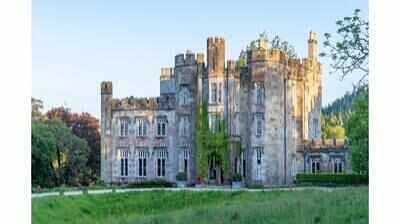
Meta CEO Mark Zuckerberg and his wife, Priscilla Chan, have purchased Strancally Castle, a historic 440-acre Gothic Revival estate in County Waterford, Ireland, for an estimated €20 million to €30 million. The property will serve as an Irish base for the family, near Meta's international headquarters in Dublin.
DUBLIN / WATERFORD — Meta Platforms Chief Executive Officer Mark Zuckerberg and his wife, Dr. Priscilla Chan, have purchased Strancally Castle, a historic 19th-century Gothic Revival estate located in County Waterford, Ireland.
The off-market transaction, confirmed by a company spokesperson on Thursday, August 21, 2026, involves a sprawling 440-acre property situated along the banks of the River Blackwater. While exact financial terms were not officially disclosed in public registries, local property estimates place the value of the estate between €20 million and €30 million (approximately $23 million to $35 million).
Architectural Heritage and Estate Details
Strancally Castle was originally constructed around 1830 for John Keily, a former British Conservative Member of Parliament. The three-storey, cut-stone fortress was designed by renowned architects James and George Richard Pain, who also designed other notable Irish landmarks. Spanning approximately 16,000 square feet, the estate is celebrated for its intricate stonework, historical grandeur, and secluded valley setting.
The property was previously owned for 25 years by Michael Alen-Buckley, co-founder of London-based private investment firm RAB Capital, and his wife Giancarla, who oversaw an extensive multi-decade restoration of the grounds and structure.
According to official corporate statements and real estate disclosures:
Property Acquired: Strancally Castle and its surrounding 440-acre estate.
Location: County Waterford, along the Blackwater Valley in southeast Ireland.
Architectural Era: Gothic Revival style, built circa 1830.
Previous Ownership: Sold by the Alen-Buckley family following a 25-year stewardship.
Official Sources Section
Quote Section
According to statements released by a spokesperson for Mark Zuckerberg regarding the estate purchase:
"Mark and his family are excited to continue caring for this historic home and look forward to spending time in Ireland, where Meta maintains its international headquarters."
In a separate joint statement, previous owners Michael and Giancarla Alen-Buckley noted:
"We are delighted that Mark and his family intend to build on our stewardship by continuing to invest in maintaining and enhancing the property and grounds as their home in a sustainable manner."
Why It Matters
For international business analysts and local observers, the purchase establishes a direct residential connection between the tech executive and Ireland, where Meta has based its European and international headquarters since 2009. Meta employs approximately 1,500 people across its Irish operations, encompassing its Dublin headquarters, a data center, and engineering units. The acquisition places Zuckerberg alongside other prominent global entrepreneurs who have recently invested in historic Irish country estates.
Key Facts at a Glance
Buyers: Mark Zuckerberg and Dr. Priscilla Chan.
Estate Size: 440 acres overlooking the River Blackwater.
Estimated Valuation: €20 million to €30 million ($23M–$35M).
Strategic Proximity: Located roughly 200 kilometers from Meta's Dublin international headquarters.
FAQ Section
What property did Mark Zuckerberg purchase in Ireland?
Mark Zuckerberg and Priscilla Chan purchased Strancally Castle, a 19th-century Gothic Revival estate in County Waterford.
How much did the Irish castle cost?
While the exact purchase price in the off-market deal was not publicly registered, local estimates value the property between €20 million and €30 million.
Why did Zuckerberg buy a home in Ireland?
A Meta spokesperson stated that the family looks forward to spending time in Ireland, where the company maintains its international headquarters and employs roughly 1,500 personnel.
Who owned the estate prior to the sale?
The castle was owned and extensively restored over 25 years by financier Michael Alen-Buckley and his wife Giancarla.
Source: The Irish Times, National Built Heritage Service, Meta, Reuters