Prime Minister Narendra Modi addressed IIT Delhi’s 57th Convocation on August 8, 2026, urging graduates to evaluate career decisions by their benefit to the nation rather than salary figures. Highlighting 'out-of-syllabus' real-world problem solving and lifelong learning, Modi also launched the Param Pragya AI supercomputer to bolster research toward Viksit Bharat.
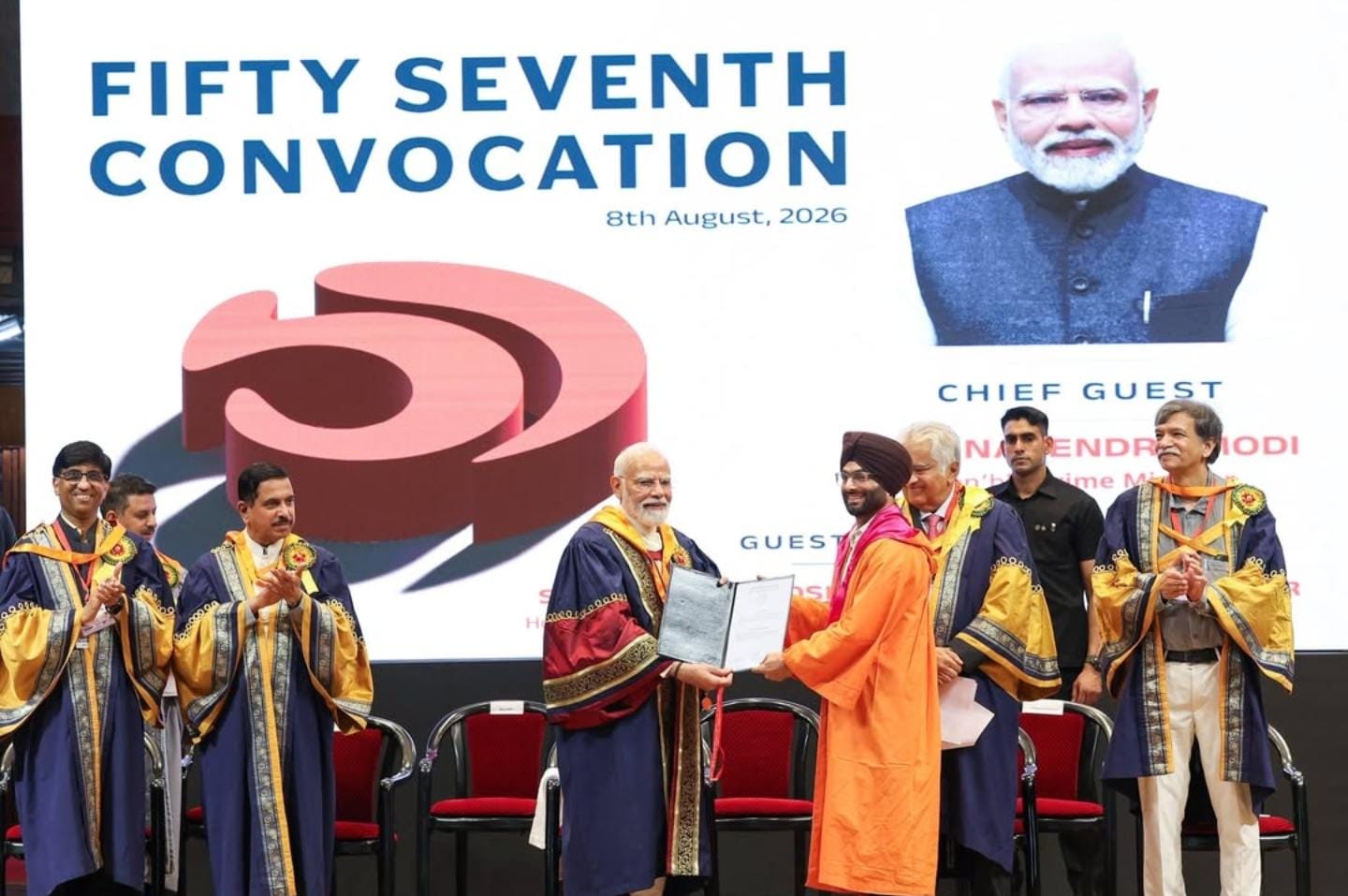
NEW DELHI — Addressing the 57th Convocation Ceremony of the Indian Institute of Technology (IIT) Delhi on Saturday, August 8, 2026, Prime Minister Narendra Modi urged India’s top engineering graduates to align their professional choices with the nation's priorities rather than measuring career success by salary slips or social media leaderboards. Emphasizing that national contribution must form "the basis of every decision," the Prime Minister called on young innovators to keep learning continuously, address "out-of-syllabus" real-world problems, and serve as the core drivers of India's vision for a developed nation (Viksit Bharat). The address comes at a crucial juncture when rapidly accelerating technological changes—ranging from artificial intelligence to semiconductor manufacturing—are reshaping global economic power dynamics and career landscapes.
Measuring Career Success by National Needs, Not Paychecks
During his 34-minute convocation address, Prime Minister Modi cautioned the graduating class against getting trapped in societal pressures surrounding high-value placement figures and startup valuations. Emphasizing that an IIT degree is "a mandate to contribute to the nation" rather than a mere personal achievement, he advised students to avoid viewing life through competitive scoreboards.
"Life is absolutely not a leaderboard; your real race is not with anyone else, it is with yourself," Modi told the audience. He noted that every generation inherits a distinct national duty, noting that the decisions made by today's graduates over the next 30 to 35 years will directly shape India's economic and technological standing when the country celebrates its independence centenary in 2047.
Solving 'Out-of-Syllabus' Challenges in a Tech-Driven World
Framing the post-academic world as fundamentally different from structured classroom examinations, the Prime Minister highlighted that critical real-world obstacles rarely come with pre-defined formulas.
"Unlike your university exams, life's most critical challenges are entirely out of syllabus," Modi said, encouraging graduates to retain their curiosity and challenge conventional assumptions. He added that the most impactful IIT alumni achieved breakthroughs not merely by offering correct answers, but by identifying questions that society had stopped asking and solving problems with which others had quietly compromised.
Underlining the speed of global technological disruption, Modi asserted that continuous learning remains the single most reliable strategy for long-term success. "The strategic equations of the world are changing rapidly, driven by the speed of technology. No one can say with certainty what the world will look like 20 or 30 years from now... but remember: the one who keeps learning will win," he stated.
Boosting Research Infrastructure: Param Pragya and ANRF
To support the institution’s research ecosystem, Prime Minister Modi virtually inaugurated Param Pragya, an advanced AI-powered supercomputing facility established at IIT Delhi's Sonipat campus. The launch coincides with expanded national investments in high-level scientific research, including the operationalization of the Anusandhan National Research Foundation (ANRF) with a target funding pool of ₹1 lakh crore.
Union Education Minister Prahlad Joshi, attending his first major public event at an educational campus since assuming additional charge of the ministry, described the ceremony as a milestone. Joshi affirmed the government's faith in the youth as the "foremost architects of Viksit Bharat 2047," calling on engineers to pair technical innovation with strong ethical leadership.
During the ceremony, more than 3,000 graduating students—including 587 PhD scholars—were conferred their degrees. Top achievers received prestigious institute honors, including the President's Gold Medal, Director's Gold Medal, Shankar Dayal Sharma Gold Medal, and Perfect Ten Gold Medals.
Impact on Students, Industry, and India's Tech Ecosystem
The Prime Minister’s address signals a clear policy push to channel top-tier technical talent toward domestic strategic sectors rather than brain drain or purely commercial pursuits:
For Students and Engineers: Encourages a shift away from placement anxiety toward high-impact domestic research, entrepreneurship, and deep-tech innovation.
For Industry and Tech Sectors: Reinforces state backing for domestic semiconductor manufacturing, space technology, digital public infrastructure, and defense manufacturing.
For Research and Academia: Boosts computing bandwidth and open access to global research literature via initiatives like the One Nation One Subscription scheme.
Official Statements and Remarks
According to official releases from the Prime Minister's Office (PMO) and the Ministry of Education, the government remains committed to supporting young innovators across emerging technology verticals.
Organizers and Officials Stated:
"Our young people are building launch vehicles, launching rockets, and creating solutions across space, drones, and semiconductors that were once limited to a handful of global powers," officials stated during the ceremony.
Education Minister Prahlad Joshi noted: "I urge the youth to innovate with purpose and lead with integrity, recognizing that excellence must go hand in hand with strong ethics and moral values."
Why It Matters
As global supply chains realign around critical technology, India’s drive for self-reliance (Atmanirbhar Bharat) depends directly on retaining skilled human capital. By encouraging engineering graduates to tackle structural challenges in energy, agriculture, defense, microelectronics, and AI, the government aims to transform local technical expertise into global industrial leadership.
Key Facts at a Glance
Event: 57th Convocation Ceremony of IIT Delhi.
Key Theme: Aligning individual career decisions with national progress and Viksit Bharat 2047.
Inauguration: AI-powered supercomputer facility Param Pragya at Sonipat campus.
Graduating Batch: Over 3,000 degrees awarded, including 587 PhDs.
Research Backing: ₹1 lakh crore funding target via Anusandhan National Research Foundation (ANRF) and PM Research Fellowship.
Frequently Asked Questions (FAQ)
Q1: What was the main message delivered by PM Modi at the IIT Delhi convocation?
PM Modi urged graduates to measure their career choices by how much they benefit the nation rather than focusing solely on salary offers or placement leaderboards. He emphasized lifelong learning and solving complex, real-world problems.
Q2: What new facility was launched at IIT Delhi during the event?
The Prime Minister virtually inaugurated 'Param Pragya,' an AI-powered supercomputing facility located at IIT Delhi’s Sonipat campus.
Q3: How many students graduated during the 57th Convocation?
More than 3,000 students received their degrees during the ceremony, including 587 PhD scholars.
Q4: Which key government schemes were highlighted for student researchers?
The Prime Minister highlighted the Prime Minister’s Research Fellowship (PMRF), the Anusandhan National Research Foundation (ANRF), and the 'One Nation One Subscription' initiative for global research journals.
Source: Official releases from the Prime Minister's Office (PMO), Ministry of Education, and Indian Institute of Technology Delhi.