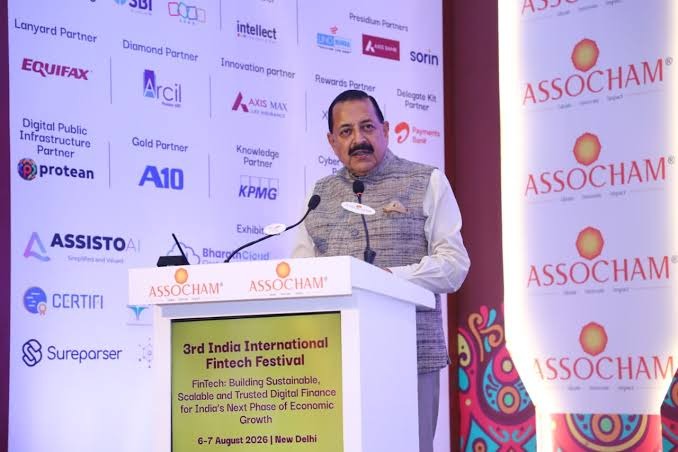
Union Minister Dr. Jitendra Singh announced at the 3rd India International FinTech Festival in New Delhi that India must evolve from financial inclusion to financial empowerment. Highlighting rapid advancements in quantum communication, AI, and a booming startup ecosystem, the government aims to propel the nation from digital payments to broad digital prosperity.
Opening Perspectives on India's Economic Evolution
NEW DELHI — Addressing delegates at the 3rd India International FinTech Festival in New Delhi, Union Minister of State (Independent Charge) for Science & Technology Dr. Jitendra Singh declared that India is primed to shift its national economic strategy from basic financial inclusion to comprehensive financial empowerment. Supported by foundational public programs like the Pradhan Mantri Jan Dhan Yojana and robust digital payment architectures via Digital India, the country has successfully integrated millions into the formal banking system.
Speaking to industry leaders, policymakers, and startup founders on August 7, 2026, Dr. Singh emphasized that the next phase of national development requires leveraging advanced technologies—such as Artificial Intelligence (AI), quantum computing, and blockchain—to convert account ownership into tangible economic prosperity. The announcement underscores government efforts to future-proof India's digital economy against complex cybersecurity challenges while cementing its status as a global innovation leader.
Harnessing Frontier Technologies for FinTech Growth
According to official statements from the Press Information Bureau of India (PIB), the future trajectory of India's financial sector depends heavily on secure, resilient, and intelligent systems. Dr. Singh highlighted that next-generation financial technology must prioritize responsible AI, machine learning, and advanced fraud prevention mechanisms.
Furthermore, the Minister pointed to massive strides in the National Quantum Mission as a critical layer of defense for future financial networks. While the 10-year roadmap originally targeted 2,000 kilometers of secure quantum communication, India has already established over 1,000 kilometers in just three years. This leap in secure data transmission is expected to safeguard cross-border transactions and core banking infrastructures against emerging cyber threats.
Startup Expansion and Public-Private Collaboration
The rapid scale-up of India's startup ecosystem serves as the backbone for this technological leap. Official data shared during the festival indicated that India's startup base has multiplied from roughly 350 entities to nearly 2.4 lakh (240,000) enterprises over the past decade.
Government officials noted that this exponential growth is catalyzed by active public-private partnerships (PPPs) bridging traditional banking institutions, technology firms, and agile startups. Additionally, broader policy reforms—such as opening up the space economy, which is projected to surge from USD 9 billion to USD 45 billion before the end of the decade—demonstrate how cross-sector regulatory shifts are driving high-tech economic expansion.
Impact on Citizens, Businesses, and Investors
Citizens and Consumers: Transitioning to financial empowerment means moving beyond holding a bank account to accessing affordable credit, intelligent advisory tools, and seamless real-time banking designed to improve livelihoods.
FinTech Businesses & Startups: Technology companies face vast opportunities in developing AI-powered financial services, advanced cybersecurity protocols, and scalable cross-border digital payment tools.
Investors: Backed by robust state-supported quantum communication and regulatory reforms, institutional investors gain a lower-risk, highly innovative ecosystem suited for long-term deployment in trusted digital assets.
Official Sources
According to official announcements by the Press Information Bureau of India (PIB).
Statements delivered by the Ministry of Science & Technology.
Briefings from the 3rd India International FinTech Festival organizers in New Delhi.
Quote Section
"The success of initiatives aimed at expanding financial access has laid the foundation for the country's next developmental milestone. The country should now aspire to progress from digital payments to digital prosperity, ensuring that technology-driven financial systems contribute directly to economic growth and improved livelihoods," stated Dr. Jitendra Singh, Union Minister of State for Science & Technology.
Why It Matters
Moving from financial inclusion to financial empowerment bridges the gap between mere account ownership and active wealth generation. By integrating advanced quantum security and AI-driven platforms into everyday banking, India aims to protect individual consumers while positioning domestic FinTech enterprises as dominant players in the global digital economy.
Key Facts at a Glance
Strategic Shift: India is officially pivoting from basic financial inclusion to holistic financial empowerment.
Quantum Leap: Over 1,000 kilometers of secure quantum communication have been established in just three years under the National Quantum Mission.
Startup Boom: India's startup ecosystem has expanded dramatically from roughly 350 enterprises to nearly 2.4 lakh over the past decade.
Macro Targets: The national space economy alone is projected to scale from USD 9 billion to USD 45 billion before the close of the decade.
Frequently Asked Questions (FAQ)
Q1: What does moving from financial inclusion to financial empowerment mean?
A: It means shifting focus from simply opening bank accounts for citizens to providing them with advanced, secure, and intelligent financial tools—such as AI-driven credit and wealth management—that actively improve their economic security and livelihoods.
Q2: What technologies are expected to shape the next phase of India's FinTech sector?
A: According to official statements, Artificial Intelligence (AI), machine learning, quantum technologies, blockchain, and advanced cybersecurity frameworks will drive the upcoming generation of financial services.
Q3: How is quantum technology helping India's financial ecosystem?
A: Through the National Quantum Mission, India has deployed over 1,000 kilometers of secure quantum communication channels, which protect sensitive banking networks and cross-border digital transactions against future cyber threats.
Q4: Where did Dr. Jitendra Singh make these announcements?
A: The announcements were made during the inauguration of the 3rd India International FinTech Festival held in New Delhi.
Source: Press Information Bureau (PIB), Ministry of Science & Technology, 3rd India International FinTech Festival Organizers