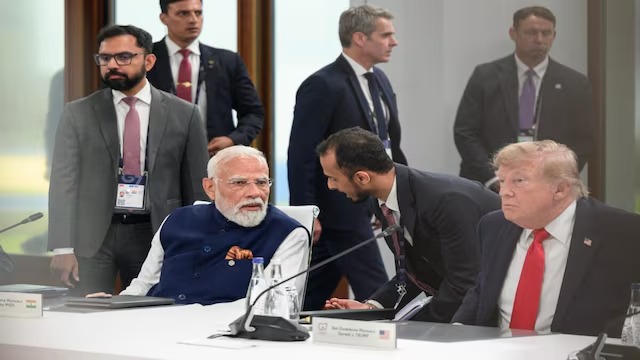
Prime Minister Narendra Modi addressed G7 leaders in France, calling for the protection of global shipping lanes following the deaths of three Indian seafarers in a U.S. military strike in the Gulf of Oman. With President Donald Trump present, Modi emphasized that ensuring the safety of maritime workers is a collective international responsibility.
EVIAN-LES-BAINS — Prime Minister Narendra Modi used his high-profile address at the G7 Summit in France to issue a strong call for the protection of global shipping lanes, declaring that the safety of international merchant mariners is a collective global responsibility. Speaking at an outreach session titled Forging New Partnerships and Rebuilding International Solidarity with U.S. President Donald Trump seated directly beside him Modi highlighted the heavy toll that escalating West Asia maritime conflicts are taking on neutral civilian workers.
The Prime Minister's firm diplomatic statement follows intense public concern in New Delhi after three Indian seafarers were killed in a U.S. military strike in the Gulf of Oman. The critical intervention positions India as a leading voice demanding absolute supply-chain immunity and the immediate sanitization of key commercial waterways from cross-border military crossfire.
Direct Diplomatic Confrontation Over West Asia Casualties
The strategic address marks a notable shift in India's global messaging regarding regional blockades. Addressing the gathered heads of state, Modi connected the macroeconomic instability caused by shipping delays directly to the human cost borne by seafaring nations.
The underlying friction stems from a June 10 military action in which American naval forces struck the Palau-flagged oil tanker MT Settebello in the Gulf of Oman over an alleged blockade violation involving Iranian crude. The vessel carried 24 Indian crew members, resulting in the deaths of three sailors: Aditya Sharma, Shivanand Chaurasiya, and Patnala Suresh.
The incident followed a separate U.S. military strike on the Guinea-Bissau-flagged tanker MT Jalveer. This sequence of events prompted New Delhi to officially summon the U.S. Charge d’Affaires to lodge a formal protest against the repeated targeting of commercial vessels staffed by Indian nationals.
Impact on Global Supply Chains and the Global South
For commercial shipping lines, international logistics businesses, and merchant mariners, the escalating tension around the Strait of Hormuz chokepoint has driven maritime insurance premiums to historic highs. Nearly 20% of the world's liquefied natural gas and petroleum supplies pass through this narrow corridor, making any disruption an immediate threat to inflation baselines in developing economies.
| Maritime Event Profile | Realized Operational Impact Metrics | Technical Core Risk Categories |
| MT Settebello Strike | Three Indian civilian fatalities logged | Direct kinetic missile interception |
| Hormuz Transit Route | Handles ~20% of global petroleum fluid flows | Prolonged commercial insurance spike |
| Indian Global Seafaring | Supplies over 10% of global maritime crew | Extended workforce retention crisis |
Modi argued that international partnerships lose their meaning if the safety of the workers who keep global trade moving is compromised. He urged a shift away from the traditional donor-recipient dynamic, calling on the G7 to engage with the Global South as equal partners in securing critical infrastructure, technology, and energy supply lines.
Official Sources Section
The operational details, diplomatic remarks, and summit agendas cited are verified by official transcripts distributed by the Ministry of External Affairs (MEA) and organizational briefings released from the G7 Summit Executive Secretariat. Shipping logs and casualty data track alongside formal maritime registry records maintained by the Directorate General of Shipping, India.
Quote Section
“India firmly believes that lasting solutions to the tensions and conflicts unfolding in various parts of the world are possible only through dialogue, diplomacy, and international cooperation... Disruptions to maritime trade in the Strait of Hormuz have harmed the global economy. Many Indian civilians have lost their lives. It is our responsibility to ensure the safety of seafarers who connect nations through global maritime trade.”
Why It Matters
The Prime Minister's sharp tone at the G7 Summit carries direct practical implications for international maritime law and trade safety. India supplies over 10% of the global seafaring workforce, meaning any expansion of conflict zones directly threatens thousands of Indian households. By turning this into a key diplomatic issue ahead of bilateral talks with the U.S., India is pushing for strict international protocols to protect commercial vessels, aiming to ensure merchant crews are no longer caught in geopolitical crossfire.
Key Facts at a Glance
Summit Platform: PM Modi raised the issue of civilian seafarer safety directly with G7 leaders during an outreach session in Evian, France.
Tragic Catalyst: The intervention follows the June 10 killing of three Indian mariners during a U.S. military strike on a commercial tanker in the Gulf of Oman.
Chokepoint Vulnerability: Disruptions along the critical Strait of Hormuz continue to impact global energy shipping and increase operational insurance overheads.
Diplomatic Strategy: The statement was delivered just a day before formal bilateral talks between Modi and U.S. President Donald Trump.
Frequently Asked Questions
What happened to the MT Settebello in the Gulf of Oman?
On June 10, U.S. military forces struck the Palau-flagged oil tanker over an alleged blockade violation while it was reportedly transporting oil from Iran, resulting in the tragic deaths of three Indian crew members.
Why is the safety of seafarers such a critical issue for India?
India is one of the world's largest suppliers of merchant navy personnel, contributing more than 10% of the global seafaring workforce. This makes Indian citizens uniquely vulnerable to maritime conflicts and regional blockades.
What is the strategic significance of the Strait of Hormuz?
The Strait of Hormuz is a crucial maritime chokepoint connecting the Persian Gulf to international waters. It handles a massive share of the world's petroleum and natural gas shipments, making its security vital to global economic stability.
Source: