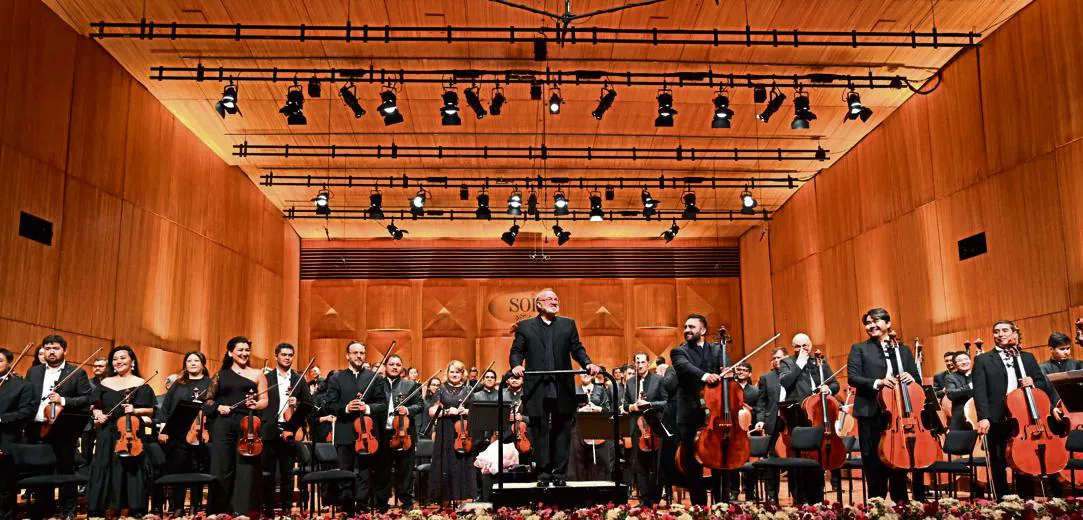
Founded in 2006 at Mumbai's NCPA by Khushroo N. Suntook and Marat Bisengaliev, the Symphony Orchestra of India overcame severe talent and infrastructure shortages. By combining international mentorship, an in-house academy, and long-term philanthropic backing, Mumbai built India's only fully professional Western classical orchestra, now celebrating twenty years.
MUMBAI — Marking its twentieth anniversary season, the National Centre for the Performing Arts (NCPA) in Mumbai has cemented its role as the administrative and financial engine behind the Symphony Orchestra of India (SOI), the nation’s first and only fully professional Western classical ensemble. Founded in 2006, the ensemble overcame structural hurdles—including severe shortages of conservatories, instrument import curbs, and a scarcity of dedicated concert halls—to establish a permanent resident symphonic tradition in a cultural ecosystem predominantly centered around Indian classical music and commercial film scores. The orchestra's development illustrates how private philanthropic capital, specialized educational pipelines, and foreign master-class instruction combined to sustain an elite 80-piece orchestra in the country's financial hub.
Overcoming Talent Deficits Through Global Collaboration
The inception of the Symphony Orchestra of India addressed a decades-long institutional vacuum. While mid-20th-century Bombay had maintained amateur and semi-professional ensembles—most notably Mehli Mehta’s Bombay Symphony Orchestra in 1935 and Jini Dinshaw’s Bombay Chamber Orchestra in 1962—the post-1970s regulatory climate and currency restrictions choked instrument supply chains and cross-border talent exchanges. By the early 2000s, India lacked the conservatory infrastructure required to assemble a full-scale professional symphonic ensemble.
In 2006, NCPA Chairman Khushroo N. Suntook partnered with internationally acclaimed Kazakh violinist and conductor Marat Bisengaliev to establish an institutional structure for the ensemble. Recognizing that an immediate, entirely domestic talent pool of sufficient standard was not yet available, Suntook and Bisengaliev adopted a hybrid model: recruiting a core cadre of virtuosic musicians from Kazakhstan and Eastern Europe while systematically auditioning, hiring, and mentoring Indian players alongside them.
Constructing an In-House Educational Feeder System
To transition from relying on international guest players to building sustainable domestic musicianship, the NCPA launched the SOI Music Academy in 2012. Headed by resident European and Kazakh faculty, the academy provides rigorous Russian-method classical training to young Indian students across strings, woodwinds, brass, and percussion.
The program operates on an eight- to ten-year immersion model, offering technical mastery, sight-reading, music theory, and orchestral performance practice. Over the past decade, academy graduates have begun filling chairs within the orchestra's primary ranks, gradually expanding the domestic percentage of the ensemble. The NCPA's acoustic flagship, the Jamshed Bhabha Theatre, serves as the SOI’s permanent acoustic rehearsal and performance hall, eliminating the venue scarcity that prevents similar permanent organizations from forming in other Indian metropolitan centers.
International Tours and Interdisciplinary Commissions
Beyond conventional European repertoire featuring Beethoven, Brahms, and Tchaikovsky, the orchestra established global recognition through high-profile cross-genre commissions. In 2016, the SOI commissioned the late tabla maestro Ustad Zakir Hussain to compose Peshkar, a full concerto for tabla and symphony orchestra that the ensemble subsequently performed on international tours across Switzerland and the United Kingdom.
The ensemble has also toured prestigious venues including the Royal Opera House in Muscat, the Cadogan Hall in London, and the Festival of the World’s Symphony Orchestras in Moscow. Recent initiatives have expanded its programming to include interdisciplinary productions, uniting Western symphonic scores with Indian classical dance vocabularies such as Kathak.
Economic Impact and Cultural Infrastructure
The operational viability of the Symphony Orchestra of India relies heavily on institutional patronage anchored by the Tata Trusts and private cultural philanthropy. Unlike Western orchestras that often depend on municipal arts grants or national endowments, the SOI functions within the self-funded framework of the NCPA.
This stability has stimulated local creative industries in Mumbai, generating demand for high-tier instrument luthiers, sound engineers specializing in unamplified acoustic recordings, and sheet-music publishing distribution. The presence of a resident professional orchestra has also positioned Mumbai on the international touring itineraries of world-renowned conductors and soloists, including Zubin Mehta, Charles Dutoit, and Martyn Brabbins.
Official Sources
Institutional timelines, performance schedules, and archival documentation have been verified via official statements released by the National Centre for the Performing Arts (NCPA), archival program releases by the Symphony Orchestra of India, and cultural sector reviews from the Ministry of Culture, Government of India.
Quotes
"According to officials and artistic directors at the NCPA, building the orchestra required rejecting the idea that classical symphonic traditions must remain foreign, proving instead that world-class resident musicianship can be cultivated indigenously through decades-long training, institutional funding, and dedicated concert halls."
Why It Matters
The development of the SOI establishes a scalable blueprint for performing arts infrastructure in South Asia. By creating a professional career avenue within Western classical music, the NCPA has enabled Indian instrumentalists to attain international orchestral employment without having to migrate overseas. It also broadens local audience exposure to complex acoustic performance arts beyond conventional commercial entertainment.
Key Facts at a Glance
Foundation: Established in 2006 at the NCPA by Chairman Khushroo N. Suntook and violinist Marat Bisengaliev.
Institutional Role: Remains India’s first and only fully professional resident Western classical symphony orchestra.
Educational Pipeline: The SOI Music Academy provides long-term Russian-technique training to groom homegrown Indian instrumentalists.
Global Collaborations: Commissioned landmark works bridging Indian and Western traditions, including Ustad Zakir Hussain's tabla concerto Peshkar.
Venue: Operates from a permanent acoustic home at the Jamshed Bhabha Theatre in Mumbai.
Frequently Asked Questions
Why is Mumbai the only Indian city with a full-time professional symphony orchestra?
Sustaining an 80-piece orchestra requires massive private funding, dedicated acoustic concert halls, and long-term administrative commitment. The NCPA in Mumbai provides the required venue infrastructure and financial patronage, which other major Indian cities currently lack.
Are the musicians in the Symphony Orchestra of India Indian or foreign?
The orchestra began with a core ensemble of foreign virtuosos from Kazakhstan and Eastern Europe playing alongside Indian musicians. Over the years, graduates from its in-house SOI Music Academy have progressively expanded the proportion of Indian players in its ranks.
How is the Symphony Orchestra of India funded?
The ensemble is fully supported and maintained through the private endowments, philanthropic trusts, and corporate patronage of the National Centre for the Performing Arts (NCPA), principally backed by the Tata group of trusts.
Source: National Centre for the Performing Arts (NCPA), Ministry of Culture, Government of India