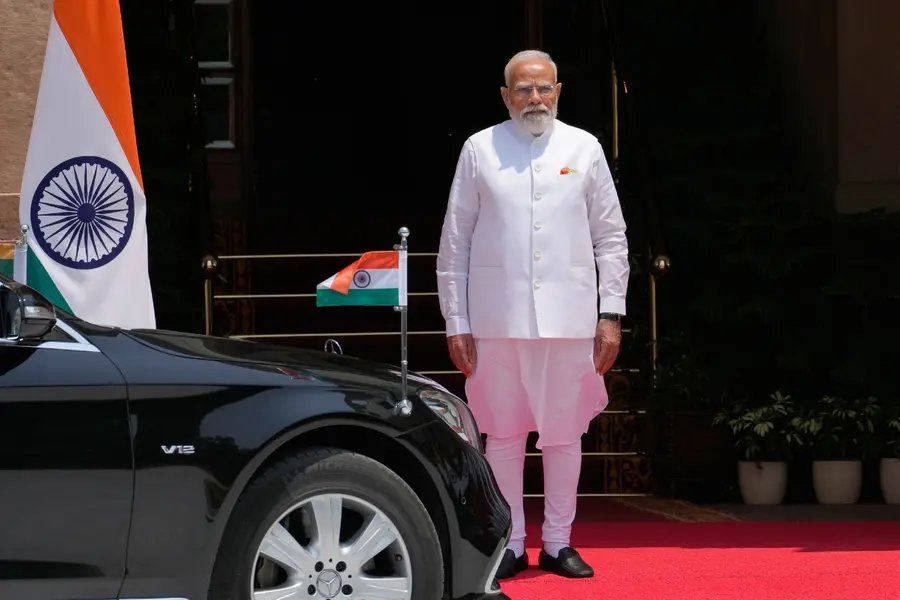
On June 10, 2026, Prime Minister Narendra Modi will complete 4,399 consecutive days in office, becoming India's longest-serving Prime Minister in the post-election era by surpassing Jawaharlal Nehru’s record as an elected leader. The milestone will be marked by a national assembly of coalition leaders in New Delhi.
NEW DELHI — Prime Minister Narendra Modi is on track to cross a historic political milestone on June 10, 2026, when he will officially become India's longest-serving Prime Minister in the post-election era. By completing 4,399 consecutive days in office, Modi will surpass the record of Jawaharlal Nehru as the head of a continuously elected government, marking a significant transition in the history of Indian governance.
The milestone comes after years of shifting political trends in India. While Nehru served as Prime Minister for a total of 6,130 days following independence in 1947, a total of 1,733 of those days were spent leading an interim or unelected government prior to the nation's first democratic general election. Looking specifically at uninterrupted service as an elected leader, Nehru held office for 4,398 days from his swearing-in on May 13, 1952, until his death on May 27, 1964. Having assumed office on May 26, 2014, Modi will officially surpass that number on June 10.
Tracking the Longevity Records in Public Office
The upcoming milestone adds to a series of institutional longevity records established by Modi during his public life. Earlier this year, on March 22, 2026, he became the longest-serving elected head of government in India's history by crossing 8,931 total days in executive public office, eclipsing the combined governance record previously held by former Sikkim Chief Minister Pawan Kumar Chamling. This cumulative metric accounts for his multi-term service as Chief Minister of Gujarat alongside his current premiership.
On his path to the top of the continuously elected prime ministerial list, Modi previously overtook former Prime Minister Indira Gandhi on July 25, 2025. Gandhi had registered a continuous, uninterrupted tenure of 4,077 days in office between January 24, 1966, and March 24, 1977, before her administration was succeeded by a coalition government.
To mark the occasion, the National Democratic Alliance (NDA) has organized a high-level meeting of Chief Ministers and Deputy Chief Ministers in New Delhi on June 10. According to coalition agendas, Andhra Pradesh Chief Minister N. Chandrababu Naidu is scheduled to move an official congratulatory resolution honoring the Prime Minister’s 12 consecutive years of executive leadership.
Changing Demographics and Electoral Scale
The transition highlights how much the scale of Indian democracy has expanded since the early post-independence era. When the first Lok Sabha was constituted in 1952, India’s total population stood at approximately 340 million, with an electorate of roughly 170 million voters participating across 53 registered political parties.
By contrast, the contemporary political environment has scaled up significantly:
The Electorate: Exceeded 960 million registered electors during the 2024 general elections.
Political Competition: The number of active political parties contesting national elections expanded to 744 in recent cycles.
National Demographics: The country's overall population is estimated to have crossed 1.46 billion citizens.
Economic and developmental infrastructures have also seen structural changes over the same period. For instance, between 2014 and 2026, the count of Indian Institutes of Technology (IITs) grew from 16 to 23, Indian Institutes of Management (IIMs) expanded from 13 to 21, and the network of All India Institutes of Medical Sciences (AIIMS) grew from seven to 23 facilities.
Implications for Investors, Businesses, and Governance
For institutional investors, domestic corporate houses, and international trade partners, political longevity generally translates into predictability for long-term economic policies. The continuity of a single administration for over a decade allows for the sustained implementation of multi-year initiatives, such as the Production Linked Incentive (PLI) manufacturing programs, large-scale infrastructure investments, and digital public infrastructure networks.
However, analysts note that long tenures also draw intense scrutiny regarding institutional checks, administrative centralization, and the balancing of regional versus federal powers. Managing an economy of India's scale requires balancing industrial expansion with job creation and inflation controls, tasks that remain primary challenges for the administration as it moves deeper into its current term.
Official Administrative Positions
The documentation regarding ministerial tenures and historic tracking parameters is maintained through formal parliamentary archives and gazette notifications.
"According to officials familiar with the upcoming state proceedings, the event will serve to highlight the administration's long-term policy implementations," coalition organizers stated in a briefing. "The milestone reflects a continuous arc of governance that has adapted to changing communication landscapes, shifting from traditional formats to real-time digital and social media scrutiny."
Why It Matters
The milestone on June 10 signifies a major structural shift in India's political identity. For over six decades, the foundational records of democratic longevity were held exclusively by leaders of the Indian National Congress. A non-Congress Prime Minister achieving this level of continuous electoral longevity indicates that the underlying dynamics of Indian political dominance, voter alignment, and national governance have transformed.
Key Facts at a Glance
The Milestone Date: June 10, 2026.
The Record: 4,399 consecutive days as a democratically elected Prime Minister.
The Context: Surpassing Jawaharlal Nehru's post-1952 elected tenure of 4,398 days.
Cumulative Metric: Modi holds the record for the longest-serving elected head of government in India, crossing 8,931 total days across his state and federal tenures.
Official Event: A meeting of NDA Chief Ministers will convene in New Delhi to pass a special celebratory resolution.
Frequently Asked Questions
Why is the record calculated from 1952 instead of 1947?
While Jawaharlal Nehru became Prime Minister upon independence on August 15, 1947, he led an interim, unelected government for the first few years. India's first democratic general election concluded in 1952, and Nehru took the oath as the leader of an elected government on May 13, 1952.
Who are the longest-serving Prime Ministers in India's total history?
When counting total days in office (including interim tenures), Jawaharlal Nehru remains the longest-serving at 6,130 days, followed by Indira Gandhi, with Narendra Modi currently positioned third in overall cumulative days as Prime Minister.
What is the purpose of the NDA meeting on June 10?
The National Democratic Alliance has scheduled a meeting of its state leaders in New Delhi to formally felicitate Prime Minister Modi, pass a resolution acknowledging his consecutive years in office, and coordinate central scheme implementations across states.
Source: Press Information Bureau, Lok Sabha Secretariat Archives, Times of India National Desk, Hindustan Times India News