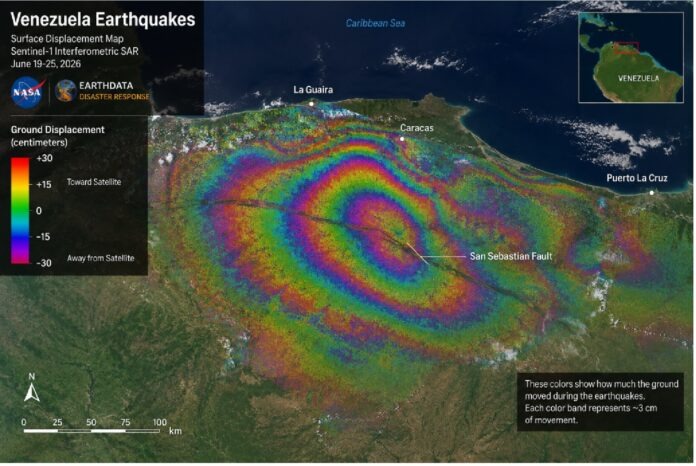
NASA has released satellite-derived InSAR maps revealing that northern Venezuela's coastline shifted by up to 30 centimeters following the devastating June 2026 twin earthquakes. These high-resolution maps are currently being used by emergency responders to assess infrastructure damage and plan recovery efforts for nearly 59,000 affected structures.
CARACAS — NASA’s Disaster Response Coordination System has released high-resolution satellite maps revealing the extent of geographical changes in northern Venezuela following the catastrophic magnitude 7.2 and 7.5 earthquakes that struck the region on June 24, 2026. The data, derived from advanced satellite radar observations, provides scientists and emergency responders with a precise look at how the Earth’s surface shifted during the seismic event.
The earthquakes, which occurred just 39 seconds apart, have permanently altered the topography along Venezuela's northern coastline. According to preliminary assessments, sections of the land near La Guaira and the Caracas corridor experienced horizontal and vertical ground displacement of up to 30 centimeters (12 inches).
Mapping the Tectonic Impact
To generate these displacement maps, NASA utilized a technique known as Interferometric Synthetic Aperture Radar (InSAR). By comparing satellite observations captured before and after the twin quakes, researchers were able to detect centimeter-scale changes in the Earth’s surface. The resulting imagery displays colorful interference bands that indicate the magnitude of movement along the San Sebastian Fault, a critical tectonic boundary between the Caribbean and South American plates.
The mapping project, conducted in collaboration with the NISAR Operations Science Team, serves as a vital tool for assessing regional infrastructure risks. Because radar waves can penetrate clouds and function in darkness, the InSAR technique provided critical visibility into the affected areas even during the immediate aftermath of the disaster, when conventional visual surveys were hindered by debris and weather conditions.
Guiding Recovery and Disaster Response
Beyond mapping surface deformation, the satellite data has been instrumental in the humanitarian response. NASA, in coordination with the European Space Agency’s (ESA) Copernicus system, has estimated that approximately 58,870 buildings were damaged or destroyed across northern Venezuela.
"These maps provide key insights for emergency managers and scientists as they prioritize search-and-rescue operations," officials stated. The agency noted that by identifying areas where the ground underwent the most significant movement, teams on the ground can better anticipate potential structural instabilities in bridges, pipelines, and building foundations.
Official Sources
The findings and imagery are based on data processed by the NASA-JPL/Caltech NISAR Operations Science Team and the Copernicus Emergency Management Service. Preliminary damage assessments were calibrated using seismic intensity maps provided by the U.S. Geological Survey (USGS).
Why It Matters
The permanent alteration of the Venezuelan landscape poses long-term challenges for civil engineering and urban planning. For local residents and businesses, the satellite-derived data is essential for identifying which zones remain stable for reconstruction and which areas may require geological reinforcement before infrastructure can be rebuilt. Furthermore, the information provides researchers with an unprecedented view of crustal responses to extreme seismic events, which could improve disaster preparedness across the wider Caribbean region.
Key Facts at a Glance
Seismic Event: Two major earthquakes (magnitude 7.2 and 7.5) occurred in northern Venezuela on June 24, 2026.
Surface Shift: Parts of the northern coast moved by as much as 30 centimeters due to tectonic activity along the San Sebastian Fault.
Technological Tool: NASA used InSAR (Interferometric Synthetic Aperture Radar) to map ground deformation from space.
Damage Assessment: Preliminary satellite analysis indicates approximately 58,870 structures were likely damaged or destroyed.
FAQ
How does NASA measure surface shifts from space?
NASA uses InSAR, a technique that compares radar images of the same location taken at different times. By analyzing the "phase difference" between the two radar waves, scientists can calculate how much the ground moved toward or away from the satellite.
Are the satellite maps final?
No, these are preliminary and experimental products designed to assist in rapid disaster response. They require field validation by ground teams to confirm the extent of damage and geological shifts.
What is the San Sebastian Fault?
It is a major tectonic structure separating the Caribbean and South American plates. Movement along this fault is the primary driver of seismic activity in northern Venezuela.
Source: NASA Earthdata GIS, U.S. Geological Survey (USGS), ESA Copernicus Emergency Management Service, NASA-JPL/Caltech