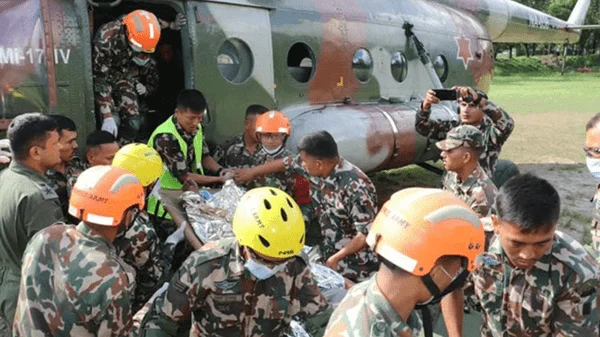
The Nepali Army has resumed major search-and-rescue operations across northern districts following destructive flash floods along the Bhotekoshi river basin. Supported by multi-agency security personnel and helicopters, emergency teams are evacuating trapped residents, transporting injured victims to medical facilities, and distributing emergency humanitarian aid to isolated mountain communities.
KATHMANDU — The Nepali Army has resumed comprehensive aerial and ground rescue operations across several disaster-hit districts after severe flash floods triggered widespread destruction along the Bhotekoshi and Trishuli river basins. Military officials confirmed on Friday that emergency teams are prioritizing isolated settlements in Rasuwa, Nuwakot, and Dhading districts to evacuate stranded residents, locate missing persons, and transport critical medical teams into cut-off zones. This renewed mobilization is critical as ground transportation corridors remain severed, leaving hundreds of local villagers, workers, and regional pilgrims dependent on immediate airlifts.
Military Mobilization and Aerial Evacuation Efforts
According to Nepali Army spokesperson Brigadier General Rajaram Basnet, specialized army units have concentrated search-and-rescue teams in the most severely impacted mountain sectors. The military has deployed multi-purpose helicopters, operating in conjunction with civilian aviation operators, to maintain continuous flights into remote landing zones.
Aviation units, including Mil Mi-17 military helicopters, have been deployed to airlift severely injured survivors directly to Tribhuvan University Teaching Hospital in Kathmandu and regional medical barracks in Trishuli. Security personnel have also focused on infrastructure facilities along the Trishuli corridor, successfully extracting dozens of workers who were trapped in hydropower tunnels and construction compounds after sudden debris flows flooded low-lying operational areas.
Multi-Agency Coordination and Casualty Management
The response operation incorporates more than 13,000 security personnel drawn from the Nepali Army, Nepal Police, and the Armed Police Force. Armed Police Force search-and-rescue teams equipped with detection equipment, trained canines, and aerial drones have been dispatched to scour collapsed structures and riverbanks across Rasuwa and Nuwakot.
Field medical facilities have been established at military barracks to stabilize victims before transferring critical cases to tertiary hospitals. The Armed Police Force has reserved emergency hospital beds in Kathmandu specifically for flood casualties, while deployable medical container units are being routed toward damaged arterial roadways.
Impact on Communities, Infrastructure, and Travel Routes
The ongoing Nepal flood crisis has caused extensive disruption to northern transit corridors, severing the primary trade and travel route between Nepal and the Tibet Autonomous Region. Heavy sedimentation and flash flooding swept away roadway segments, localized bridges, and communication towers, leaving multiple border settlements without electricity or cellular connectivity.
The sudden inundation impacted hundreds of travelers and pilgrims traveling along northern transit routes. Local authorities confirmed that temporary shelter centers have been arranged in community buildings and schools for displaced residents, while local administrative offices have begun distributing emergency cash grants and relief provisions.
Regional Assistance and Disaster Response Logistics
International disaster relief efforts have commenced to support the Nepal flood emergency response. Transport aircraft from the Indian Air Force have delivered emergency humanitarian assistance and disaster relief materials, including essential pharmaceuticals, water purification supplies, and food rations, to Tribhuvan International Airport in Kathmandu.
Nepal's Ministry of Foreign Affairs has established an Emergency Control Room to facilitate coordination, verify the whereabouts of affected foreign nationals, and streamline consular communications with diplomatic missions.
Official Sources Section
This report is compiled using official briefings and situation bulletins released by:
Quote Section
"According to officials from the Nepali Army, search-and-rescue teams have been heavily concentrated in high-risk zones across Rasuwa and Nuwakot, where aviation units and ground soldiers continue to evacuate trapped residents, deliver medical support, and restore vital humanitarian lifelines."
Why It Matters
The resumption of synchronized aerial and ground search operations is crucial to preventing further loss of life in mountainous zones where surface roads have collapsed. Re-establishing logistical connections allows emergency medical teams to reach injured individuals, ensures the delivery of clean water and food supplies, and accelerates the restoration of critical cross-border trade and power infrastructure.
Key Facts at a Glance
Lead Agency: Nepali Army in coordination with the Nepal Police and Armed Police Force.
Primary Impact Zones: Rasuwa, Nuwakot, and Dhading districts along the Bhotekoshi and Trishuli river valleys.
Deployment Scale: Over 13,000 security personnel mobilized with combined military and civilian helicopter fleets.
Key Operations: Aerial casualty evacuations, tunnel extractions at hydropower installations, and emergency field hospital deployments.
Frequently Asked Questions (FAQ)
What caused the recent flood emergency in northern Nepal?
The disaster followed upstream flash flooding and heavy debris flows along the Bhotekoshi and Trishuli river systems, damaging roads and settlements near the northern border.
Which areas are receiving priority in the rescue operations?
Search-and-rescue missions are primarily focused on isolated communities in Rasuwa, Nuwakot, and Dhading districts where roadway connections remain severed.
How are authorities reaching individuals trapped in cut-off zones?
The Nepali Army and private operators are deploying rotary-wing aircraft to conduct medical evacuations and drop emergency supplies directly into isolated mountain sectors.
Source: