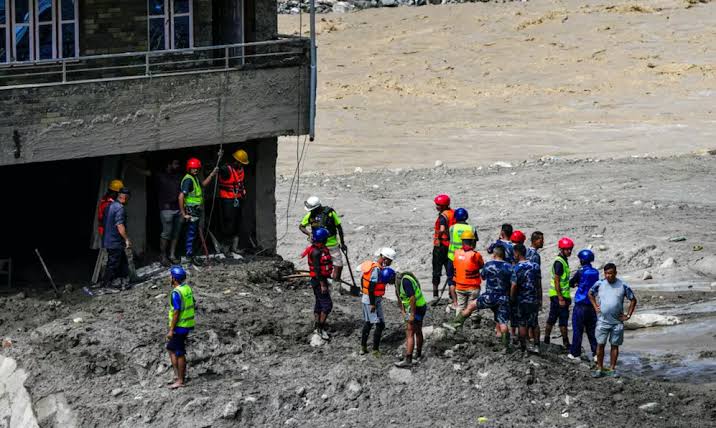
The death toll from severe flash floods in Nepal has risen sharply as Nepal Police and disaster management forces recover bodies across affected districts. Over 15,000 security personnel are deployed in search operations, with more than 1,900 people still reported missing following catastrophic river overflows along border valleys.
KATHMANDU — The death toll from devastating flash floods and torrents sweeping through central and northern Nepal continues to mount rapidly, with Nepal Police confirming hundreds of fatalities as rescue teams work through mud and river debris across eight districts. Official disaster updates issued by the National Disaster Risk Reduction and Management Authority (NDRRMA) indicate that security personnel have recovered 579 bodies, while local emergency operations report the total confirmed fatalities climbing toward 626 as search teams access previously cut-off downstream settlements. The tragedy, triggered by catastrophic outbursts along the Himalayan border river systems, has left nearly 2,000 people missing, including foreign tourists, hydroelectric site workers, and local residents.
Massive Multi-District Casualty Breakdown
The catastrophe originated earlier this week following a high-altitude burst near the Tibet-Nepal border that sent millions of tons of water, mud, and boulders downstream through the Bhotekoshi, Trishuli, and Narayani river corridors. The resulting deluge inundated riverside towns, collapsed bridges, and swept away infrastructure across central Nepal.
According to field updates provided by Nepal Police and local district authorities, body recoveries span multiple administrative zones:
| District / Region | Bodies Recovered | Major Impact Areas |
| Chitwan | 221+ | Downstream Narayani riverbank inundations |
| Nawalparasi East | 134+ | Low-lying settlement washouts along river paths |
| Gorkha | 46+ | Mountain valley landslides and structural collapses |
| Nuwakot | 37+ | Trishuli river valley flooding |
| Dhading | 33+ | Transport corridor washouts and highway mudslides |
| Rasuwa & Others | 30+ | Border crossings and hydroelectric project sites |
High-Risk Search Operations and Missing Persons Emergency
More than 15,000 security personnel—including 6,755 Nepal Army personnel, 4,473 Nepal Police personnel, and 4,203 Armed Police Force members—have been deployed across affected districts. Search and rescue teams face significant obstacles from damaged road networks, persistent rainfall, and fresh flood warnings issued for low-lying river regions.
The missing list remains alarming, with over 1,900 individuals still unaccounted for. Officials report that over 900 workers stationed at remote hydroelectric power projects in the mountain corridors were swept away or isolated in tunnels. Additionally, hundreds of foreign nationals trekking in the popular Rasuwa and Langtang regions remain uncontactable as aerial reconnaissance missions attempt to establish contact with stranded groups.
Infrastructure Breakdown and International Relief Deployment
The surge damaged major road arteries connecting Kathmandu to border regions and central trade hubs, severing vital supply routes. Emergency workers have carried out dozens of helicopter sorties to air-evacuate critically injured citizens and drop essential supplies, food rations, and satellite communication sets into isolated pockets. Neighboring India has mobilized specialized disaster response teams and relief supplies to bolster Nepal's rescue efforts.
Official Sources Section
Fatality statistics, search progress, and operational figures are sourced from official press releases, field communications, and disaster bulletins issued by the Nepal Police, the National Disaster Risk Reduction and Management Authority (NDRRMA), the Nepal Army, and the Ministry of Home Affairs, Nepal.
Quote Section
According to officials at the National Disaster Risk Reduction and Management Authority (NDRRMA):
"Over 15,000 security personnel are working around the clock under extreme terrain conditions to locate the missing and move affected populations to safety. We urge all residents and rescue teams along the Bhotekoshi and Trishuli river corridors to remain on high alert due to elevated water levels and potential secondary landslides."
Why It Matters
This disaster highlights the acute vulnerability of Himalayan river corridors to sudden glacial outbursts, cloudbursts, and mudslides. The rapid destruction of critical transport links and power infrastructure disrupts regional trade routes between Nepal and China while creating urgent humanitarian needs for thousands of displaced families and stranded travelers.
Key Facts at a Glance
Devastating Casualty Count: Over 570 confirmed deaths reported by authorities, with local counts reaching toward 626 as recoveries continue.
Massive Missing Figure: Over 1,900 people remain missing, including more than 900 hydroelectric workers and over 500 foreign nationals.
Security Deployment: More than 15,000 personnel from the Nepal Army, Nepal Police, and Armed Police Force are deployed in rescue operations.
Hardest Hit Areas: Chitwan, Nawalparasi, Gorkha, Nuwakot, and Dhading districts report the heaviest casualties.
Frequently Asked Questions (FAQ)
What caused the massive flash floods in Nepal?
The floods were triggered by a catastrophic high-altitude water surge near the Tibet-Nepal border that sent massive volumes of water, sediment, and debris down the Bhotekoshi and Trishuli river systems.
How many people are currently missing in the flood-affected areas?
According to official disaster management updates, over 1,900 people are reported missing, including local residents, construction staff at hydroelectric facilities, and international visitors.
Which agencies are conducting the search and rescue operations?
Search and rescue operations are led by the Nepal Army, Nepal Police, and the Armed Police Force (APF), supported by private helicopter operators and international disaster response teams.
Source: Nepal Police Press Releases, National Disaster Risk Reduction and Management Authority (NDRRMA) Bulletins, Nepal Ministry of Home Affairs Updates.