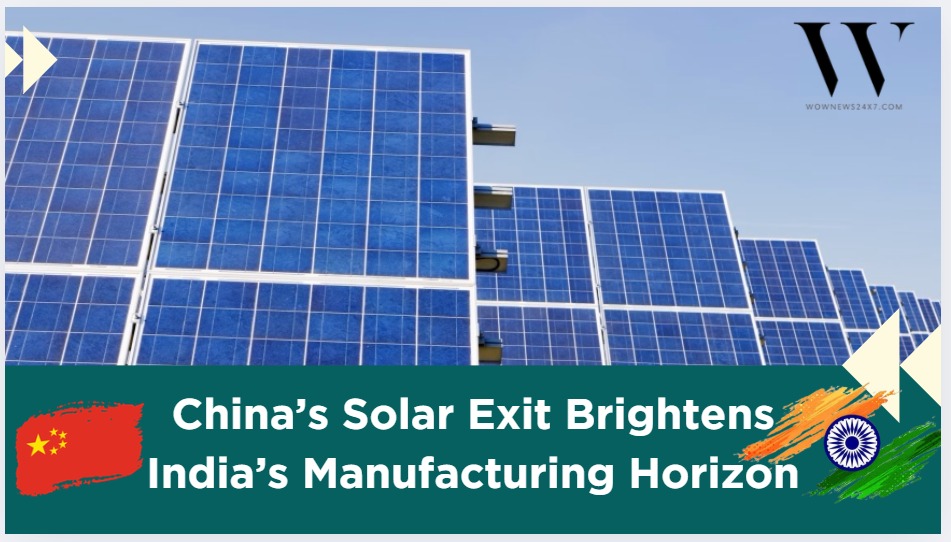

China’s decision to abolish VAT export rebates on solar products from April 2026 is expected to raise global panel prices and reduce dumping. Indian manufacturers such as Waaree Energies, Premier Energies, Adani Solar, and Insolation Energy are likely to benefit, gaining market share and strengthening domestic renewable energy capacity.
China’s Ministry of Finance has announced the gradual removal of export tax rebates on photovoltaic (PV) products starting April 2026, with complete elimination by January 2027. For years, these rebates ranging between 9% and 13% helped Chinese firms dominate global solar markets by keeping prices artificially low. The policy shift is expected to reshape global trade dynamics, creating opportunities for Indian solar companies.
Key Highlights
-
Policy Change: VAT export rebates on solar panels and batteries will be phased out from April 2026, fully removed by January 2027.
-
Impact on Prices: Global solar panel prices are expected to rise, reducing the risk of Chinese dumping in India.
Indian Beneficiaries:
-
Waaree Energies: Shares jumped over 5% following the announcement.
-
Premier Energies: Gained more than 4% as investors anticipate stronger demand.
-
Adani Solar & Insolation Energy: Likely to benefit from increased reliance on domestic manufacturing.
Strategic Importance: Supports India’s Aatmanirbhar Bharat initiative by boosting indigenous solar capacity and reducing import dependence.
Global Context: Move addresses China’s overcapacity concerns and trade pressures, while opening space for competitors.
This development positions Indian solar firms to capture greater domestic and international market share, reinforcing India’s role in the global clean energy transition.
Sources: TradeBrains, LinkedIn, Bloominglobal