
ISRO's Aditya-L1 has decoded a powerful October 2024 solar storm's turbulent region, which compressed Earth's magnetosphere, exposed geostationary satellites to plasma, and super-intensified auroral currents. Published in Astrophysical Journal, the study using Aditya-L1 and global data stresses real-time space weather monitoring for asset protection.
India's Aditya-L1 mission has decoded how a powerful October 2024 solar storm's turbulent region compressed Earth's magnetosphere, exposing satellites and intensifying auroral currents, as detailed in a new Astrophysical Journal study using ISRO and global data.
This breakthrough highlights Aditya-L1's role in real-time space weather monitoring amid rising solar activity.
Key Highlights
-
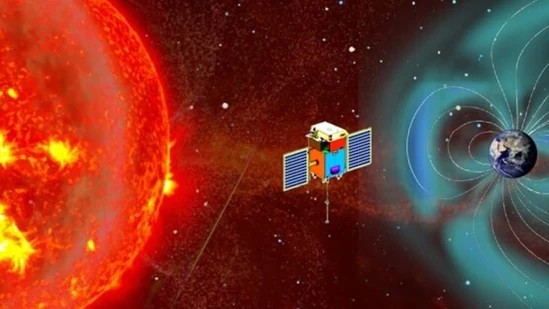
Aditya-L1, positioned at the Sun-Earth L1 point, detected the storm's chaotic turbulent sheath within a coronal mass ejection (CME).
-
The turbulent front slammed into Earth's invisible magnetic shield, compressing it dramatically and pushing boundaries perilously close to the planet's surface.
-
Geostationary satellites faced direct exposure to hostile solar plasma, a rare event limited to extreme space weather.
-
Auroral electrojets at high latitudes surged intensely, risking upper atmosphere heating and particle escape into space.
-
The study, published December 2025 in The Astrophysical Journal (DOI: 10.3847/1538-4357/ae1974), merges Aditya-L1 observations with international missions for comprehensive analysis.
Storm's Genesis and Journey
The October 2024 event stemmed from a massive solar plasma eruption forming an interplanetary coronal mass ejection (ICME).
En route to Earth, the ICME developed a turbulent sheath that amplified its geoeffectiveness beyond expectations.
Aditya-L1's real-time data revealed this structure, enabling precise mapping of the storm's interaction with our planet's defenses.
Implications for Space Security
These insights underscore the need for vigilant space weather forecasting to protect satellites, power grids, and navigation systems.
As solar maximum peaks through 2026, Aditya-L1 cements India's leadership in global efforts against cosmic threats.
Enhanced predictions could prevent disruptions, safeguarding critical infrastructure reliant on space technology.
Sources: ISRO.gov.in, India Today, The Astrophysical Journal