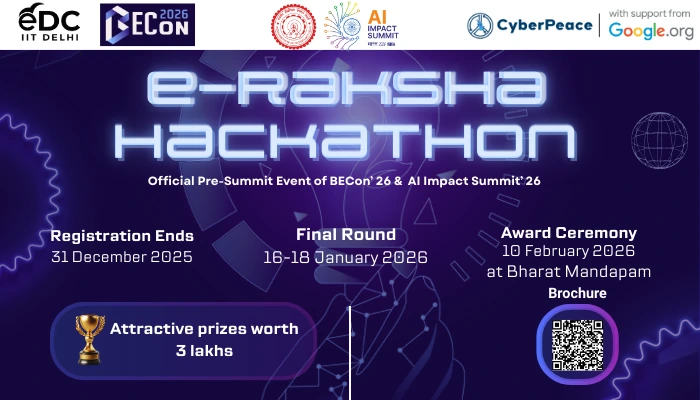

IIT Delhi will host the E-Raksha Hackathon 2026 from January 16 to 18, focusing on cybersecurity, defence AI, and digital safety. Organized with CyberPeace, the 36-hour national event invites students and innovators to develop solutions against threats like deepfakes, IoT vulnerabilities, and online abuse, offering mentorship and recognition.
The Indian Institute of Technology (IIT) Delhi is set to host the E-Raksha Hackathon 2026, a national-level cybersecurity challenge scheduled from January 16 to 18. Organized in collaboration with CyberPeace, the event will bring together students, innovators, and tech enthusiasts to design AI-driven solutions addressing pressing digital threats. The hackathon aims to strengthen India’s cybersecurity ecosystem while fostering innovation among young talent.
Key highlights from the announcement include
-
The E-Raksha Hackathon 2026 will run for 36 hours at IIT Delhi from January 16 to 18.
-
Focus areas include IoT defence, deepfake detection, child safety online, and digital resilience.
-
The event is jointly organized by IIT Delhi’s Entrepreneurship Development Cell and CyberPeace.
-
Participants can apply through platforms like Unstop, with teams of one to three members eligible.
-
Applications require submission of ideas and presentations, with top teams shortlisted for the final round.
-
Prizes worth Rs 3 lakh will be awarded, along with mentorship and national visibility.
-
The hackathon coincides with the India AI Impact Summit 2026, amplifying its relevance in the tech ecosystem.
-
Industry experts note that the initiative reflects India’s growing emphasis on cybersecurity and AI innovation.
The hackathon is designed not only as a competition but also as a platform for real-world impact. By encouraging solutions to challenges such as hacked smart devices, viral deepfakes, and online abuse, IIT Delhi and CyberPeace aim to empower participants to contribute meaningfully to digital safety. With strong institutional backing and national recognition, the event is expected to attract wide participation and set benchmarks for future cybersecurity initiatives.
Sources: Indian Express, TechGig, Unstop