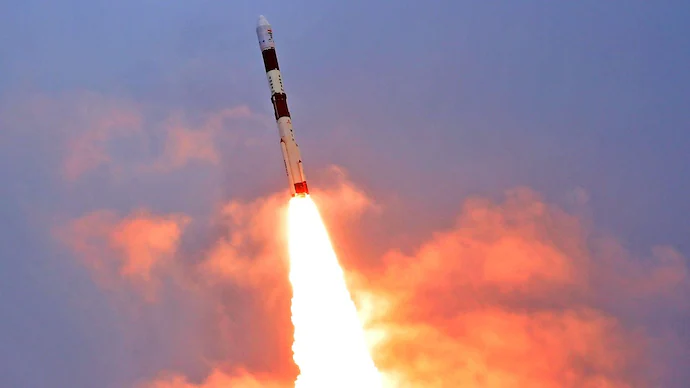

India is set to launch 16 satellites in a single PSLV mission, underscoring ISRO’s confidence in its versatile, cost-efficient launcher. PSLV’s precision injection, multi-orbit capability, and long track record—highlighted by the 104-satellite feat in 2017—make it the reliable choice for national payloads and commercial rideshare under NewSpace India Limited.
ISRO’s upcoming rideshare will deploy 16 satellites—mixing domestic and international payloads—onboard the Polar Satellite Launch Vehicle (PSLV). Beyond sheer capacity, PSLV’s appeal lies in its repeatable accuracy, flexible configurations (Core Alone, DL, XL), and demonstrated ability to deliver satellites into diverse orbits in a single flight.
The mission also showcases India’s growing commercial footprint through NSIL’s rideshare model, which pools small satellites to lower launch costs and expand access. For earth observation, communications, and technology demonstrators, PSLV’s heritage gives customers predictable timelines and risk profiles. Its stable supply chain and incremental upgrades have kept reliability high, ensuring continuity while GSLV and LVM3 serve heavier classes.
Notable updates and major takeaways
-
Mission scale: 16 satellites, combining national and foreign payloads.
-
Trusted platform: PSLV’s multi-orbit delivery and precise injection underpin confidence.
-
Configuration flexibility: Core Alone/DL/XL variants match payload needs and budgets.
-
Commercial momentum: NSIL rideshare broadens access for startups and global customers.
-
Track record: Iconic 104-satellite launch (2017) exemplifies PSLV’s high-throughput capability.
-
Strategic impact: Supports India’s EO, telecom, and tech-demo pipeline with dependable cadence.
Sources: Indian Space Research Organisation (ISRO) release; Press Trust of India/Business Standard coverage; India Today Science Desk; The Hindu Science & Tech Bureau.