

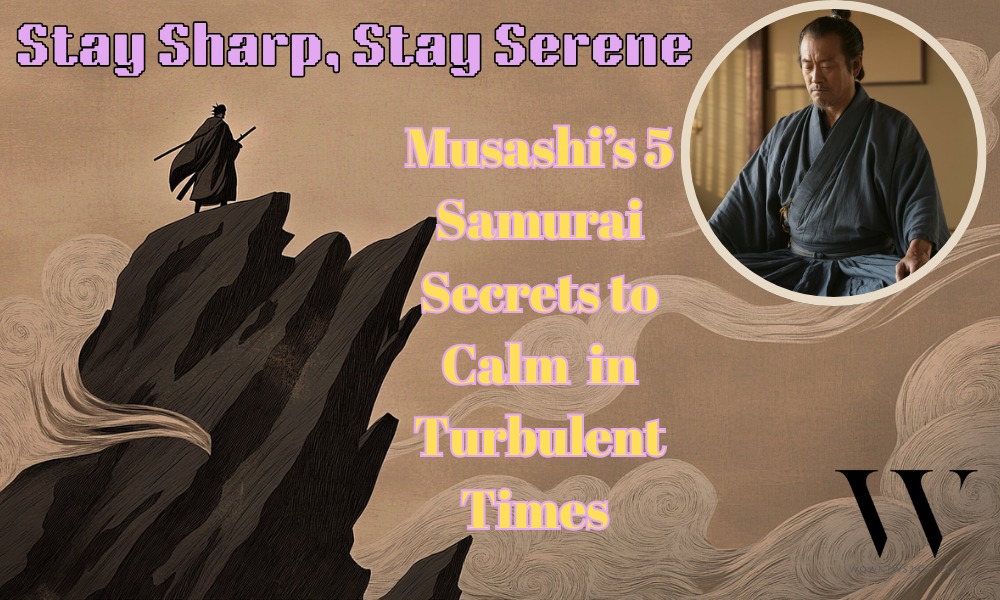
Miyamoto Musashi’s five samurai principles—emotional distance, anticipatory awareness, strategic breathing, anchoring to purpose, and self-knowledge—offer timeless strategies for staying calm under pressure. Modern thinkers apply these teachings to workplace stress, conflict, and fear, blending ancient wisdom with neuroscience to help individuals cultivate resilience and composure in today’s chaotic world.
In a world defined by constant stress, uncertainty, and high-pressure environments, the wisdom of Miyamoto Musashi, Japan’s legendary samurai and undefeated swordsman, continues to resonate. His teachings, rooted in discipline and clarity, offer timeless strategies for staying calm in any situation. Drawing from his philosophy and writings, modern thinkers and educators are reinterpreting Musashi’s principles to help individuals navigate today’s challenges with composure and strength.
Key highlights of Musashi’s principles include:
Emotional Distance: Musashi emphasized detachment from immediate emotions. By practicing non-attachment, individuals can avoid rash decisions and maintain clarity under pressure. This principle aligns with Buddhist and Taoist traditions, encouraging balance and perspective.
Anticipatory Awareness: He taught the importance of foresight—anticipating challenges before they arise. In modern contexts, this translates to proactive planning and situational awareness, whether in business negotiations or personal conflicts.
Strategic Breathing: Musashi believed in controlling the body to control the mind. Breathing techniques help regulate stress responses, allowing one to remain centered even in chaotic environments.
Anchoring to Purpose: Staying calm requires a clear sense of purpose. Musashi’s philosophy urged warriors to remain grounded in their mission, a lesson equally relevant for professionals striving toward long-term goals.
Self-Knowledge and Discipline: Musashi’s undefeated record was built on ruthless self-awareness and discipline. He urged individuals to understand their strengths and weaknesses deeply, cultivating resilience through practice and reflection.
These principles are not confined to the battlefield. They are increasingly applied to modern struggles such as workplace stress, emotional conflict, fear, and self-doubt. Experts highlight that Musashi’s teachings blend seamlessly with neuroscience and psychology, reinforcing the idea that composure is a skill that can be trained and mastered.
The renewed interest in Musashi’s philosophy reflects a broader cultural trend: the search for ancient wisdom to solve contemporary problems. From corporate leadership seminars to mindfulness workshops, Musashi’s principles are being adapted into practical frameworks for emotional mastery. His legacy demonstrates that true strength lies not in force, but in the ability to remain unshaken when confronted with adversity.
As global challenges—from economic uncertainty to digital overload—continue to test resilience, Musashi’s five principles serve as a blueprint for calmness, clarity, and control. They remind us that composure is not passive; it is an active discipline that empowers individuals to lead, decide, and thrive with confidence.
Sources: MEDA Foundation, Focus & Flow (YouTube), Mentalzon