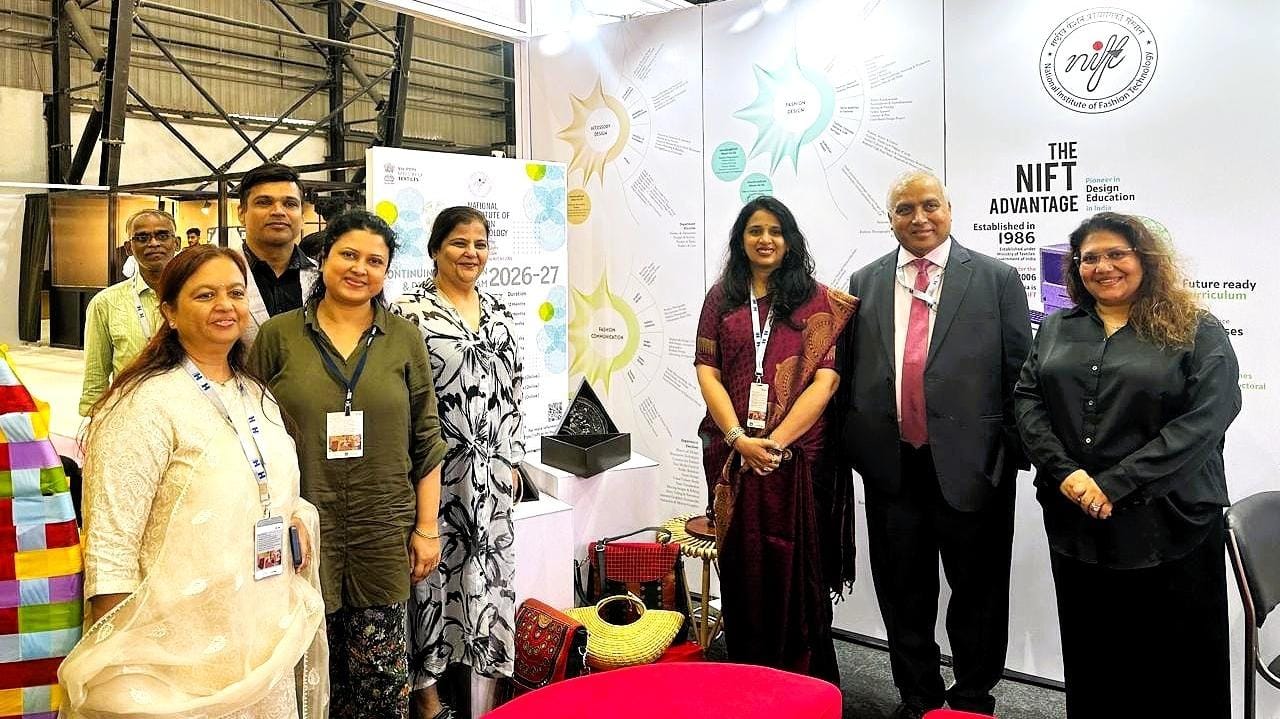
NIFT Mumbai participated in the 19th HGH India 2026 trade show at the Bombay Exhibition Centre to present its academic, craft, and technical textile innovations. Visited by Textile Commissioner Vrunda Manohar Desai, the pavilion successfully connected student designs with over 43,000 retail buyers and industry manufacturers.
MUMBAI — The National Institute of Fashion Technology (NIFT) Mumbai showcased its latest academic developments, technical textile research, and community-driven craft innovations at the 19th edition of the HGH India 2026 trade exhibition. The prominent four-day home fashion event ran from June 30 to July 3, 2026, at the Bombay Exhibition Centre (NESCO) in Goregaon, Mumbai. NIFT Mumbai's active participation served as a major point of connection between academic design concepts and actual marketplace commercial production.
Operating under the administrative aegis of the Union Ministry of Textiles, NIFT's presentation comes at a time when consumer preferences across both major metros and 700 regional towns are moving toward sustainable, high-functionality living products. By setting up a dedicated innovation pavilion at India’s largest trade show for home textiles, decor, and houseware, the public institute is actively working to establish a future-ready, creatively agile domestic design workforce.
Displaying Technical Textiles and Academic Research Frameworks
According to official project disclosures shared by the institute's management team, the dedicated NIFT Mumbai pavilion structured a multifaceted overview of its institutional capabilities. A major centerpiece of the display focused on the institute's specialized research output under the National Technical Textiles Mission (NTTM) Project. The initiative aims to integrate high-performance technical raw materials into everyday lifestyle, bedding, and home decoration applications.
The institutional pavilion divided its educational and operational outputs into five distinct core focus areas:
Regular Academic Programmes: Presenting baseline student portfolios spanning apparel design, lifestyle accessory structures, and specialized textile development curriculum maps.
Continuing Education Programmes (CEP): Highlighting specialized, short-duration training modules designed for active industry executives looking to pick up automated digital design techniques.
Craft Cluster Initiatives: Showcasing grass-roots rural design intervention schemes that link regional Indian artisans directly with urban corporate distribution networks.
The National Technical Textiles Mission (NTTM) Portfolio: Presenting early-stage prototypes of highly functional fabrics engineered for advanced durability, safety, and moisture-wicking characteristics.
Innovative Student Graduation Projects: Exhibiting select, physical home product designs developed by final-year design and technology students.
High-Level Regulatory Reviews and Industry Networking Impact
The 19th edition of the HGH India 2026 trade fair drew massive commercial interest, recording an aggregate attendance of 43,920 professional trade buyers hailing from more than 700 cities across India, alongside 32 international enterprise delegations. This broad target audience provided NIFT's student innovators with direct access to modern retail buyers, commercial exporters, product manufacturers, and boutique interior decorators.
During the event proceedings, Smt. Vrunda Manohar Desai, IRS, Textile Commissioner for the Government of India, completed an official visit to the NIFT Mumbai pavilion. The commissioner reviewed the live student projects and commended NIFT's persistent efforts to build meaningful bridges between academic design labs, traditional craft preservation, and modern manufacturing facilities.
Aligning Student Innovations with Global Trade Trends
The layout of NIFT Mumbai’s design exhibits closely mirrored the overarching structural themes of HGH India 2026, which prioritized contemporary design, futuristic functionality, and responsible living. The trade platform introduced several specialist areas, such as the Trend Forecasts pavilion and the Indian Heritage and Sustainability Pavilion, where organic fibers and biodegradable composites took center stage.
By placing student projects alongside global market trend forecasts, NIFT gave corporate retailers an early look at how upcoming creative professionals interpret evolving consumer demands. This direct interaction sparked deep dialogue between academic directors and corporate brand executives regarding future cooperative research, technical product testing, and joint student internship programs.
Official Sources Section
According to official statements published by the Press Information Bureau (PIB) Mumbai on behalf of the Ministry of Textiles, NIFT’s participation at HGH India 2026 serves as a primary foundation for building stronger industry-academia partnerships, preserving indigenous craft skills, and driving eco-friendly product innovation.
Quote Section
"According to officials at the Ministry of Textiles, NIFT Mumbai's interactive presentation highlights the critical need for continuous dialogue between academic design labs and corporate manufacturing houses to build a highly competitive creative workforce for India's textile sector."
Why It Matters
The strategic intersection of design academia with large-scale industrial trade fairs like HGH India provides vital practical benefits for multiple sectors. For design students, it eliminates the traditional gap between classroom theory and real-world commercial production requirements. For the retail and manufacturing sectors, it offers a regular stream of verified consumer research, technical textile innovations, and fresh creative concepts. This collaborative ecosystem ultimately ensures that traditional Indian crafts and sustainable materials are smoothly integrated into modern commercial retail supply chains.
Key Facts at a Glance
Event Milestone: NIFT Mumbai showcased its academic and research portfolios at the 19th annual edition of the HGH India 2026 trade fair.
Strategic Venue: The extensive trade exhibition took place from June 30 to July 3, 2026, at the Bombay Exhibition Centre (NESCO) in Goregaon, Mumbai.
Massive Trade Scale: The event attracted 43,920 trade buyers from over 700 cities alongside 32 international participant groups.
Core Technical Projects: The institute highlighted its specialized research initiatives under the National Technical Textiles Mission (NTTM).
High-Level Inspection: Smt. Vrunda Manohar Desai, IRS, Textile Commissioner for the Government of India, officially visited and evaluated the NIFT stall.
FAQ Section
Q1: What unique projects did NIFT Mumbai display at HGH India 2026?
NIFT Mumbai presented its Regular Academic Programmes, Continuing Education Programmes (CEP), Craft Cluster Initiatives, student graduation designs, and technical research developments under the National Technical Textiles Mission (NTTM).
Q2: Who were the main visitors interacting with the NIFT pavilion?
The pavilion engaged with a wide group of industry professionals, including retail brands, exporters, manufacturing entrepreneurs, interior designers, and prospective design students.
Q3: How did the Government of India evaluate NIFT’s trade show participation?
Smt. Vrunda Manohar Desai, IRS, Textile Commissioner for the Government of India, visited the pavilion and highly commended NIFT's efforts to advance quality design education, craft development, and industry-wide collaboration.
Source: Press Information Bureau (PIB) Government of India, National Institute of Fashion Technology Official Portal, HGH India Trade Show Communications Desk.