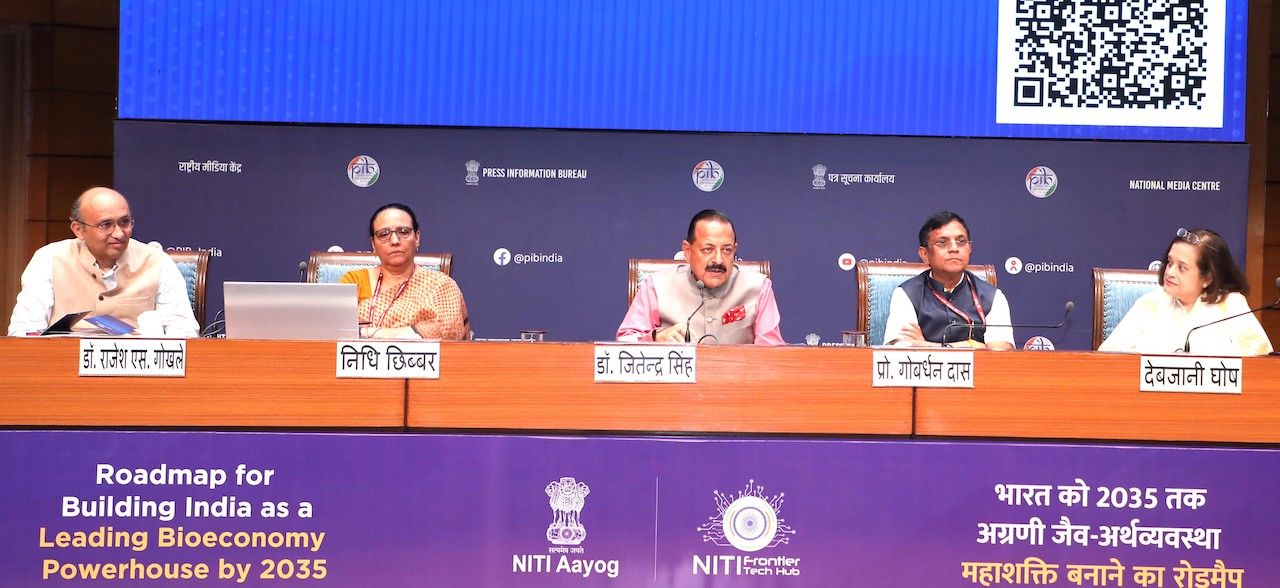
Dr. Jitendra Singh has announced India’s first undergraduate degree in Engineering Biology to bolster the nation’s bioeconomy, targeting $700 billion by 2035. This interdisciplinary program integrates AI, medicine, and engineering to prepare a specialized workforce for advancements in synthetic biology, biomanufacturing, and precision healthcare within an increasingly sovereign biotechnology ecosystem.
The new undergraduate program aims to build a sovereign biotechnology workforce capable of driving India’s $700 billion bioeconomy goal by 2035.
NEW DELHI — In a strategic move to position India as a global leader in biotechnology, Union Minister of State (Independent Charge) for Science and Technology, Dr. Jitendra Singh, announced the launch of the country’s first-ever undergraduate degree course in Engineering Biology.
The announcement was made on July 16, 2026, during the unveiling of the "Building India as a Leading Bioeconomy Powerhouse by 2035" roadmap. Dr. Singh described the initiative as a foundational step toward creating an "independent and sovereign" biotechnology ecosystem, drawing a parallel to the transformative role computer science played in India’s digital revolution.
Bridging Biology, Engineering, and AI
The Engineering Biology program is designed to move beyond conventional biotechnology curricula by integrating multiple high-impact disciplines. Students will be trained at the intersection of engineering, life sciences, medicine, and emerging computational technologies.
According to officials, the curriculum is intended to equip graduates with the skills necessary to handle complex tasks such as:
Synthetic Biology: Designing or modifying biological systems for specific applications.
AI-Enabled Biology: Using advanced computational tools to analyze and design biological functions.
Advanced Bio-manufacturing: Scaling biological processes into reliable industrial production.
Gene-based Therapies: Connecting laboratory research with clinical and manufacturing requirements.
"The IITs have already begun submitting proposals for interdisciplinary programmes in collaboration with medical institutions," Dr. Singh noted, highlighting the growing synergy between engineering and healthcare sectors.
Powering the 2035 Bioeconomy Roadmap
The introduction of this degree is a cornerstone of the broader roadmap targeting a $700 billion bioeconomy by 2035. India’s bioeconomy has seen rapid expansion, growing from approximately $10 billion in 2014 to nearly $95 billion today. With projections suggesting this figure could reach $300 billion by 2030, the government is prioritizing the development of a specialized talent pipeline to support this trajectory.
The strategy also includes a proposed ₹50,000 crore Bioeconomy Growth Fund to support biomanufacturing, precision healthcare, and sustainable agriculture.
Why It Matters
For India’s academic and industrial sectors, this course addresses a critical "knowledge vacuum." Biotechnology innovation now requires professionals who can move fluidly between scientific discovery, engineering design, clinical application, and commercial production. By institutionalizing this interdisciplinary training at the undergraduate level, India aims to prevent skill shortages that could otherwise constrain the sector's expansion.
Key Facts at a Glance
New Degree: India's first undergraduate Engineering Biology graduation course.
Core Focus: Integration of engineering, biology, medicine, and AI.
Economic Goal: Targeting a $700 billion bioeconomy by 2035.
Growth Context: India is home to over 11,000 biotechnology startups and nearly 100 bio-incubators.
Frequently Asked Questions
Q: How does this course differ from traditional biotechnology?
A: Traditional biotechnology often centers on biological sciences. Engineering Biology adds a rigorous engineering and computational (AI) framework, focusing on the design and modification of biological systems for industrial and clinical applications.
Q: Which institutions will offer this program?
A: Dr. Singh indicated that IITs have already started proposing interdisciplinary programs in collaboration with medical institutions.
Q: What is the primary objective of this initiative?
A: The main goal is to create a sovereign, self-reliant biotechnology ecosystem by preparing a future-ready workforce for advanced healthcare, sustainable food systems, and industrial biomanufacturing.
Source: Ministry of Science & Technology (PIB), BioSpectrum India, PharmaBiz, Medical Buyer