The Nifty 50 index surged 200 points in the final minutes of trading on August 3, 2026, driven by the rollout of SEBI's new Closing Auction Session. Thin trading volumes during the debut session caused outsized price adjustments in key index heavyweights, leading to a sharp benchmark gain at the closing bell.
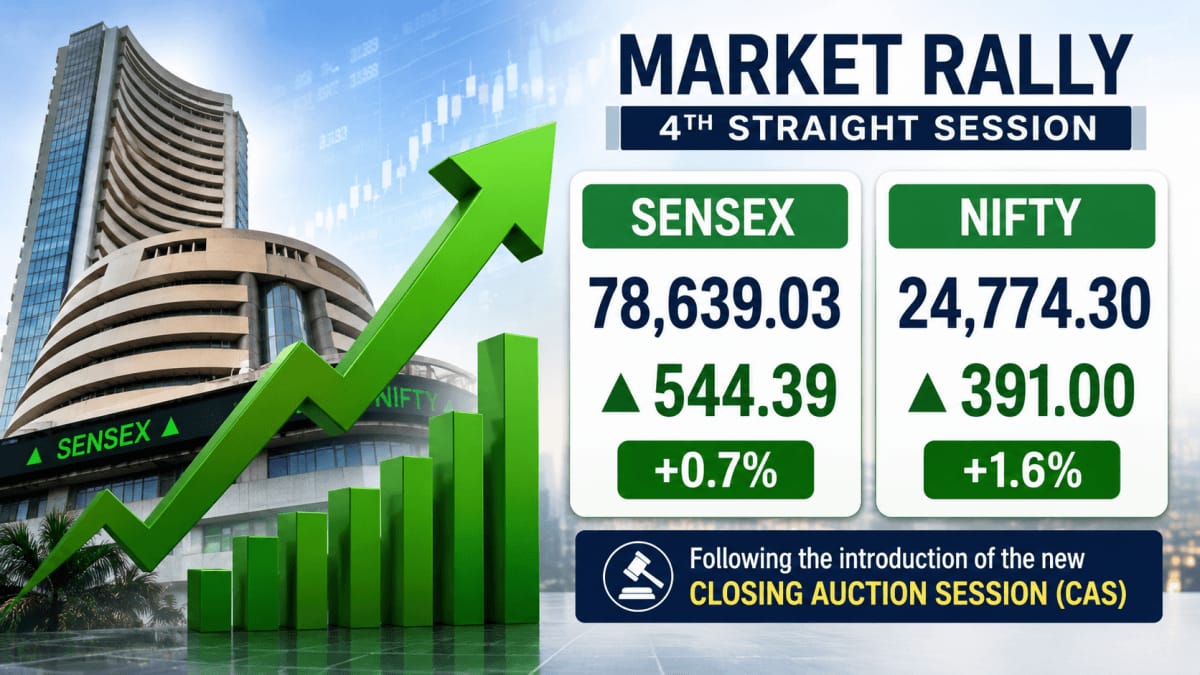
MUMBAI — Indian equity markets witnessed an unexpected end-of-day spike on August 3, 2026, as the benchmark Nifty 50 jumped 200 points in final minutes of trade to settle 1.60% higher at 24,774.30. The sudden movement occurred on the National Stock Exchange (NSE) during the official debut of the Securities and Exchange Board of India’s (SEBI) new Closing Auction Session (CAS) framework. Designed to align domestic trading practices with international markets, the newly implemented auction-based price discovery mechanism replaced the traditional volume-weighted average price (VWAP) system for single-stock derivatives. The sharp move left intraday market participants surprised and created a temporary divergence between benchmark indices.
Mechanics Behind the New Closing Auction Session
Prior to August 3, 2026, official closing prices for securities in the equity cash segment—including those traded in the Futures and Options (F&O) segment—were calculated using the volume-weighted average price (VWAP) of all executed trades during the final 30 minutes of continuous trading (3:00 PM to 3:30 PM).
Under the revised regulatory framework established by the Securities and Exchange Board of India (SEBI), continuous trading for eligible F&O-linked cash market stocks stops at 3:15 PM. The exchange then initiates a 20-minute Closing Auction Session structured as follows:
Reference Price Phase (3:00 PM – 3:15 PM): A baseline reference price is calculated using the VWAP of trades executed in the preceding 15 minutes.
Transition & Order Entry (3:15 PM – 3:30 PM): Between 3:15 PM and 3:20 PM, continuous trading halts. From 3:20 PM to 3:30 PM, market participants place market and limit orders into a single liquidity pool. Order entry closes randomly between 3:28 PM and 3:30 PM to prevent last-second order manipulation.
Order Matching & Equilibrium (3:30 PM – 3:35 PM): The exchange algorithms execute orders at a single equilibrium price—the level that maximizes trade execution volume. This equilibrium price becomes the official daily close.
Day-One Liquidity Dynamics Cause Benchmark Divergence
Market analysts and institutional desk commentary indicated that when the Nifty 50 jumped 200 points in final minutes of trade, the rally was not driven by fresh fundamental news or macro developments. Instead, relatively low trading volume during the inaugural 20-minute auction window resulted in limited sell liquidity.
As institutional buy orders were matched against limited order books, heavyweights such as ICICI Bank, Axis Bank, State Bank of India, Asian Paints, and Titan saw their equilibrium closing prices rise by 1% to 2% compared to their 3:15 PM levels. Because the Nifty 50 is a market-capitalization-weighted index, these individual adjustments collectively pushed the benchmark index up from 24,573 at 3:15 PM to its final official close of 24,774.30.
By contrast, the BSE Sensex recorded a smaller gain of 0.70% to close at 78,639.03. This divergence occurred because the new Closing Auction Session applies specifically to stocks listed in the F&O category, leading to differing calculation timings across index components.
Official Sources Section
Regulatory approvals and operational guidelines for the Closing Auction Session were issued via official circulars by the Securities and Exchange Board of India (SEBI) and implemented simultaneously across the National Stock Exchange of India (NSE) and the BSE Limited.
Official Quotes and Market Reactions
According to market regulators and exchange representatives, the transition to an auction-based closing protocol is designed to eliminate end-of-day price distortions caused by illiquid final trades.
"According to officials, the Closing Auction Session aligns Indian equity markets with global best practices by pooling buy and sell interest into a single transparent mechanism, reducing tracking error for passive index funds and improving execution efficiency for large institutional orders."
Market participants noted that initial volatility is common during structural trading shifts. "As institutional participants adapt their order-routing algorithms to the new 3:15 PM cutoff and auction window, liquidity will deepen, stabilizing the closing price discovery process," stated equity strategists in commentary following the session close.
Why It Matters
The shift to an auction-based closing price impacts institutional investors, mutual funds, retail traders, and derivative market participants:
Passive Funds: Index funds and ETFs benefit from lower tracking errors, as trades execute directly at the single discovered closing price.
Intraday Traders: Day traders holding open positions must account for the early 3:15 PM close for F&O cash stocks to prevent unexpected execution gaps during the auction.
Derivatives Settlement: Option and future settlement prices now reflect consolidated market demand rather than late-session VWAP averages, reducing price manipulation risks.
Key Facts at a Glance
Market Surge: The Nifty 50 jumped 200 points in final minutes of trade on August 3, 2026, settling at 24,774.30.
Regulatory Trigger: SEBI introduced the Closing Auction Session (CAS) for derivative-eligible stocks on August 3.
Revised Schedule: Continuous cash trading for F&O stocks halts at 3:15 PM, followed by a 20-minute auction phase ending by 3:35 PM.
Random System Closure: Order entry window closes randomly between 3:28 PM and 3:30 PM to prevent predatory order stacking.
Post-Closing Window: A post-close session operates from 3:50 PM to 4:00 PM, allowing trades exclusively at the final auction equilibrium price.
Frequently Asked Questions (FAQ)
Why did Nifty 50 jump 200 points in the final minutes of trade?
The sudden jump was caused by the launch of SEBI's new Closing Auction Session on August 3, 2026. Lower trading participation during the first day of the new auction led to higher equilibrium prices for index heavyweights, lifting the overall index value at the official close.
What is the new Closing Auction Session (CAS)?
CAS is an order-matching mechanism where buy and sell orders placed between 3:15 PM and 3:30 PM are aggregated to find a single equilibrium price, which then serves as the official closing price for F&O-listed stocks.
How does the new closing system differ from the old VWAP method?
Previously, closing prices were derived from the 30-minute Volume-Weighted Average Price (VWAP) between 3:00 PM and 3:30 PM. The new system calculates an equilibrium price via a batch auction between 3:15 PM and 3:35 PM.
What time does regular trading end for F&O stocks now?
Continuous trading for stocks eligible for futures and options halts at 3:15 PM, after which they enter the 20-minute Closing Auction Session.
Source: Securities and Exchange Board of India (SEBI) | National Stock Exchange of India (NSE) | BSE Limited