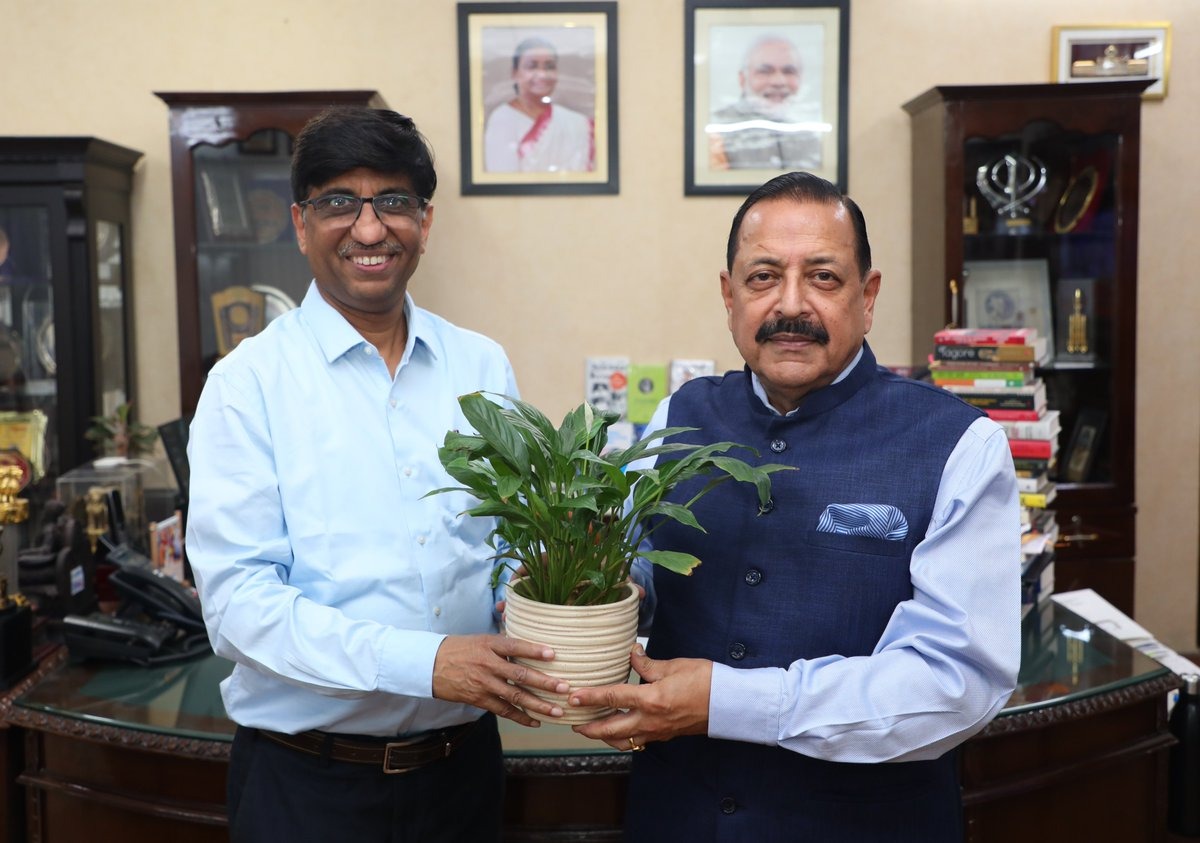
NITI Aayog member Abhay Karandikar warned that recent US export controls blocking foreign access to Anthropic's flagship AI models must serve as a technology wake-up call for India. He urged accelerated development of sovereign AI models and compute hardware to mitigate geopolitical supply risks.
NEW DELHI — In a major policy intervention, NITI Aayog member Prof. Abhay Karandikar has stated that the United States government’s latest export controls on advanced artificial intelligence models must serve as a critical wake-up call for India to rapidly achieve comprehensive self-reliance in technology. The remarks follow a sudden directive by Washington that forced prominent American AI labs to pull their most advanced computing models offline for all foreign nationals.
Addressing technology stakeholders on June 18, 2026, Karandikar emphasized that relying entirely on foreign-based foundational software infrastructure introduces high geopolitical risks for domestic enterprise solutions. The policy think tank member called for a structural pivot toward building sovereign large language models (LLMs) and indigenous cloud hardware capacity to protect India's sprawling digital ecosystem from sudden cross-border regulatory blockades.
Geopolitical Realities of the Anthropic Access Disruption
The policy warning comes immediately after San Francisco-based AI developer Anthropic suspended foreign access to its latest flagship models, Fable 5 and Mythos 5, on June 12, 2026. The firm confirmed it received an emergency export-control directive from the US government issued on strict national security grounds.
The sweeping US mandate applies broadly:
Global Access Shutdown: It completely blocks standard API access for users located outside the United States.
Workforce Restrictions: It bars foreign-national employees, including Indian engineers working inside American tech hubs, from interacting with the underlying code.
This swift enforcement has caused widespread disruption among Indian software exporters and deep-tech startups that utilize these high-tier models to power corporate automation tools. Industry leaders like Zoho co-founder Sridhar Vembu reacted sharply to the development, stating that "globalization is dead" and warning that access to advanced software has become the ultimate weapon in modern trade diplomacy.
Accelerating the IndiaAI Mission Funding Buffers
To counter these supply chain vulnerabilities, NITI Aayog is pushing for a rapid acceleration of the government's flagship IndiaAI Mission. Earlier this fiscal year, the Ministry of Electronics and Information Technology (MeitY) selected a cohort of 12 domestic firms to spearhead the creation of homegrown foundational computing stacks. This initiative is backed by the government's newly operationalized ₹1 Lakh Crore Research, Development, and Innovation Fund, which provides long-term, low-cost capital to deep-tech ventures.
Karandikar, who previously oversaw the operationalization of the national deep-tech fund during his tenure as Secretary of the Department of Science and Technology, noted that India must focus its financial resources on hardware autonomy. While domestic startups excel at building customer-facing software applications, the underlying compute power remains dependent on importing high-end graphics processing units (GPUs), leaving the nation exposed to foreign export management regimes like ITAR.
Official Sources Section
The policy recommendations, economic assessments, and regulatory timelines outlined in this report originate from official statements distributed by the NITI Aayog (National Institution for Transforming India) press office, statutory compliance filings published by the Ministry of Science and Technology, and international trade notifications tracked by the US Bureau of Industry and Security.
Quote Section
"According to officials accompanying the policy formulation teams, the sudden restriction of the Fable 5 models demonstrates that software access can be turned off instantly during a geopolitical friction point. Organizers stated that India must treat sovereign computing capacity with the same level of strategic security as nuclear or space infrastructure, ensuring local developers have unconditional access to open-source foundation platforms."
Why It Matters
For Indian businesses, engineering students, and software developers, this regulatory shift means that relying on a single foreign tech provider is no longer a viable long-term strategy. As trade restrictions tighten around advanced technology transfers, local firms will face stricter compliance audits and potential service cutoffs. Building a robust, homegrown AI ecosystem ensures that Indian digital services can operate independently, safeguarding consumer data privacy and protecting the continuity of corporate enterprises.
Key Facts at a Glance
Policy Alert: NITI Aayog brands US AI export controls as a vital technology wake-up call for India.
US Action: Access to Anthropic's flagship Fable 5 and Mythos 5 models was cut off for all foreign nationals over national security concerns.
Sovereign Push: Indian policy leaders urge immediate investments to expand the domestic GPU computing cluster under the IndiaAI Mission.
Capital Buffer: The government is utilizing its specialized ₹1 Lakh Crore Deep-Tech Fund to finance alternative open-source software architectures.
FAQ Section
What triggered the latest warnings regarding India's technological dependence?
The concerns were reignited after the US government issued an export-control directive forcing AI developer Anthropic to suspend access to its advanced models for all foreign users and international workers.
How is the Government of India responding to these foreign software restrictions?
Through the IndiaAI Mission, the government has selected 12 domestic consortiums to build indigenous foundational models, while using a specialized ₹1 lakh crore fund to back deep-tech startups and independent research teams.
Should Indian enterprises shift toward open-source AI models?
Yes. Technology experts and policy advisors recommend that local organizations explore smaller, cost-effective open-source alternatives that can be hosted locally, reducing the risk of sudden foreign service disruptions.
Source: NITI Aayog Official Leadership Portals, Ministry of Electronics and Information Technology (MeitY) Data Registries, and Press Information Bureau (PIB) Delhi.