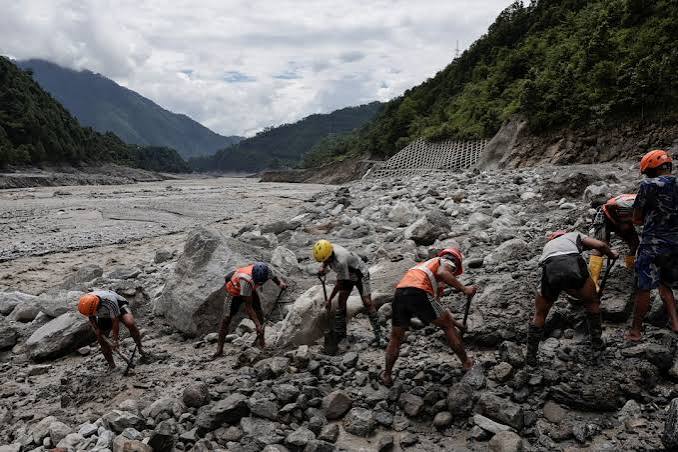
Engineers in a 500-member WhatsApp group are providing critical blueprints and real-time technical guidance to rescue workers scouring blocked hydropower tunnels in Nepal's Trishuli valley. The digital network has become a vital lifeline in the race to locate survivors trapped by millions of tonnes of post-flood debris.
KATHMANDU — An army of experts communicating through a dedicated WhatsApp group is directing rescue operations across Nepal’s Trishuli valley following a devastating flash flood on August 26, 2026.
The messaging network, which expanded to more than 500 members, has emerged as a crucial tactical tool alongside helicopters and heavy machinery. Authorities are racing against time to locate survivors who may have sheltered inside the tunnel networks of six heavily damaged hydropower plants. With the deluge depositing 2.2 million tonnes of mud and debris across the valley, finding and navigating tunnel entrances has presented an extraordinary challenge for ground teams.
Digital Blueprints and Subterranean Rescues
As rescue workers face altered topography and blocked subterranean passages, the WhatsApp group acts as an immediate clearinghouse for technical data. Government officials and military personnel routinely post requests for architectural schematics, receiving layout drawings of powerhouses and access tunnels within minutes.
Nepal Army spokesperson Raja Ram Basnet noted that the disaster severely deformed the structural integrity of the tunnels, making expert engineering insight indispensable. Teams at sites like the Chilime, Rasuwagadhi, and Upper Trishuli projects have utilized these shared schematics to direct heavy excavation equipment, pump oxygen into suspected air pockets, and consult former plant employees regarding internal chamber layouts.
According to official briefings, project updates, and field reports:
Group Membership: Expanded to over 500 engineering and technical experts.
Core Function: Rapid sharing of structural drawings, access tunnel details, and missing personnel tracking information.
Target Sites: Six devastated hydropower facilities across the Trishuli valley.
Operational Hurdles: Over 2.2 million tonnes of accumulated silt and debris blocking primary subterranean entry points.
Official Sources Section
Quote Section
"According to Nepal army spokesperson Raja Ram Basnet, the flood severely altered the terrain around the tunnels and packed debris inside, making real-time technical coordination essential for navigating the compromised structures."
Why It Matters
For emergency responders, crowdsourced engineering telemetry drastically cuts down response times when physical maps are destroyed or rendered obsolete by shifting mudflows. The initiative highlights how consumer messaging platforms can be effectively mobilized for high-stakes disaster relief, potentially saving lives trapped in isolated subterranean pockets.
Key Facts at a Glance
Event Date: Flash floods struck the Trishuli valley on August 26, 2026.
Primary Tool: A 500+ member engineering coordination chat group on WhatsApp.
Search Priority: Subterranean chambers and access tunnels across damaged hydropower stations.
Support Measures: Oxygen pipeline deployment and heavy equipment transport.
FAQ Section
How are engineers using WhatsApp to assist the Nepal flood rescue?
Experts in the group instantly supply layout drawings, structural schematics, and technical advice to military and civilian rescue teams navigating blocked hydropower tunnels.
Why are rescue workers searching inside hydropower tunnels?
Authorities believe several missing workers may have escaped the flash flood by fleeing deeper into internal chambers and access tunnels.
What are the main obstacles faced by rescue teams in the Trishuli valley?
Teams face massive accumulations of mud, rocks, and debris—totaling over 2.2 million tonnes—along with heavily altered terrain that obscures tunnel entrances.
Where can official updates on the rescue operations be monitored?
Periodic operational briefs are issued directly through government channels and the Nepal Army Portal.
Source: Nepal Army Directorate, Nepal Electricity Authority, Reuters Field Reports, The Japan Times