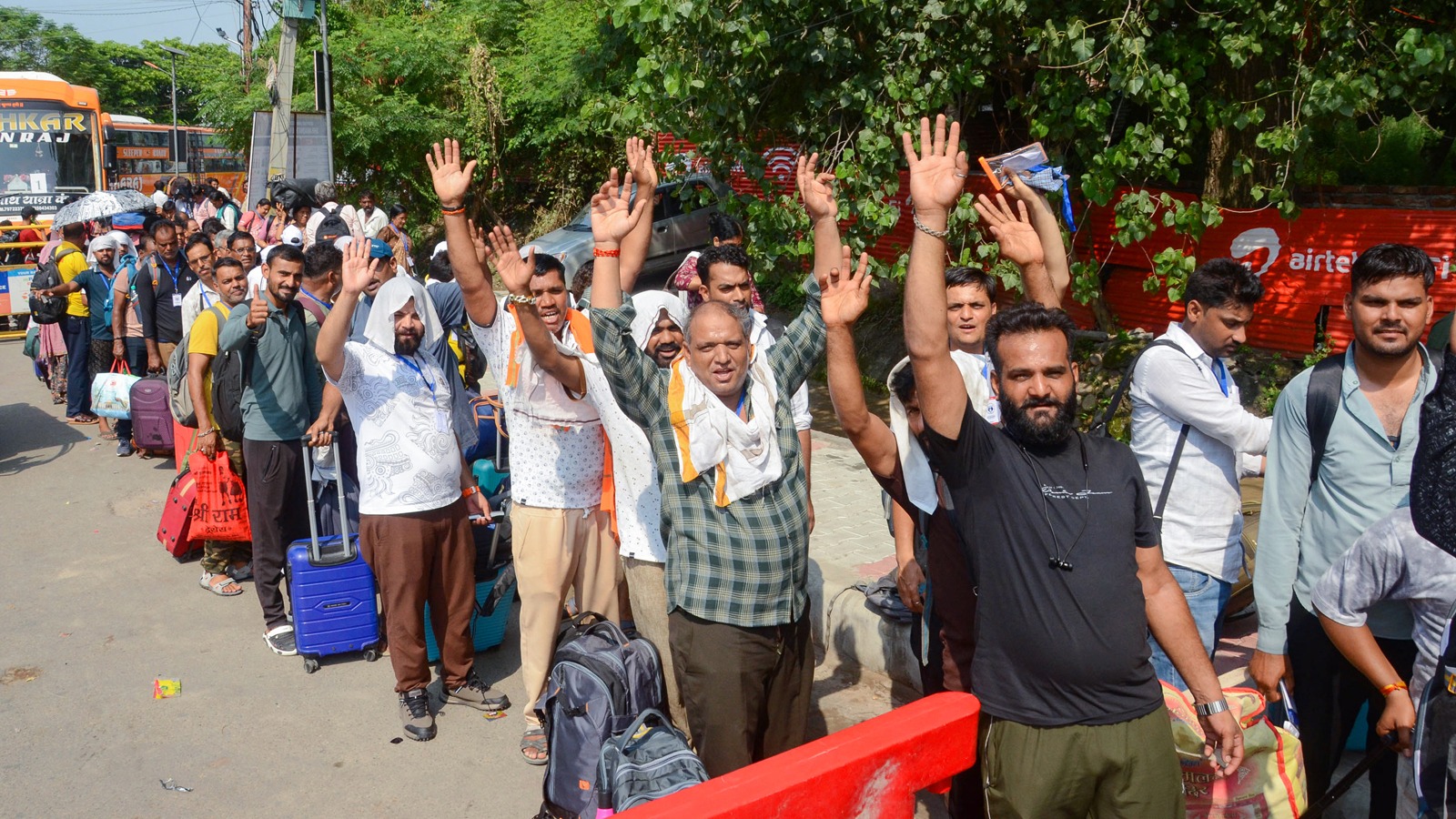
The 10th batch of the Amarnath Yatra saw 9,182 pilgrims depart the Jammu Bhagwati Nagar base camp in the early hours of Saturday. Moving in a 333-vehicle convoy monitored by RFID technology and multi-tier security forces, the group split between the Baltal and Pahalgam routes toward the cave shrine.
JAMMU — The 10th consecutive batch of the ongoing annual Shri Amarnath Ji Yatra-2026 successfully departed the Bhagwati Nagar base camp in the early hours of Saturday, July 11, 2026. Security officials confirmed that 9,182 pilgrims left the winter capital in a heavily escorted vehicular convoy of 333 transport vehicles. This deployment marks a significant operational scaling of the transit security grid along the Jammu-Srinagar National Highway (NH 44), ensuring crowd protection as the overall number of pilgrims exiting the Jammu transit terminal surpasses 70,000 this season.
Split Route Convoys and Demographic Breakdown
According to the Joint Police Control Room located at the Bhagwati Nagar Base Camp, the 10th batch departed in two distinct, time-staggered groups to prevent logistical bottlenecks on the mountain passes. The first group, a Baltal-bound convoy carrying ,305 pilgrims, cleared the main transit gates at 2:43 a.m.. The second group, a larger Nunwan-Pahalgam-bound convoy comprising 5,877 pilgrims, commenced its journey shortly after at 3:31 a.m..
Official data registries shared by the transit camp administration provided a clear demographic overview of the moving batch:
Male Pilgrims: 6,455 individuals
Female Pilgrims: 2,389 individuals
Sadhus & Sadhvis: 256 sadhus and 46 sadhvis
Children & Minor Dependents: 31 children registered under medical criteria
Transgender Devotees: 5 registered pilgrims
Administrative officials formally noted that no foreign national passport holders were registered within this specific 10th batch. The massive fleet utilized by the pilgrims consisted of 196 large passenger buses, 43 medium motor vehicles (MMVs), 91 light motor vehicles (LMVs), and three registered two-wheelers.
Escalated Multi-Tier Security Infrastructure
To secure the extensive transit routes winding through volatile terrain, a multi-tier security web has been operationalized. Personnel from the Jammu and Kashmir Police, the Central Reserve Police Force (CRPF), and allied paramilitary units are executing round-the-clock highway patrolling and electronic surveillance.
Senior sector commanders are personally supervising vulnerable bottleneck positions along the Jammu-Srinagar National Highway. Under guidelines issued by the Shri Amarnathji Shrine Board (SASB), no pilgrimage vehicles are permitted to move along transit corridors without active Radio Frequency Identification (RFID) tracking tags attached to both the vehicles and individual pilgrim credentials.
This security presence operates alongside extensive infrastructure upgrades. The Border Roads Organisation (BRO) has deployed technical teams, including the 122 Road Construction Company (RCC), to continuously maintain the steep tracks leading from the Baltal axis to the holy cave shrine. Their recent interventions have focused on widening walking paths and setting up protective retaining walls to secure devotees from unpredictable rockfalls and early monsoon landslides.
Healthcare Matrices and Transit Accommodations
Recognizing the severe physiological challenges associated with climbing to the 3,880-metre high cave shrine, regional medical Directorates have deployed an aggressive health management framework. The Udhampur and Ramban Health Departments have operationalized stationary first-aid clinics at critical intervals along the highway, spanning from the Tikri Kali Mata Temple to the strategic Chenani-Nashri Tunnel.
These medical stations are equipped with dedicated oxygen concentrators, automated external defibrillators (AEDs), and blood sugar management systems to stabilize acute cases of high-altitude pulmonary edema. Six advanced life-support ambulances are stationed at high-risk points to guarantee rapid evacuation to tertiary care facilities.
Furthermore, civil society groups like the Om Shiv Shakti Sewa Langar Committee have established 24-hour support stations providing dietary provisions alongside the state-managed lodgings at Chanderkote Yatri Niwas.
Official Sources Section
The verified metrics, vehicle tallies, and demographic classifications featured in this report are based on official daily situation reports published by the Joint Police Control Room at Bhagwati Nagar Base Camp, statutory press updates from the Shri Amarnathji Shrine Board (SASB), and highway logistics logs maintained by the Union Ministry of Home Affairs (MHA).
Quote Section
"The Baltal-bound convoy, carrying 3,305 pilgrims, left Jammu at 2:43 a.m., while the Pahalgam-bound convoy, comprising 5,877 pilgrims, departed at 3:31 a.m... taking the total number of pilgrims who have departed from Jammu since the beginning of this year's pilgrimage to 70,794."
— Bhagwati Nagar Joint Police Control Room Official Report
"According to officials, the integration of real-time RFID tracking systems and synchronized time-stamping for all vehicular convoys has significantly mitigated transit congestion, ensuring that security forces can track every single vehicle moving through the highway corridors."
Why It Matters
For local businesses, logistics managers, and travel operators, the smooth progress of the Amarnath Yatra demonstrates the region's robust capacity to handle massive seasonal crowds under complex security conditions. The debut of dedicated rail networks alongside strictly timed road convoys shows a clear transition toward modern, data-driven crowd management. This operational success directly minimizes shipping delays for commercial freight along NH 44 while boosting the regional hospitality and tourism economy.
Key Facts at a Glance
Batch Volume: A total of 9,182 registered pilgrims departed Jammu in the 10th batch on Saturday.
Route Split: 5,877 pilgrims chose the traditional Pahalgam axis, while 3,305 preferred the shorter Baltal route.
Cumulative Milestone: Over 70,700 pilgrims have successfully transitioned from the Jammu base camp since the July 3 launch.
Safety Mandate: All moving assets are strictly monitored via active RFID systems and multi-tier armed escorts.
FAQ Section
What are the two primary travel routes used for the Amarnath Yatra?
Pilgrims use either the Nunwan-Pahalgam axis in Anantnag, which is a longer, traditional route taking 4 to 5 days, or the Baltal axis in Ganderbal, a steeper path that can be completed in 1 to 2 days.
What safety prerequisites must a pilgrim fulfill before leaving Jammu?
Every yatri must possess a valid Compulsory Health Certificate (CHC) issued by an authorized medical officer and must secure an official RFID card from designated state counters before starting the trek.
How long does the annual pilgrimage last this year?
The 2026 pilgrimage is a 57-day annual event that commenced officially on July 3 and is scheduled to conclude on August 28, coinciding with the festival of Raksha Bandhan.
Source: Shri Amarnathji Shrine Board (SASB) Official Portal, Jammu and Kashmir Police Media Directorate, Border Roads Organisation (BRO) Operational Logs.