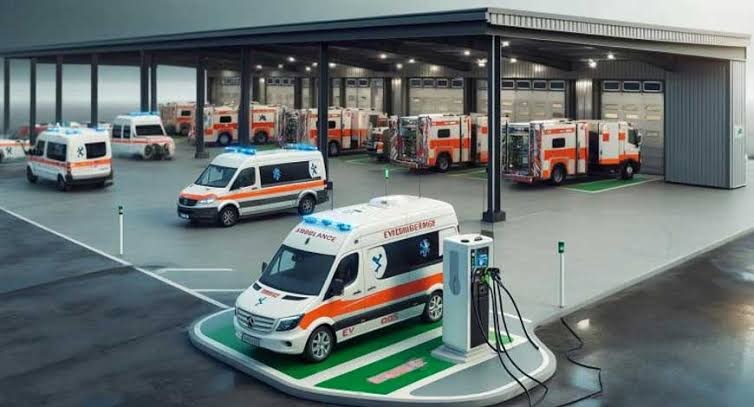
The Ministry of Heavy Industries has launched a ₹500 crore e-ambulance incentive under the PM E-DRIVE scheme, slashing purchase costs by up to 35% or an average of ₹13 lakh per vehicle. The program will support 3,800 electric ambulances, with market leader Force Motors expected to benefit most.
NEW DELHI — The Ministry of Heavy Industries (MHI) has formally notified the operational framework for its dedicated electric ambulance program under the comprehensive PM E-DRIVE scheme. Backed by a targeted public corpus of ₹500 crore, the newly released guidelines will subsidize the purchase of an estimated 3,800 zero-emission emergency vehicles over the next two fiscal periods. By lowering upfront procurement costs by an average of ₹13 lakh per unit, the sub-scheme repositions commercial utility manufacturers, with Pune-headquartered medical transport giant Force Motors positioned as the primary commercial beneficiary of this national fleet modernization drive.
Technical Payout Matrix and Financial Injections
The statutory framework issued by the central administration changes the baseline pricing structures for specialized medical fleet operators. According to the gazette notification released by the Ministry, the central government will directly backstop up to 35% of the ex-factory vehicle cost, capped explicitly at a demand incentive rate of ₹30,000 per kilowatt-hour (kWh) of onboard battery capacity.
The fiscal allocation is distributed evenly across three separate ambulance specifications defined under Central Motor Vehicles Rules (CMVR):
Patient Transport Vehicles (Type B): Intended for non-emergency patient movement.
Basic Life Support Vehicles (Type C): Configured for standard localized emergency response.
Advanced Life Support Vehicles (Type D): Outfitted with intensive critical care systems and high-capacity electrical architectures.
Dividing the gross ₹500 crore funding pool across the targeted 3,811 eligible vehicles creates an implied state support benchmark of approximately ₹13 lakh per ambulance. This substantial intervention targets the traditional premium pricing associated with commercial electric vehicle (EV) chassis, closing the historical price gap that has kept government healthcare boards dependent on traditional diesel platforms.
Force Motors Set to Lead Market Capture
Equity research desks and automotive sector analysts point to Force Motors as the manufacturer best suited to capture a dominant share of this subsidized pipeline. The company currently commands a dominant share of greater than 70% of India's conventional internal combustion engine (ICE) ambulance market through its ubiquitous Traveller and Trax utility product lines, which form the spine of state-level 108 emergency operations.
While automotive peers such as Maruti Suzuki, Mahindra & Mahindra, and Switch Mobility have formally expressed corporate interest in developing e-ambulances, Force Motors' existing relationships with regional directorates of health give the firm a distinct edge. The shift to a localized electric Traveller chassis will allow the engineering major to offer immediate, plug-and-play cabin conversions for Type B, C, and D variants, bypassing the long chassis-validation timelines that alternative competitors must navigate.
Strict Localization and Performance Thresholds
To safeguard public fund allocation and promote domestic industrial development, the MHI has linked all financial disbursements to strict technological and manufacturing parameters:
| Operational Test Parameter | Mandatory Statutory Threshold | Core Engineering Objective |
| Minimum Driving Range | 140 Kilometers (km) Per Charge | Guarantees multi-trip urban turnaround reliability |
| Minimum Top Speed | 70 Kilometers Per Hour (kmph) | Secures rapid transit capabilities during emergency runs |
| Comprehensive Warranty | 5 Years or 1,25,000 km Mileage | Protects public assets against early battery degradation |
| Phased Manufacturing (PMP) | Domestic Value Addition (DVA) thresholds | Forces local sourcing of motors, controllers, and cells |
The Phased Manufacturing Programme (PMP) rules dictate that import privileges for basic EV components will be systematically phased out between September 2026 and March 2027. Consequently, automotive brands must source critical sub-assemblies including battery packs, battery management systems (BMS), and traction motors from domestic vendors to remain eligible for the ₹13 lakh consumer pass-through window.
Official Sources Section
The corporate transaction incentives, technical specifications, and budgetary outlays reviewed inside this market dispatch are derived from statutory gazette notifications distributed by the Ministry of Heavy Industries (MHI) under the PM E-DRIVE Portal. Commercial fleet statistics and alignment data are cross-referenced against public transport registers maintained by the Ministry of Health and Family Welfare and media tracking updates from the Press Information Bureau (PIB).
Quote Section
"According to officials from the Ministry of Heavy Industries' clean mobility desk, the carving out of a ring-fenced ₹500 crore pool for e-ambulances aims to eliminate emissions directly within our public health infrastructure. Administrators stated that while commercial operators are sensitive to upfront equipment costs, the substantial ₹13 lakh demand incentive will allow state medical corporations to achieve total cost of ownership (TCO) parity with diesel equivalents within the first two years of regional deployment."
Why It Matters
Decarbonizing public emergency transport is a vital step in India's broader transition to green energy, as these vehicles run almost continuously and idle frequently outside medical centers. While previous incentive structures focused primarily on consumer two-wheelers and public transit buses, expanding funding to specialized emergency fleets solves a critical logistics challenge. By absorbing a large portion of the initial battery expense through direct subsidies, the government allows municipal hospitals to cut long-term fuel costs while building a cleaner, quieter urban healthcare infrastructure.
Key Facts at a Glance
Substantial Price Drop: The PM E-DRIVE e-ambulance sub-scheme provides a direct subsidy of up to 35% of a vehicle's ex-factory cost.
Targeted Funding Pool: A dedicated ₹500 crore corpus has been officially locked in to support the rollout of roughly 3,800 electric ambulances.
Market Frontrunner: Force Motors is positioned as the primary corporate winner due to its existing 70% share in India's standard medical transport market.
Operational Requirements: Vehicles must deliver a minimum range of 140 km, a top speed of 70 kmph, and feature a full 5-year battery warranty.
FAQ Section
Who can directly apply to receive the ₹13 lakh e-ambulance subsidy?
The financial incentives are available to central and state government health departments, public sector undertakings (PSUs), autonomous municipal hospitals, and eligible public healthcare entities.
Can these incentives be combined with other government health grants?
Yes. The Ministry of Heavy Industries has confirmed that this demand incentive can be legally combined with capital assistance available under the National Health Mission (NHM) program.
Does an MHI certification automatically clear a vehicle for emergency medical runs?
No. While a vehicle might qualify for the financial subsidy, manufacturers must still secure separate technical and equipment approvals from the Ministry of Health and Family Welfare to verify medical compliance.
Source: Statutory gazette circulars, program guidelines, and industrial registration updates published by the Ministry of Heavy Industries, the Ministry of Health, and Force Motors Corporate Relations.