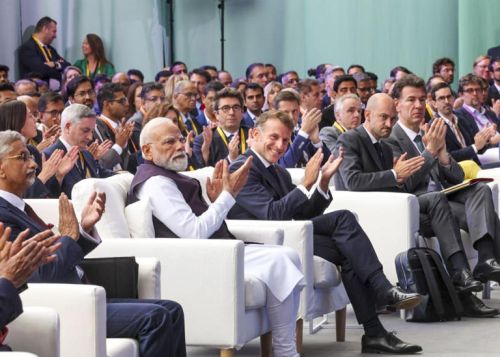
Prime Minister Narendra Modi and French President Emmanuel Macron jointly launched the Bharat Innovates 2026 summit on June 14, 2026, in Nice, France. During his keynote speech, PM Modi urged global developers to prioritize human-centric technologies, emphasizing that true innovation must deliver equitable societal impact and sustainable global public welfare.
NICE — Highlighting a profound paradigm shift in global engineering priorities, Indian Prime Minister Narendra Modi declared on Sunday, June 14, 2026, that international partners are moving away from purely profit-driven metrics toward trusted, inclusive, human-centric technologies. Speaking alongside French President Emmanuel Macron at the inauguration of the high-profile "Bharat Innovates 2026" summit, Prime Minister Modi emphasized that contemporary advancements must prioritize collective societal welfare and global equity. The bilateral assembly marks a definitive evolution in Indo-French strategic ties, signaling New Delhi's transition from an passive consumer of foreign systems into an influential exporter of frontier deep-tech platforms.
From Adopters to Providers: The Deep-Tech Pivot
The three-day technology forum at the Palais des Expositions in Nice serves as the centerpiece of the ongoing India-France Year of Innovation. The summit provides a massive launchpad for 120 of India’s most promising deep-tech startups and more than 20 distinct academic Institutes of Excellence, showcasing local progress in artificial intelligence (AI), quantum computing, biotechnology, space systems, and advanced materials.
During his opening keynote speech, Prime Minister Modi outlined the expanding scale of India’s entrepreneurial ecosystem, which now spans more than 200,000 active startups to rank as the third-largest startup incubator network globally. The Prime Minister underscored how India's public policy has successfully combined digital modernization with broad financial inclusion, utilizing foundational concepts like Digital Public Infrastructure (DPI) to address real-world challenges across rural areas.
Redefining Innovation Through Human Impact
A core theme of the address was a direct critique of conventional tech sector evaluations. Prime Minister Modi challenged the elite investment community to broaden their parameters when evaluating emerging platforms, arguing that true valuation should match a system's capacity to upgrade human lives.
This people-first framework forms the cornerstone of India's current digital outreach, known across international networks as "Technology for Humanity." The governance plan aims to utilize intelligent automation to narrow socioeconomic disparities rather than reinforce them. By emphasizing the integration of regional Indian languages into AI-driven educational software and introducing automated healthcare diagnostics inside underfunded primary health clinics, India aims to provide a proven template for balanced development across the Global South.
Deepening Strategic Indo-French Ties
The collaborative summit also generated concrete policy alignment between New Delhi and Paris. French President Emmanuel Macron offered clear praise for the baseline stability and continued policy predictability of the Indian administration, following Prime Minister Modi's recent milestone achievement as one of India's longest-serving prime ministers since independence.
President Macron reaffirmed France's commitment to bilateral manufacturing partnerships, particularly within the framework of the "Make in India" program. Beyond current investments in defense aviation and aerospace, both leaders explored expanded technological horizons, including joint research initiatives for Small Modular Reactors (SMRs) in civil nuclear energy and shared development protocols for green hydrogen, semiconductor manufacturing, and electric mobility.
Pillars of India's Human-Centric Technology Vision
The strategic framework driving India's domestic and international tech policies targets major structural developments across several key sectors:
| Sector Focus | Primary Technology Applied | Targeted Human Impact |
| Public Health | AI Diagnostic Models | Early detection of tuberculosis and retinopathy at rural clinics. |
| Grassroots Agriculture | Weather Intelligence & Analytics | Real-time crop advisory and localized data access for rural farmers. |
| Education | Multilingual Learning Platforms | Custom academic support for students in regional languages. |
| Clean Infrastructure | Green Hydrogen & EV Batteries | Providing sustainable, low-carbon transportation frameworks. |
Official Sources Section
The official data, institutional numbers, and policy declarations included in this report are sourced from verified statements issued by the following authorities:
Prime Minister's Office (PMO), India: Official speech transcripts and executive briefing notes issued in Nice, France.
Ministry of External Affairs (MEA), India: Diplomatic press communiqués detailing the strategic scope of Bharat Innovates 2026.
Press Information Bureau (PIB), New Delhi: Media releases outlining the 13 critical technology pillars of Indo-French collaboration.
The Élysée Palace, Paris: Executive comments and bilateral statements from French President Emmanuel Macron.
Official Statements and Quotes
"Today, the world is looking towards technologies that are trusted, inclusive, human-centric, and aimed at the global good. In such times, India's priority is technology for humanity, human-centric innovation. India has demonstrated that innovation and inclusion are not contradictory but complementary. This means that the greatness of any innovation lies not merely in its valuation, but in its human impact."
— Narendra Modi, Prime Minister of India
"France respects the Make in India initiative, and Paris has been a proud partner across diverse sectors. The real question today is no longer whether India is innovating, but who will choose to innovate alongside India. We share a true partnership in critical fields like artificial intelligence and climate change."
— Emmanuel Macron, President of France
Why It Matters
The joint launch of human-centric technologies sets a crucial international standard for tech governance at a time when global regulators are grappling with the ethical risks of unguided AI and data privacy vulnerabilities. For global tech investors, the summit opens direct investment access to India's regulated deep-tech pipeline. For everyday consumers and businesses, this partnership speeds up the transition toward sustainable energy alternatives and secure, localized digital products designed for public welfare rather than unchecked commercial data extraction.
Key Facts at a Glance
Global Shift Initiated: PM Modi called for global adoption of "human-centric technologies" focused on human impact rather than corporate market valuation.
Summit Milestone: The inaugural Bharat Innovates 2026 event in Nice, France, showcased 120 leading Indian deep-tech startups to over 350 global venture capitalists.
Ecosystem Scale: India's startup ecosystem has grown to encompass more than 200,000 active enterprises, making it the third-largest in the world.
Bilateral Expansion: France and India established new joint development pipelines covering artificial intelligence, quantum computing, biotechnology, and Small Modular Reactors.
Inclusive Mandate: The administrative goal emphasizes utilizing advanced digital tools to dissolve urban-rural divides through targeted public health and education programs.
Frequently Asked Questions (FAQ)
What exactly does "human-centric technology" mean in this context?
As outlined by Prime Minister Modi, human-centric technology refers to digital tools and innovations engineered primarily to address human welfare, bridge social divides, and solve real-world problems—such as expanding healthcare and education access—rather than prioritizing corporate valuations and market monetization.
What is the primary purpose of the Bharat Innovates 2026 event in France?
The three-day summit in Nice serves as an international platform to connect Indian deep-tech innovators, researchers, and startups with European venture capitalist funds, fostering joint research, co-development, and cross-border manufacturing agreements.
How is India utilizing artificial intelligence to support its rural populations?
India is integrating targeted AI software to analyze soil health and weather patterns for small-scale farmers, providing real-time dairy production guidance via localized cooperative frameworks like Amul, and deploying automated diagnostic tools to catch early signs of chronic diseases at rural primary health centers.
Source: Official archival transcripts, event program registries, and press releases hosted by the Ministry of External Affairs, India and the Press Information Bureau (PIB).