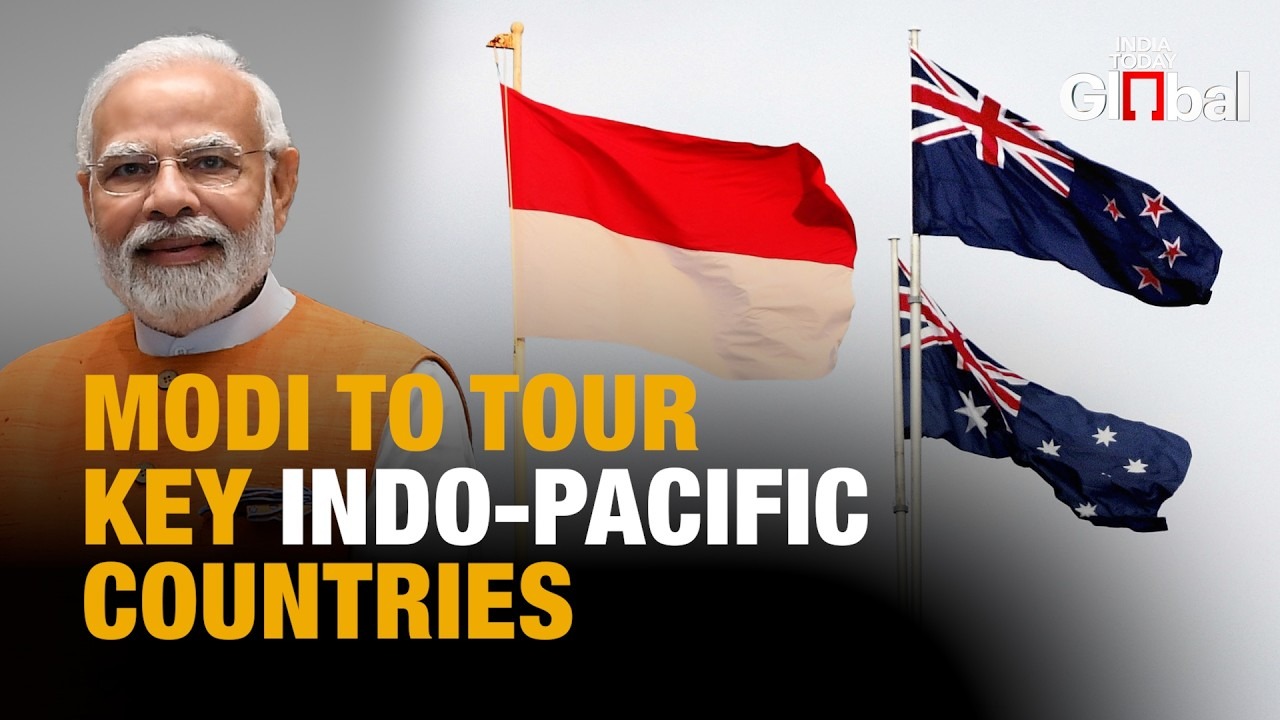
Prime Minister Narendra Modi has commenced a critical six-day tour of Indonesia, Australia, and New Zealand starting July 6, 2026. The trip addresses Indo-Pacific maritime security, secures essential lithium supplies for domestic technology sectors, and capitalizes on a historic free trade agreement with New Zealand.
NEW DELHI — Prime Minister Narendra Modi officially embarked today, July 6, 2026, on an intensive six-day, three-nation diplomatic tour spanning Indonesia, Australia, and New Zealand. The strategic mission seeks to significantly expand India's "Act East" policy and anchor its economic and security footprint across the Indo-Pacific region amid tightening global supply chains and rising geopolitical competition.
The tour begins with a high-profile bilateral meeting in Jakarta, shifts to an annual leadership summit in Melbourne, and concludes with a historic state visit to Auckland—marking the first time an Indian Prime Minister has officially visited New Zealand in four decades.
Act East: Security Along the Critical Malacca Strait
The first leg of Prime Minister Modi's itinerary runs from July 6 to July 8 in Indonesia. Arriving at the invitation of President Prabowo Subianto, this marks Modi's first bilateral visit to Jakarta since the formal elevation of ties to a Comprehensive Strategic Partnership.
According to updates from the Ministry of External Affairs (MEA), the primary agenda revolves around strengthening defense channels and fortifying maritime security frameworks.
Ministry briefers underscored that Indonesia remains a vital stabilizing anchor across the Malacca Strait. This maritime zone handles the majority of India's commercial sea lanes of communication, making joint anti-piracy, coastal defense, and naval deterrence strategies a matter of national economic survival.
Beyond defense, the Prime Minister will travel to Yogyakarta to visit the UNESCO World Heritage-listed Prambanan Temple complex, where India and Indonesia are launching a joint cultural conservation initiative.
Securing Critical Minerals for India's Semiconductor Ambitions
From July 8 to July 10, the Prime Minister will be positioned in Melbourne, Australia, for the third India-Australia Annual Summit alongside Prime Minister Anthony Albanese.
While security remains a foundational pillar, the operational focus of the Australian stop centers squarely on industrial supply chain resilience and emerging technologies.
| Country Focus | Key Strategic Objective | Core Sectors Involved |
| Indonesia | Maritime Security & Defense | Malacca Strait Patrols, Coastal Defense |
| Australia | Resource Security & Tech | Lithium/Cobalt Supply, Semiconductor Assets |
| New Zealand | Free Trade Execution | Market Access Tariffs, 95% Duty Eliminations |
Indian manufacturing conglomerates are aggressively moving to secure long-term bilateral access to Australia's vast critical mineral reserves, notably lithium and cobalt. These raw materials are vital to fueling India's domestic semiconductor missions and local electric vehicle (EV) ecosystems.
Modi is also scheduled to address the India-Australia CEOs Forum to pitch direct foreign investment into India's high-tech manufacturing corridors.
Implementing a Landmark Free Trade Pact in New Zealand
The final leg of the tour, from July 10 to July 11, brings Prime Minister Modi to Auckland, New Zealand. The state visit is historically significant as the first by an Indian premier in forty years, arriving on the heels of the recently enacted New Zealand-India Free Trade Agreement (FTA).
The newly integrated trade treaty removes 95% of tariffs on New Zealand exports while guaranteeing reciprocal, duty-free market access for Indian agricultural, textile, and engineering goods.
Furthermore, New Zealand Prime Minister Christopher Luxon previously announced that the economic framework brings a committed $20 billion investment pipeline from Wellington into Indian infrastructure and technological developments, signaling massive institutional confidence.
Official Sources Section
The baseline agendas, schedules, and ministerial objectives outlined for this three-nation diplomatic tour are based directly on formal press briefings conducted by Rudrendra Tandon, Secretary (East) in the Ministry of External Affairs (MEA), India, alongside statements published by the Office of the Prime Minister of India and official communications from the Government of New Zealand.
Quote Section
Briefing the press corps in New Delhi regarding the overarching motivations behind the six-day deployment, Secretary (East) Rudrendra Tandon stated:
"This is a very important maritime zone for India, as it represents one of the country's most important sea lanes of communication. It is significant not only for India as an Indian Ocean nation but probably for the global economy as well. The conversations will cover emerging areas of the bilateral relations, in particular critical minerals, the cybersecurity domain, supply chain resilience, and emerging technologies."
Why It Matters
For everyday citizens and businesses, the expansion of these international corridors directly translates to greater domestic supply stability. Securing direct access to critical minerals protects tech manufacturing against sudden price shocks, ensuring localized electronics and vehicles remain affordable.
Concurrently, the elimination of cross-border tariffs under the New Zealand FTA opens vast new operational horizons for Indian exporters and creates job opportunities within specialized manufacturing hubs.
Key Facts at a Glance
Tour Timeline: A six-day, three-nation diplomatic tour spanning July 6 to July 11, 2026.
Indonesian Priority: Focused on defense integration and stabilizing critical sea lanes around the Malacca Strait.
Australian Summit: Targeting guaranteed pipelines for lithium, cobalt, and key industrial tech.
Historic Milestone: Represents the first official state visit by an Indian Prime Minister to New Zealand in 40 years.
Trade Integration: Activating free trade terms, which include a $20 billion long-term investment commitment from Wellington.
FAQ Section
Why is the stop in Indonesia considered crucial for India's maritime security?
Indonesia controls the primary boundaries of the Malacca Strait, a vital shipping choke point. Steady bilateral relations ensure that India's key commercial sea lanes remain stable, predictable, and protected against regional disruption.
What are "critical minerals," and why is Prime Minister Modi discussing them in Australia?
Critical minerals like lithium and cobalt are essential components needed to manufacture advanced microchips, batteries, and electric vehicles. Securing direct contracts with Australian mines ensures Indian tech firms have an uninterrupted supply of raw materials.
What will the Free Trade Agreement with New Zealand change for Indian markets?
The treaty eliminates 95% of existing tariffs, giving Indian exports duty-free entry into New Zealand markets while paving the way for $20 billion in direct, incoming Pacific capital investments.
Source: Ministry of External Affairs India Media Center, Prime Minister of India Official Updates, Beehive New Zealand Government Official Tool.