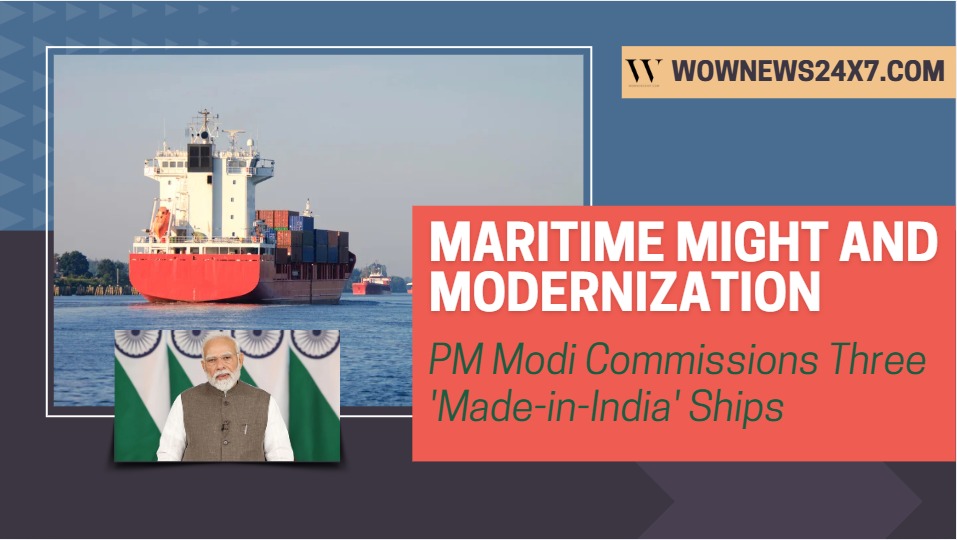
Prime Minister Narendra Modi commissioned three indigenously built naval ships in Kolkata, emphasizing that maritime strength is vital for safeguarding national peace and global prosperity. The event, occurring alongside International Day of Yoga celebrations, showcased India's commitment to defense self-reliance, with 45 additional large naval platforms currently under construction.
Prime Minister Narendra Modi underscored the strategic importance of India’s maritime strength during his visit to Kolkata on Sunday, June 21, 2026. While commissioning three indigenously built naval vessels—INS Dunagiri, INS Sanshodhak, and INS Agray—at the Syama Prasad Mookerjee Port, the Prime Minister highlighted that while India has always viewed the ocean as a medium of international cooperation, the nation remains acutely aware that military strength is essential to safeguard peace.
Strengthening India’s Naval Arsenal
The tri-commissioning ceremony marks a significant milestone in India’s ongoing pursuit of self-reliance in the defense sector. The three vessels were designed by the Indian Navy’s Warship Design Bureau and constructed in Kolkata by Garden Reach Shipbuilders & Engineers (GRSE). According to official data, the construction of these platforms saw extensive participation from the domestic industry, including over 200 Micro, Small, and Medium Enterprises (MSMEs).
Addressing the gathering, the Prime Minister stated that "security is necessary for prosperity and self-reliance is needed for building the future." He further noted that the Indian Navy has integrated nearly 40 "Made-in-India" warships and submarines in recent years, with an additional 45 large naval platforms currently under various stages of construction across the country.
Connecting Yoga, Wellness, and National Security
The Prime Minister’s visit to West Bengal coincided with the 12th International Day of Yoga. Earlier on Sunday, PM Modi led the national observance of Yoga Day at Kolkata’s historic Red Road, where thousands gathered under the theme “Yoga for Healthy Ageing.”
The dual focus on wellness and defense modernization served to highlight the government’s broader vision of a "Viksit Bharat" (Developed India). The Prime Minister noted that the land of West Bengal has historically accelerated India’s intellectual renaissance and remains a vital link for India’s global maritime connectivity.
Why It Matters
For India, the commissioning of these vessels is a strategic response to evolving geopolitical threats in the Indo-Pacific region. By enhancing maritime domain awareness and bolstering coastal security, India aims to protect its vital sea lanes—which facilitate the majority of the world’s trade—and ensure the safety of seafarers. The expansion of naval assets also signals India’s intent to play a more proactive role as a regional net security provider.
Key Facts at a Glance
Tri-Commissioning: INS Dunagiri (stealth frigate), INS Sanshodhak (survey vessel), and INS Agray (anti-submarine warfare craft) joined the Indian Navy.
Indigenous Production: All three ships were designed by the Navy's Warship Design Bureau and built by GRSE, Kolkata.
Naval Growth: Approximately 40 indigenous naval platforms have been inducted recently, with 45 more under construction.
Strategic Focus: The PM emphasized that maritime strength is a prerequisite for a nation to become a "great power."
FAQ
What is the significance of the three ships commissioned in Kolkata?
INS Dunagiri, INS Sanshodhak, and INS Agray represent a boost to India’s operational capabilities in stealth, hydrographic surveying, and anti-submarine warfare, respectively.
Why did the Prime Minister link maritime strength to peace?
PM Modi articulated that while India advocates for peaceful cooperation at sea, the ability to protect sovereign interests and trade routes through a strong navy is a necessary deterrent to ensure long-term stability.
What was the theme of the International Day of Yoga event in Kolkata?
The 12th International Day of Yoga was celebrated under the theme "Yoga for Healthy Ageing," focusing on physical and mental well-being for an aging global population.
Source: Prime Minister of India (PMO), ANI News, The Times of India