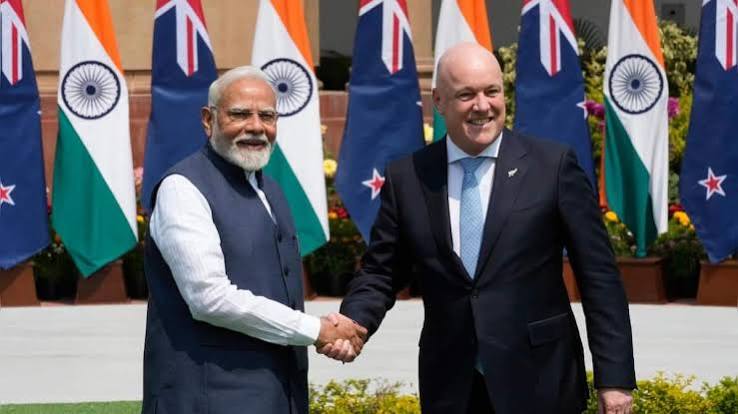
Prime Minister Narendra Modi concluded his historic 40-year-first visit to New Zealand by announcing a new Strategic Partnership with PM Christopher Luxon. This framework builds on the recently signed India-New Zealand FTA, aiming to deepen cooperation in defense, technology, and connectivity while bolstering bilateral trade and economic resilience.
AUCKLAND — Prime Minister Narendra Modi wrapped up his landmark state visit to New Zealand on Saturday, describing the deepening relationship between New Delhi and Wellington as a “historic milestone.” The two-day visit, the first by an Indian Prime Minister in 40 years, was centered on accelerating the implementation of the India-New Zealand Free Trade Agreement (FTA) and formalizing a new Strategic Partnership.
During delegation-level talks in Auckland, PM Modi and New Zealand Prime Minister Christopher Luxon announced that the new Strategic Partnership would serve as a comprehensive framework for expanding cooperation beyond trade. The partnership is set to deepen ties across critical sectors, including defense, technology, maritime security, and people-to-people exchanges.
A New Chapter in Bilateral Relations
The Strategic Partnership follows the successful signing of the India-New Zealand FTA in April 2026. PM Modi credited PM Luxon’s leadership for the swift conclusion of the trade pact, which eliminates tariffs on 100% of Indian exports to New Zealand and significantly reduces duties on 95% of New Zealand’s exports to India.
“Today, we are binding our relationship together through a Strategic Partnership,” PM Modi stated during the delegation talks. “This milestone will inspire us to move forward with greater energy and confidence.”
For his part, PM Luxon emphasized that the focus of the relationship has moved past the initial trade negotiations. “It’s about where we go next in this relationship and how we broaden that out,” Luxon said. “We are very proud to announce that we will be forming a strategic partnership which will give the relationship more framework and breadth for us to continue to expand.”
Economic and Logistical Integration
The visit highlighted significant progress in infrastructure and connectivity, which are viewed as essential pillars of the FTA. New Zealand’s Minister for Trade and Investment, Todd McClay, confirmed plans to expand shipping routes and aviation connectivity between the two nations. Air New Zealand is slated to open three offices in India, while collaborations between Air India and Air New Zealand are currently under regulatory review to streamline passenger travel.
The economic implications are significant: bilateral trade has already seen a sharp increase, growing from $900 million in 2019-20 to $1.3 billion in 2024-25. The new trade framework is expected to catalyze this growth further by providing business certainty amidst global geopolitical uncertainties.
Official Sources
Ministry of External Affairs (MEA): Confirmed the visit was aimed at unlocking cooperation in trade, defense, sports, culture, and education.
Prime Minister’s Office (PMO): Released official statements highlighting the FTA as a landmark moment that benefits farmers, youth, MSMEs, and startups.
New Zealand Government: Prime Minister Christopher Luxon’s office emphasized the role of the FTA in boosting job creation and exports.
Why It Matters
For businesses and investors, the Strategic Partnership provides a more stable regulatory and diplomatic environment, reducing risks associated with cross-border commerce. By aligning their economic goals, both nations are strengthening their positions in the Indo-Pacific region. For citizens, the focus on improved air connectivity and cultural exchange promises easier travel and enhanced social ties between the two vibrant democracies.
Key Facts at a Glance
Historic Visit: First Indian PM visit to New Zealand in 40 years.
FTA Impact: 100% duty-free access for Indian exports; 95% tariff reduction for New Zealand exports to India.
Strategic Scope: Broadened to include defense, maritime security, technology, and supply chain resilience.
Connectivity: Plans for new aviation offices and increased shipping frequency to support trade.
Bilateral Growth: Trade volume grew from $900 million (2019-20) to $1.3 billion (2024-25).
FAQ
What is the significance of the new Strategic Partnership?
It provides a broad framework to expand bilateral cooperation beyond trade into areas like defense, technology, and maritime security.
How does the FTA benefit New Zealand businesses?
The agreement allows 57% of New Zealand’s exports to enter India tariff-free from day one, providing access to a market of 1.4 billion consumers.
Are there improvements in travel between the two nations?
Yes, Air New Zealand is planning to open three offices in India, and regulators are reviewing potential flight operation cooperation between Air India and Air New Zealand.
What was the focus of PM Modi’s visit?
The visit focused on strengthening the India-New Zealand friendship, trade, defense, sports, culture, and diaspora engagement.
Source: MEA, PMO India, ANI News, The Hindu