Prime Minister Narendra Modi’s meeting with President Droupadi Murmu has triggered strong expectations of an imminent Union Cabinet reshuffle. Following the resignation of Minister George Kurian and key party organizational changes, the upcoming adjustments aim to address ministerial vacancies and realign regional representation ahead of crucial state assembly polls.
PM Modi Meets President Murmu Amid Union Cabinet Reshuffle Buzz
National capital registers intense political activity as executive vacancies and upcoming state assembly polls trigger institutional adjustments.
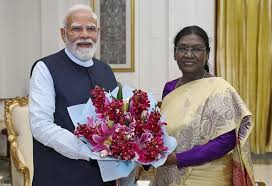
NEW DELHI, India — Prime Minister Narendra Modi called on President Droupadi Murmu at Rashtrapati Bhavan, initiating a high-level executive dialogue that has intensified domestic speculation regarding an imminent Union Cabinet reshuffle. The official meeting, which took place following a civil investiture ceremony to confer the Padma awards, comes at a critical juncture marked by the structural resignation of a Union Minister, the conclusion of key parliamentary tenures, and strategic organizational appointments made by the ruling Bharatiya Janata Party (BJP).
The interaction between the heads of government and state underscores a pending realignment within the Union Council of Ministers, as the administration balances administrative governance with shifting electoral priorities across multiple states. With the Union Cabinet scheduled to assemble for a formal session on June 24 at 11:00 AM, political analysts and legislative officials view the Rashtrapati Bhavan dialogue as the preliminary procedural groundwork required for adjusting ministerial portfolios under Article 75 of the Indian Constitution.
Executive Vacancies and Legislative Adjustments
The immediate catalyst for the intensifying Cabinet reshuffle momentum is a series of structural vacancies within the Council of Ministers. A Presidential communique issued by Rashtrapati Bhavan confirmed that President Droupadi Murmu formally accepted the resignation of Union Minister of State George Kurian. Kurian, a senior leader from Kerala who managed portfolios within the Ministry of Minority Affairs alongside Fisheries, Animal Husbandry, and Dairying, stepped down following the official expiration of his Rajya Sabha term.
Simultaneously, the upper house parliamentary tenure of Ravneet Singh, the Union Minister of State for Railways and Food Processing Industries, expired. Under prevailing Indian jurisprudence, a non-member can retain a ministerial portfolio for a maximum statutory window of six consecutive months, requiring a definitive parliamentary path before December to sustain their executive position.
The architectural composition of the reshuffle is further influenced by the BJP's institutional adherence to its "one man, one post" operational convention. Several sitting Union Ministers have recently been assigned commanding roles within state party units:
Harsh Malhotra: The Union Minister of State for Road Transport and Highways, and Corporate Affairs, was designated as the chief of the BJP's Delhi unit.
Pankaj Chaudhary: The Union Minister of State for Finance, was appointed to lead the party's organizational unit in Uttar Pradesh.
These organizational structural shifts are expected to lead to the formal relinquishment of their ministerial duties, expanding the pool of portfolios requiring fresh administrative allocation.
Shifting Coalitions and Regional Dynamics
Beyond internal party dynamics, the anticipated cabinet reconfiguration is expected to integrate a series of high-profile political defectors who have recently joined the National Democratic Alliance (NDA) coalition. Legislative shifts over the past quarter have expanded the ruling alliance's parliamentary pool, creating new compulsions for executive representation.
According to tracked parliamentary filings, a notable faction of seven Rajya Sabha members from the Aam Aadmi Party (AAP)—including prominent legislator Raghav Chadha—completed a transition to support the Treasury benches. This shift is accompanied by a breakaway group of Trinamool Congress (TMC) lawmakers who declared an alliance with the NDA via the Nationalist Citizens Party of India (NCPI), alongside dissident lawmakers originating from Uddhav Thackeray's Shiv Sena (UBT) faction who aligned with Chief Minister Eknath Shinde's camp.
The impending ministerial appointments are heavily localized around geographical arithmetic. The inclusion of new representation from Punjab is viewed as a calculated effort to fortify the administration's policy footprint in the agricultural state, where competitive assembly elections are approaching. Similarly, adjustments in the representation of Uttar Pradesh reflect a recalibration of local policy execution ahead of the state's next legislative assembly poll cycle.
Official Sources Section
The details surrounding executive resignations, institutional meetings, and official portfolios have been verified via formal press communiques distributed by the President of India Secretariat and records maintained by the Cabinet Secretariat of India. Parliamentary tenure data and political party appointments were sourced from statutory declarations compiled by the Rajya Sabha Secretariat.
Quote Section
"According to officials familiar with institutional protocols, the interaction between the Prime Minister and the President serves as the necessary constitutional conduit before any formal alterations to the Council of Ministers can be executed and administered via an official oath-taking ceremony."
Why It Matters
A structural reorganization of the Union Cabinet has direct operational consequences for citizens, financial markets, and corporate entities:
Policy Continuity and Execution: The introduction of new leadership within pivotal ministries such as Finance, Corporate Affairs, or Transport directly alters the velocity of regulatory approvals, infrastructure spending, and sector-specific reforms.
Investor Sentiment: International and domestic institutional investors closely track changes in economic ministries to assess potential shifts in economic policy, privatization targets, and trade agreements.
Electoral Governance: Regional representation within the federal cabinet ensures that localized infrastructural needs and regional state demands find direct expression in central budgetary allocations.
Key Facts at a Glance
High-Level Dialogue: Prime Minister Narendra Modi met President Droupadi Murmu at Rashtrapati Bhavan, signaling a impending Cabinet restructure.
Ministerial Resignation: President Murmu accepted the formal resignation of MoS George Kurian following the expiration of his Rajya Sabha mandate.
Organizational Overlap: Sitting ministers Harsh Malhotra and Pankaj Chaudhary have taken up senior political chief roles, necessitating a redistribution of their portfolios.
Coalition Integration: The reshuffle is highly anticipated to accommodate new parliamentary defectors from Punjab, Delhi, and West Bengal to stabilize the ruling coalition's legislative numbers.
FAQ Section
Why does a Union Cabinet reshuffle require a meeting with the President?
Under Article 75 of the Constitution of India, the President appoints Union Ministers on the explicit advice of the Prime Minister. Any formal addition, removal, or portfolio reassignment must be submitted to and approved by the President before taking official effect.
How long can a minister serve without being a Member of Parliament?
A individual can hold a ministerial portfolio without active membership in either the Lok Sabha or the Rajya Sabha for a maximum continuous period of six months. To continue past this timeline, they must secure election or nomination to either house of Parliament.
When was the last major restructuring of the Union Council of Ministers?
The current Council of Ministers was fundamentally structured following the general election cycle and subsequent oath-taking ceremonies executed in mid-2024, with minor portfolio adjustments occurring incrementally since.
Source: President of India Secretariat Official Communiques, Cabinet Secretariat, Government of India