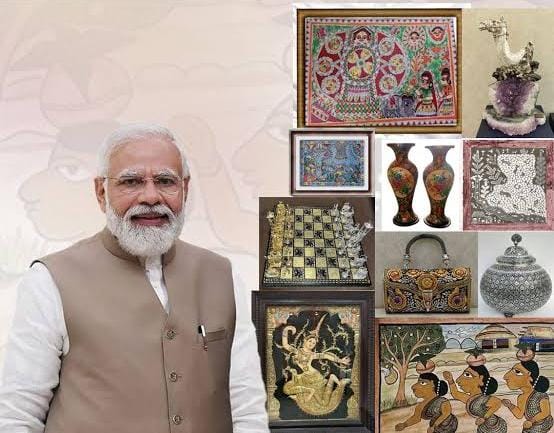
Prime Minister Narendra Modi announced that traditional Indian craftsmanship will serve as a key economic growth driver. By linking heritage skills with modern innovation, global partnerships, and frameworks like "One District, One Product", the government aims to transform rural artistry into self-sustaining, globally competitive export enterprises.
NEW DELHI — Prime Minister Narendra Modi on Sunday emphasized that traditional Indian craftsmanship holds the potential to significantly drive economic growth through targeted innovation, heritage preservation, and strategic global partnerships. Speaking on the importance of local economies, the Prime Minister outlined how combining inherited artisan skills with modern market demands can elevate India's global competitiveness and expand sustainable livelihoods across rural and semi-urban sectors. This development underscores a paradigm shift in public policy, transitioning from viewing cultural arts as segments requiring subsidies to recognizing them as active pillars of commercial enterprise.
Integrating Heritage with Global Markets
The Prime Minister emphasized that the nation’s rich cultural legacy should not merely remain confined to history but must function as a core asset for future financial development. By scaling up production capabilities and maintaining high international standards, traditional Indian craftsmanship can access premium consumer segments worldwide.
A central element of this strategy is the "One District, One Product" (ODOP) initiative, which aims to select, brand, and promote at least one unique product from every district in India. Government updates reveal that the institutional framework behind ODOP is actively working to bridge the gap between local manufacturing hubs and global logistics channels. The strategy focuses on equipping traditional clusters with digital marketing infrastructure and quality-assurance certifications to ensure competitive parity in international supply chains.
Strategic Collaborations and Economic Scalability
A notable blueprint for this economic model is the evolving Indo-French collaboration seen in sectors like luxury textiles and detailed embroidery. Enterprises like Vastrakala have successfully brought high-value design curation together with the intricate skills of local Indian artisans. Such models illustrate that labor-intensive industries can maintain their traditional roots while achieving the structural efficiency required to service elite global design houses, châteaux, and museums.
According to official administrative reviews, these public-private synergies provide rural communities with structured employment portfolios, minimizing involuntary migration to urban centers. The integration of scientific design methods, climate-controlled preservation techniques, and color-coding infrastructure enables local artisans to achieve predictable incomes while scaling operations.
Official Sources Section
According to official statements from the Prime Minister's Office (PMO) and regulatory updates from related ministries, state support will focus heavily on capacity building, credit accessibility, and the establishment of dedicated export desks. The Ministry of Commerce and Industry and regional export promotion councils are slated to expand trade fair participation to introduce specialized regional crafts directly to international buyers.
Quotes Section
In his address detailing the economic roadmap, Prime Minister Narendra Modi stated:
"Traditional Indian craftsmanship is not just a link to our past; it is a dynamic catalyst that can drive substantial economic growth. By combining our historical artistic capabilities with contemporary innovation and robust global partnerships, we unlock sustainable livelihoods for millions of our artisans."
Officials from the Ministry of Micro, Small and Medium Enterprises (MSME) further added:
"Organizers stated that future policy frameworks are being calibrated to treat traditional crafts as high-yield export assets rather than sectors dependent on protective subsidies alone."
Why It Matters
The shift toward commercializing traditional Indian craftsmanship alters the financial landscape for micro-entrepreneurs and rural cooperatives. For investors and businesses, it opens up heavily untapped, authentic product lines ready for sustainable consumer bases globally. For consumers, it guarantees higher quality-vetted, culturally significant commodities. Practically, this ensures that the financial fruits of international trade flow directly back to the primary producers and artisans at the grass-roots level, reinforcing rural financial stability.
Key Facts at a Glance
Economic Catalyst: Traditional Indian craftsmanship is positioned as a primary driver for rural and semi-urban economic growth.
Policy Transformation: Focus shifts from protective financial subsidies to market-led revenue generation and global competitiveness.
Global Footprint: Enhanced international collaborations, such as the Indo-French initiatives, open reliable export pipelines for local clusters.
Strategic Programs: The 'One District, One Product' framework serves as the logistical backbone to standardize and export regional crafts globally.
FAQ Section
How does traditional Indian craftsmanship impact the broader economic growth?
By transforming localized artistic skills into organized, market-driven enterprises, traditional crafts generate substantial rural employment, boost non-farm sector income, and increase India's overall manufacturing export volume.
What role does the 'One District, One Product' initiative play?
The initiative identifies unique regional products across districts, standardizes their quality parameters, provides technological support, and establishes supply links to present them efficiently to international markets.
How do global partnerships benefit local Indian artisans?
Global collaborations bring high-end design curation and international quality standards to local workshops, allowing rural artisans to sell their work to premium global markets and secure predictable, fair wages.
Source: The Prime Minister's Office (PMO) India, Ministry of Commerce and Industry, IANS News Wire Services