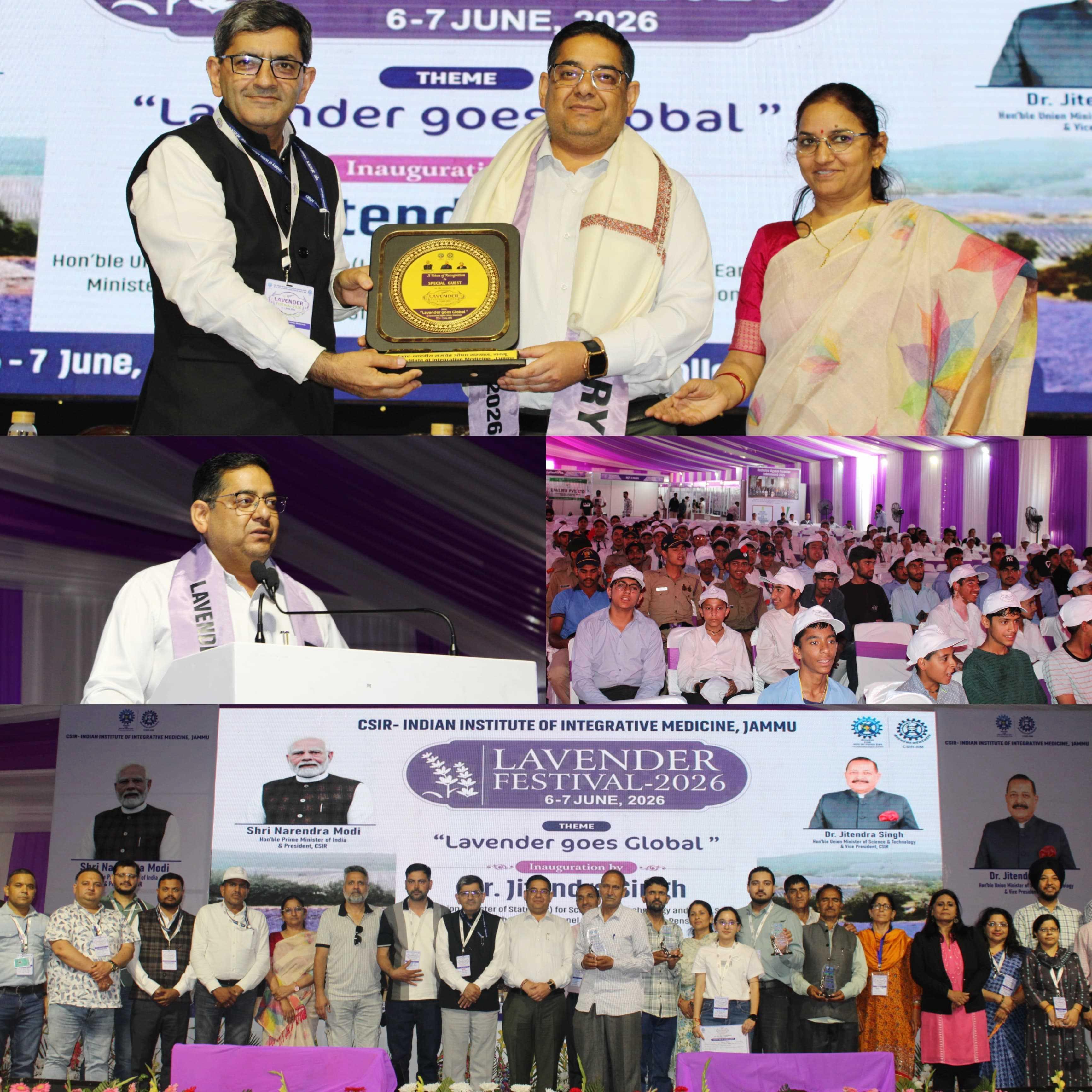
The 4th Lavender Festival concluded at Bhaderwah under the theme "Lavender Goes Global," highlighting the expansion of India’s Purple Revolution to 1,500 hectares. Organised by CSIR-IIIM, the event brought together over 5,000 participants and secured key trade MoUs, bypassing middlemen to link rural essential oil growers directly with international markets.
BHADERWAH — The two-day 4th Mega Lavender Festival officially concluded on Sunday, June 7, 2026, at Government Degree College (GDC) Bhaderwah, cementing the mountain district's position as the primary engine of India's "Purple Revolution." Organized by the Council of Scientific and Industrial Research - Indian Institute of Integrative Medicine (CSIR-IIIM), Jammu, the event operated under the core theme, "Lavender Goes Global."
The high-profile gathering brought together more than 5,000 localized farming families, scientific researchers, agricultural startup founders, and global fragrance industry representatives. It showcased the remarkable economic transition of the Chenab Valley from traditional maize farming to high-value aromatic crop cultivation under the state-backed CSIR Aroma Mission.
Establishing Direct Agri-Business Pipelines
The final day of the festival centered around a major Farmers-Buyers-Sellers Meet, a structured business matching forum designed to eliminate predatory supply-chain middlemen. This direct corporate pipeline allowed small-scale essential oil growers to establish contractual partnerships with leading national and international wellness brands, ensuring standardized pricing matrices for raw yields.
The integration of scientific extraction and market expansion follows a highly structured economic pipeline:
By providing direct commercial avenues, the scientific council has bridged the gap between remote Himalayan farms and industrial processing corporations looking for top-tier lavender oil.
Quantifying the Scale of the Purple Revolution
According to official progress reports compiled by the Council of Scientific and Industrial Research (CSIR), lavender cultivation has expanded to encompass nearly 1,500 hectares of terraced land across Jammu and Kashmir. This massive conversion from subsistence farming to commercial essential oil production has completely realigned the agrarian economy of the region.
The multi-year impact metrics highlight an explosive growth curve:
| Operational Metric | Reported Baseline Data | Current Strategic Target |
| Active Farming Demographics | 4,500+ Registered Aromatic Growers | Expanding to 6,000+ Integrated Families |
| Essential Oil Extraction Volume | 4,000+ Kilograms of High-Value Oil | Scaled Distillation via Community Processing Units |
| Cumulative Ecosystem Revenue | Exceeding ₹18 Crore in Combined Yields | Boosting Value-Added Derivative Manufacturing |
| Regional Distribution Footprint | Concentrated inside Doda and Chenab Valley | Replication in Uttarakhand and Himachal Pradesh |
The underlying data confirms that high-purity lavender oil sourced from Bhaderwah easily competes with traditional European imports, offering local farmers up to four times the net profits generated by traditional cereal crops.
Technological Transfer and Global Value Chains
A primary objective of the festival was accelerating technology transfer from laboratory benches directly into rural fields. Senior scientists from CSIR-IIIM Jammu conducted extensive technical training sessions, educating growers on advanced post-harvest processing methods, energy-efficient steam distillation mechanics, and strict quality control standards needed to clear international export regulations.
To secure this global push, a formal Memorandum of Understanding (MoU) was signed during the event between CSIR-IIIM and major private fragrance companies. This administrative treaty is designed to refine the localized lavender value chain, providing rural distillation facilities with advanced equipment to isolate premium therapeutic aromatic compounds right at the harvest site.
Official Sources Section
The production datasets, crop expansion calculations, corporate MoUs, and agricultural guidelines detailed in this report are based on official public notices issued by the Council of Scientific and Industrial Research (CSIR), administrative deployment registries from the CSIR-Aroma Mission National Core Committee, and valedictory briefings delivered by the Directorate of the CSIR-Indian Institute of Integrative Medicine, Jammu.
Quote Section
"According to officials from the scientific directorate, the success of the 4th Lavender Festival proves that science-driven agriculture can completely revitalize the rural economy of the Himalayan region. The call to take Bhaderwah's lavender global is now backed by a concrete infrastructure roadmap focused on cutting-edge value addition and strong international industry partnerships."
— Dr. Zabeer Ahmed, Director, CSIR-IIIM Jammu
Why It Matters
The conclusion of the 4th Lavender Festival marks a major milestone in India's quest for agricultural self-reliance in cosmetic and wellness raw materials. For local farmers, moving from basic subsistence crops to high-value aromatic plants provides a sustainable buffer against climate-induced rainfall irregularities, as lavender is a highly resilient perennial crop.
On a broader scale, the economic success of the Purple Revolution provides an excellent blueprint for other Himalayan and northeastern states. By showing that high-altitude terrains can be leveraged to produce premium, export-grade essential oils, the initiative drives rural employment, deters youth outward migration, and positions India as a competitive player in the multi-billion-dollar global fragrance market.
Key Facts at a Glance
Global Positioning: The 4th Lavender Festival concluded under the theme "Lavender Goes Global," highlighting Bhaderwah’s transformation into India's Lavender Capital.
Economic Impact: The Purple Revolution has expanded to 1,500 hectares, benefiting over 4,500 local farming families and generating more than ₹18 crore in cumulative revenue.
Strategic Trade Alliances: A key Memorandum of Understanding (MoU) was signed with private fragrance giants to elevate and refine the regional lavender value chain.
Direct Market Access: The festival's signature Farmers-Buyers-Sellers Meet completely bypassed traditional middlemen, securing fair, direct pricing structures for rural growers.
National Replication Model: Following its success in the Chenab Valley, the Bhaderwah lavender model is now being adapted across other Himalayan states, including Uttarakhand.
FAQ Section
1. What exactly is the "Purple Revolution" in Jammu and Kashmir?
The Purple Revolution refers to the shift from low-yield, traditional crops like maize to high-value, scientifically backed aromatic plants—specifically lavender—spearheaded by the CSIR Aroma Mission.
2. How does lavender cultivation financially benefit small-scale farmers?
Lavender is a hardy, drought-resistant perennial crop that yields premium essential oil. It provides up to four times the net profits of traditional crops and offers a stable income source for over two decades per planting.
3. What role does CSIR-IIIM Jammu play in this agricultural initiative?
CSIR-IIIM Jammu serves as the core scientific facilitator, providing farmers with free quality planting material (QPM), establishing regional steam distillation units, and teaching modern crop management techniques.
4. How can private fragrance and wellness companies source oil from Bhaderwah?
Companies can establish direct sourcing partnerships through the annual buyer-seller meets organized by CSIR, or sign formal trade MoUs to contract directly with local farmer cooperatives.
Source: Council of Scientific and Industrial Research (CSIR), CSIR-Indian Institute of Integrative Medicine (IIIM), Jammu, Press Trust of India (PTI) Jammu Bureau.