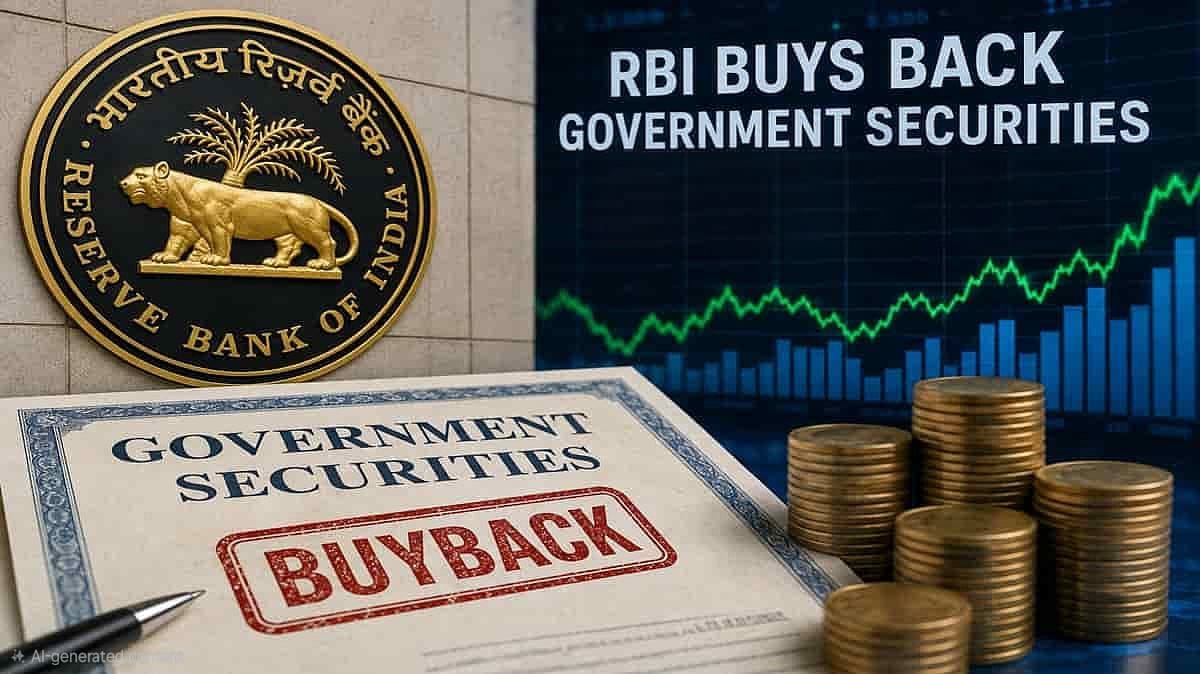
The Reserve Bank of India announced that the Government of India will buy back dated securities worth ₹30,000 crore on September 3, 2026. The auction will be conducted on the E-Kuber system using the multiple price method for four bonds maturing between October 2026 and February 2027.
MUMBAI — The Reserve Bank of India (RBI) announced on Friday, August 28, 2026, that the Government of India will buy back dated government securities worth ₹30,000 crore (face value) through an electronic auction process scheduled for September 3, 2026.
The central bank will execute the repurchase auction on its Core Banking Solution platform, E-Kuber, targeting four short-term government bonds maturing between October 2026 and February 2027. The financial maneuver serves as part of the government's sovereign debt management strategy to prematurely redeem near-maturity obligations, reduce upcoming debt redemption burdens, and optimize cash management across the central government's balance sheet.
Targeted Bonds and Multiple Price Auction Methodology
According to the official RBI notification, the buyback operation covers four specific dated securities issued by the central government:
7.33% GS 2026 (Maturity Date: October 30, 2026)
5.74% GS 2026 (Maturity Date: November 15, 2026)
8.15% GS 2026 (Maturity Date: November 24, 2026)
8.24% GS 2027 (Maturity Date: February 15, 2027)
The central bank clarified that no individual notified amounts have been fixed for specific securities within the overarching aggregate ceiling of ₹30,000 crore. Bidding will proceed under the multiple price method, allowing participating primary dealers and institutional investors to offer specific repurchase yields.
Eligible market participants must submit bids electronically through the RBI E-Kuber system between 10:30 a.m. and 11:30 a.m. IST on Thursday, September 3, 2026. The central bank will announce the auction results later that afternoon, with financial settlement set for Friday, September 4, 2026.
Sovereign Liquidity and Debt Management Strategy
The decision to execute a ₹30,000 crore buyback operation reflects ongoing efforts by the Ministry of Finance and the central bank to manage domestic banking liquidity efficiently.
The repurchase provides institutional lenders, primary dealers, insurance funds, and commercial banks an opportunity to liquidate short-duration government paper, converting near-term assets into immediate cash liquidity. The Government of India retained explicit operational discretion regarding the final allocation. The central government reserves the right to decide the specific quantum bought back for each individual security, accept more or less than the ₹30,000 crore notified ceiling, or reject any or all submitted bids without assigning specific justifications.
Impact on Financial Markets and Institutional Investors
For commercial banks and primary dealers, the buyback auction offers an active liquidity mechanism to deploy surplus capital and rebalance short-dated bond portfolios prior to the second half of the financial year.
By retiring short-term debt before formal maturity, the government smooths out heavy cash outflow obligations due in late 2026 and early 2027. Money market analysts expect the repurchase to stabilize short-term money market rates and support overall liquidity conditions across the banking system ahead of second-quarter corporate tax outflows.
Official Sources Section
According to official Press Release No. 2026-2027/986 issued on August 28, 2026, by Chief General Manager Brij Raj of the Department of Communication at the Reserve Bank of India, the government securities buyback auction will take place on September 3, 2026. Detailed auction terms and debt management guidelines were coordinated in conjunction with the Ministry of Finance.
Quote Section
"According to officials from the Reserve Bank of India, the offers for the auction should be submitted in electronic format on the Reserve Bank of India Core Banking Solution (E-Kuber) system on September 3, 2026, between 10:30 a.m. and 11:30 a.m., with settlement taking place on September 4, 2026."
Why It Matters
The ₹30,000 crore debt repurchase allows the Indian government to clear upcoming maturity liabilities early while injecting liquidity into the commercial banking system. By utilizing surplus government cash balances to buy back short-dated bonds maturing in late 2026 and early 2027, the central bank mitigates concentration risk during future redemption cycles and maintains order across secondary sovereign bond markets.
Key Facts at a Glance
Buyback Amount: Aggregate ceiling of ₹30,000 crore (face value).
Auction Date: Thursday, September 3, 2026 (10:30 a.m. to 11:30 a.m. IST).
Targeted Bonds: Four dated securities maturing between October 30, 2026, and February 15, 2027.
Auction Platform: Conducted electronically on the RBI E-Kuber system using the multiple price method.
Settlement Date: Friday, September 4, 2026.
Frequently Asked Questions
Which government securities are included in the September 3 buyback?
The four targeted securities are 7.33% GS 2026 (maturing Oct 30, 2026), 5.74% GS 2026 (maturing Nov 15, 2026), 8.15% GS 2026 (maturing Nov 24, 2026), and 8.24% GS 2027 (maturing Feb 15, 2027).
How will the buyback auction be conducted?
The auction will take place on the RBI E-Kuber electronic platform using the multiple price method.
What is the total notified amount for the government securities buyback?
The total aggregate ceiling for the buyback is ₹30,000 crore, with no fixed individual limits for each of the four specified securities.
When will settlement take place for successful bids?
Bidding takes place on September 3, 2026, and financial settlement will be executed on Friday, September 4, 2026.
Source: Official Press Release No. 2026-2027/986 issued by the Reserve Bank of India on August 28, 2026, in coordination with the Ministry of Finance.