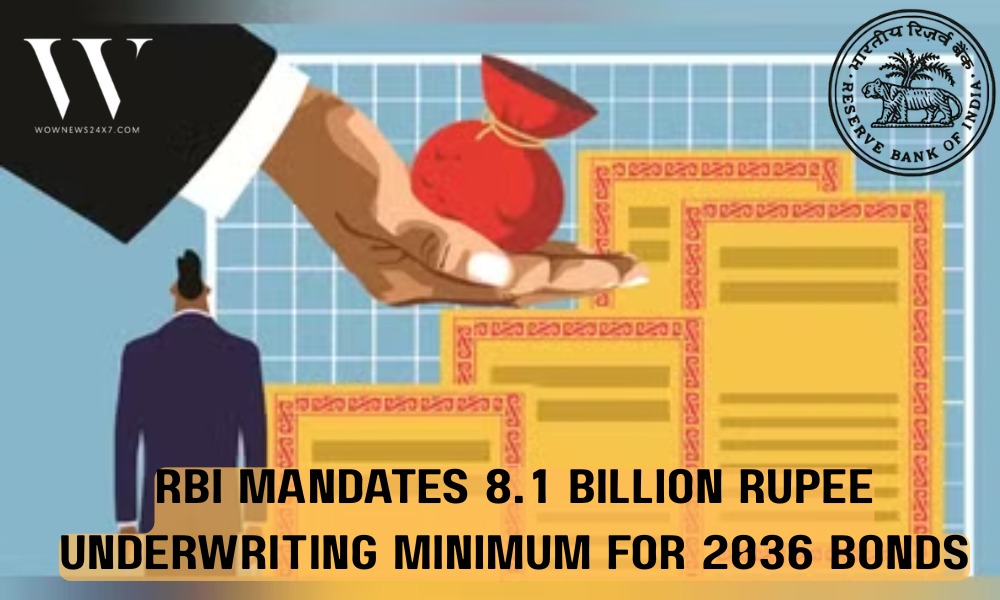
The Reserve Bank of India (RBI) announced a new regulatory directive on Thursday, fixing a precise minimum underwriting commitment of 8.1 billion Indian rupees for the upcoming auction of government securities maturing in 2036. This administrative mechanism legally requires India's primary dealers to absorb predefined portions of the sovereign debt issue if public market demand falls short. This regulatory intervention serves as a structural safety net for the central government's sovereign borrowing program, ensuring total debt distribution while containing yield volatility amidst fluctuating macroeconomic metrics across emerging markets.
Central Bank Mandates Primary Dealer Targets for Long-Term Debt
According to official operational parameters released by the Reserve Bank of India via its debt management department on June 4, 2026, the specific 8.1 billion rupee baseline represents a mandatory commitment threshold spread across authorized institutional underwriters. The targeted security belongs to the long-duration bucket of the sovereign yield curve, making its auction execution a key indicator for macro interest rate expectations.
Under current institutional underwriting guidelines, primary dealers must submit individual bids detailing the additional volume of government bonds they are prepared to guarantee. By enforcing a minimum underwriting commitment, the RBI prevents structural auction failures and limits the risk of "devolution"—a scenario where the central bank is forced to absorb unsold sovereign debt onto its own balance sheet, potentially complicating national monetary expansion strategies.
Impact on Banking Liquidity and Institutional Investors
The introduction of the 8.1 billion rupee commitment comes during a period of calculated liquidity management by the Indian central bank. Sovereign debt auctions in India heavily rely on institutional participation from scheduled commercial banks, state-run insurance conglomerates, and specialized primary dealerships.
For institutional treasury managers and fixed-income portfolio managers, the underwriting mandate offers a clear framework for structural price discovery. The explicit allocation guarantees that the total auction issue will be fully capitalized, minimizing erratic secondary market yield spikes immediately following the debt distribution process.
Official Sources Section
The institutional debt targets, regulatory allocation baselines, and legal underwriting parameters detailed in this market notification are derived directly from the official auction notices and debt management schedules published by the Reserve Bank of India.
Quote Section
"According to officials tracking national debt management frameworks, setting clear minimum underwriting targets for long-term securities ensures that the government's developmental capital requirements are successfully met without inducing artificial distortion in the broader interbank lending markets."
Why It Matters
From a practical financial perspective, a successful sovereign bond auction directly stabilizes national interest rate benchmarks, which dictate the pricing of corporate loans, consumer credit lines, and domestic mortgages. For global bond index trackers and local capital market participants, this structural backdrop reinforces the stability of India’s sovereign debt market, smoothing the execution of large-scale infrastructure investments funded via national fiscal programs.
Key Facts at a Glance
Mandated Allocation: RBI imposes a minimum underwriting commitment baseline of 8.1 billion Indian rupees.
Target Security: Long-term Indian government debt instruments carrying a final maturity date in 2036.
Primary Compliance Objective: Eliminate sovereign auction devolution risks and anchor long-term interest rate trends.
Regulated Sector: Affects active domestic primary dealers and institutional fixed-income trading divisions.
FAQ Section
What happens if public demand for the 2036 bonds is lower than expected?
If public bids fail to cover the targeted debt issue size, the primary dealers are legally obligated to buy the remaining balance up to their minimum underwriting commitment, absorbing the bonds into their own institutional portfolios.
How do primary dealers profit from this mandatory commitment?
In exchange for carrying the institutional risk of absorbing unsold sovereign debt, primary dealers receive an underwriting commission fee paid out by the central bank, determined via a competitive bidding process before the main bond auction.
Why did the RBI pick the 2036 maturity bond for this specific underwriting floor?
Long-duration securities face higher sensitivity to changing long-term inflation and interest rate perspectives. Implementing strict underwriting commitments ensures these critical instruments remain liquid, even during periods of short-term global asset reallocation.
Source: Official primary market auction declarations and debt infrastructure reports published by the Reserve Bank of India and verified through fixed-income data monitors at the National Stock Exchange of India.