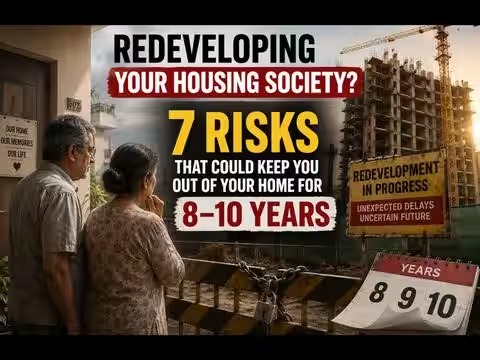
Housing society redevelopment projects frequently encounter severe structural bottlenecks, financial defaults, and legal disputes that delay construction timelines. Real estate experts highlight seven critical risks—ranging from developer insolvency and title flaws to protracted litigation—that can leave residents displaced and homeless for up to a decade.
Urban housing society redevelopment projects face critical delays and legal hurdles, leaving displaced residents stranded outside their homes for nearly a decade.
The Complex Realities of Urban Housing Redevelopment
Urban residential redevelopment has become a dominant trend across metropolitan centers as aging apartment complexes seek modern amenities, increased floor space index (FSI), and structural reinforcement. However, transforming a cooperative housing society into a high-rise residential complex is fraught with complex challenges. While developers often promise swift completion and lucrative corpus funds, structural bottlenecks frequently stretch execution timelines far beyond initial estimates.
According to real estate analysts and urban planning experts, poorly structured agreements and developer defaults routinely trap residents in temporary rental accommodations for eight to ten years. Understanding the underlying vulnerabilities is essential for managing committee members and flat owners embarking on multi-million-dollar redevelopment agreements.
Seven Critical Risks Threatening Housing Redevelopment
Navigating a redevelopment project requires rigorous due diligence across financial, legal, and operational dimensions. Industry professionals have identified seven primary risk factors that can derail housing society projects:
Developer Insolvency and Financial Default: Economic downturns or liquidity crunches can cause a developer to default on construction loans, leading to immediate site abandonment.
Protracted Legal Disputes and Title Flaws: Unresolved property title disputes, ancestral claims, or internal member litigation can freeze construction orders indefinitely through court stays.
Delayed Municipal Approvals and Permitting Bottlenecks: Bureaucratic delays in securing environmental clearances, commencement certificates (CC), and occupation certificates (OC) stall physical progress.
Substandard Construction and Engineering Failures: Compromised building materials or structural flaws discovered mid-construction require expensive teardowns and redesigns.
Default on Hardship and Rent Compensation: Developers failing to disburse monthly transit rent or displacement allowances leave residents struggling to pay third-party landlords.
Unrealistic FSI and Viability Projections: Promoters overpromising large corpus funds and extra square footage based on unapproved FSI parameters often abandon projects when municipal bodies reject layout plans.
Internal Society Fractures and Consensus Deficits: Disagreements among resident factions regarding developer selection, flat allocation ratios, and corpus distribution paralyze decision-making.
Impact on Homeowners, Communities, and Financial Stability
The materialization of these seven risks carries devastating practical and financial consequences for displaced homeowners. For senior citizens and fixed-income families, living in transit accommodations for eight to ten years creates severe psychological stress and financial strain, especially if the developer stops paying monthly rent.
Furthermore, prolonged project abandonment leads to structural decay of partially completed concrete frames, depreciating surrounding real estate values and exposing the cooperative society to complex bankruptcy proceedings if the developer enters insolvency liquidation.
Quote Section
"According to real estate experts and urban redevelopment advisors, inadequate due diligence and developer defaults remain the primary drivers behind prolonged project delays, frequently leaving displaced homeowners stranded for nearly a decade."
Why It Matters
Awareness of housing redevelopment risks matters because a residential flat represents the single largest lifetime asset for most families. Recognizing financial and legal vulnerabilities before signing binding agreements empowers resident welfare associations to select solvent developers, insert stringent penalty clauses, and safeguard their homes against protracted displacement.
Key Facts at a Glance
Primary Danger: Project delays stretching housing displacement to eight to ten years
Common Financial Failure: Default on monthly transit rent and corpus fund disbursements
Regulatory Safeguard: Mandatory adherence to RERA guidelines and rigorous developer background checks
Key Vulnerability: Unverified property titles and disputed municipal FSI allocations
Frequently Asked Questions (FAQ)
What is the primary cause of long delays in housing society redevelopment?
According to real estate experts, delays are typically driven by developer insolvency, protracted legal disputes, delayed municipal approvals, and internal society disagreements.
How can housing societies protect themselves against developer default?
Associations can safeguard their interests by conducting rigorous financial background checks, appointing independent legal advisors, and incorporating strict penalty clauses for delayed rent payments into the development agreement.
What happens if a developer stops paying monthly transit rent?
If a developer defaults on rental compensation, affected residents can file complaints before the Real Estate Regulatory Authority (RERA) or civil courts to seek financial relief and execution enforcement.
Source: Ministry of Housing and Urban Affairs (MoHUA) Official Portal, Real Estate Regulatory Authority (RERA) Compliance Guidelines, and National Real Estate Development Council (NAREDCO).