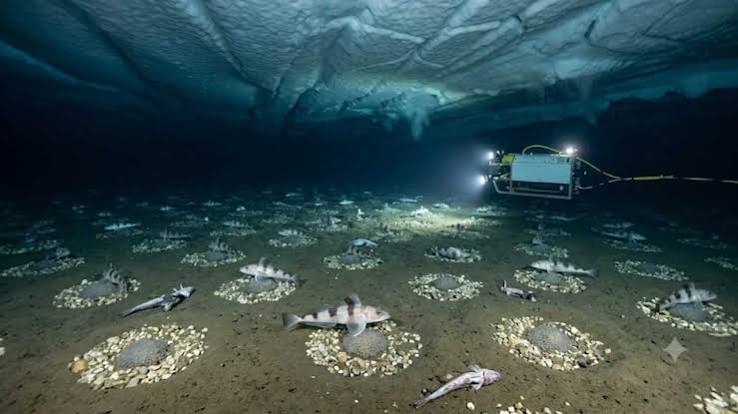
Scientists have discovered a massive breeding colony of 60 million icefish nests beneath Antarctica's Filchner Ice Shelf. Spanning 240 square kilometers, this unique "underwater city" thrives in slightly warmer deep-water pockets, highlighting the ecological importance of these remote, hidden habitats and the need for continued conservation efforts in the Southern Ocean.
ANTARCTICA — Hidden beneath the freezing, dark waters of the Filchner Ice Shelf in Antarctica, scientists have identified what is being described as a sprawling "underwater city" of fish nests [1.1.1, 1.1.2]. The site, which covers an estimated 240 square kilometers, contains approximately 60 million active nests belonging to the blackfin icefish (Neopagetopsis ionah), making it the largest fish breeding colony ever discovered on Earth [1.1.1, 1.2.4].
The discovery was first documented by a team of researchers led by Dr. Autun Purser of the Alfred Wegener Institute (AWI) during a 2021 expedition [1.1.1, 1.1.2]. Utilizing the Ocean Floor Observation and Bathymetry System (OFOBS), researchers captured footage of thousands of circular depressions on the seafloor, each meticulously cleared of sediment and guarded by an adult icefish [1.1.1, 1.2.4].
An Extraordinary Nursery in the Deep
The scale of this breeding colony, which is comparable to the size of Orlando, Florida, has fundamentally reshaped scientific understanding of marine life in Antarctica [1.1.1, 1.1.2]. The icefish—a species renowned for its transparent blood and specialized antifreeze proteins that allow it to survive in sub-zero waters—appears to thrive here due to unique oceanographic conditions [1.1.1, 1.1.2].
According to official findings, modified "Warm Deep Water" flows into the Filchner Trough, creating a pocket on the seafloor that is up to 2°C warmer than the surrounding environment [1.1.1, 1.2.1]. Researchers believe this slight temperature variation, combined with access to nutrients, makes this specific area an ideal, albeit extreme, nursery for the species [1.1.1, 1.2.3].
Monitoring a Hidden Ecosystem
In recent years, AWI scientists have returned to the site using advanced technology, including the Low-Altitude Survey System for Icefish (LASSIE), to ensure long-term monitoring [1.1.1, 1.1.2]. Observations confirmed that the colony's size and nesting density have remained stable since its initial discovery, providing a critical baseline for understanding how these fragile, hidden ecosystems adapt to the broader Southern Ocean [1.1.1, 1.1.2].
The site is not just a nursery; it also plays a key role in the Antarctic food web [1.1.2, 1.3.3]. Predators, such as Weddell seals, have been documented frequenting the area to feed, highlighting the interconnected nature of this deep-sea habitat [1.1.2, 1.2.1].
Official Sources
Alfred Wegener Institute (AWI): Lead organization for the expedition and research on the Weddell Sea colony [1.1.1, 1.2.4].
Current Biology: Peer-reviewed journal that published the initial findings of the breeding colony [1.1.1, 1.2.3].
Quote Section
"The idea that such a huge breeding area of icefish in the Weddell Sea was previously undiscovered is totally fascinating," stated Dr. Autun Purser, lead author of the study and deep-sea biologist at the Alfred Wegener Institute [1.2.4].
Why It Matters
This discovery underscores the vast, unexplored nature of the Antarctic seafloor and the importance of safeguarding these unique habitats [1.1.2, 1.3.3]. Researchers are using this data to advocate for the formal designation of the Weddell Sea as a Marine Protected Area, arguing that protecting these hidden nurseries is essential for maintaining biodiversity in the face of environmental changes [1.2.4, 1.3.3].
Key Facts at a Glance
Location: Filchner Ice Shelf, Weddell Sea, Antarctica [1.1.1, 1.1.2].
Scale: Estimated 60 million nests across 240 square kilometers [1.1.1, 1.2.1].
Species: Blackfin icefish (Neopagetopsis ionah) [1.1.1, 1.1.2].
Nesting Density: Average of 0.26 nests per square meter [1.1.1, 1.2.1].
Environmental Factor: Warmer "Warm Deep Water" currents support the colony [1.1.1, 1.2.1].
FAQ
Why do the fish build these nests?
Icefish clear circular depressions to create a protected environment for their eggs, with a typical nest containing approximately 1,700 eggs, which are then guarded by an adult fish [1.1.1, 1.2.3, 1.2.4].
What makes the icefish unique?
The species lacks hemoglobin, the protein that gives blood its red color, resulting in transparent blood. They also produce natural antifreeze proteins that prevent them from freezing in extreme temperatures [1.1.1, 1.1.2].
How are scientists monitoring the site?
Researchers utilize autonomous underwater vehicles (AUVs) like LASSIE and towed camera systems (OFOBS) to survey the seafloor beneath the ice shelf, providing high-resolution imagery without disturbing the ecosystem [1.1.1, 1.1.2, 1.2.4].
Source: Alfred Wegener Institute, Current Biology, The Indian View