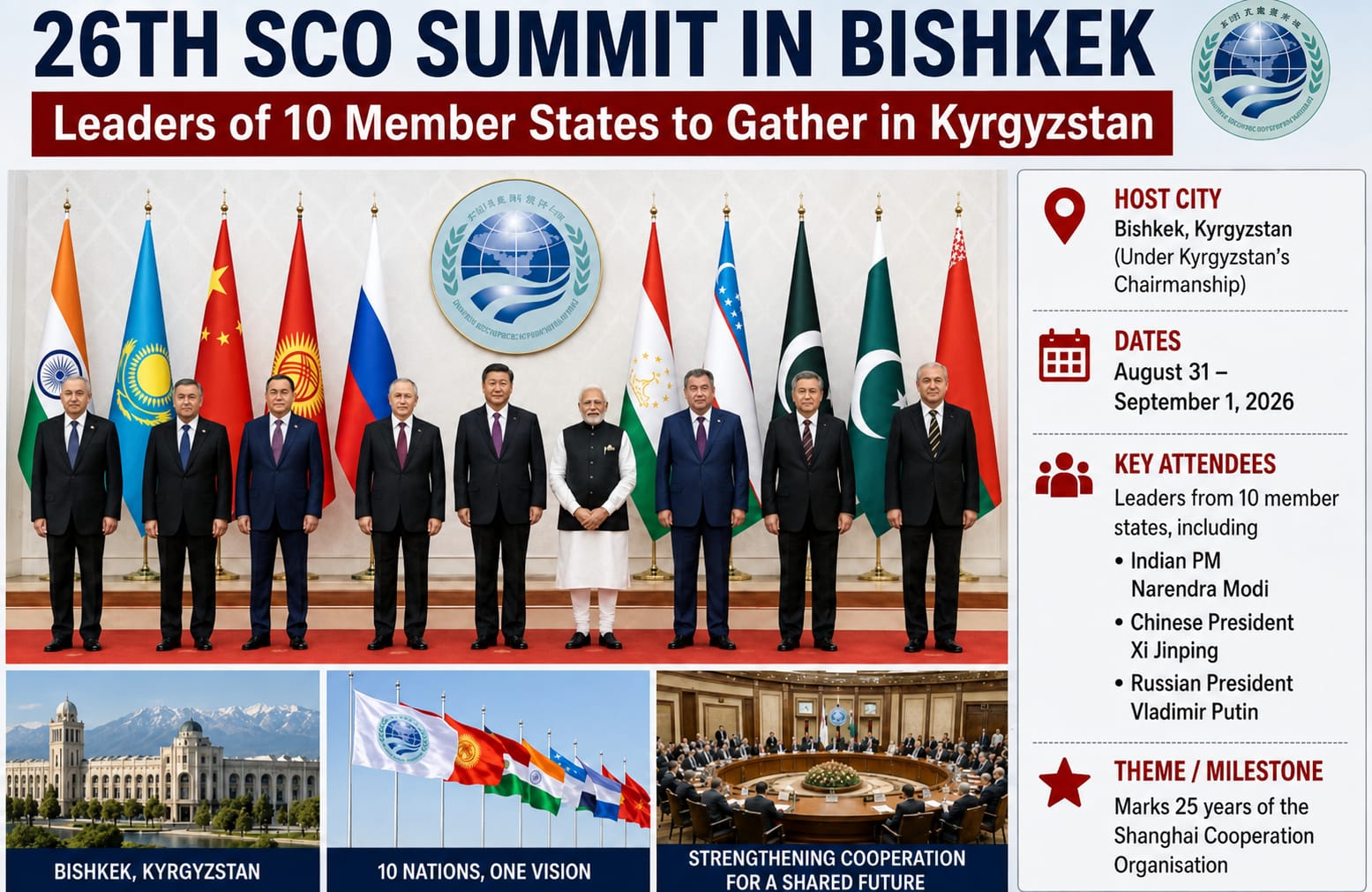
Prime Minister Narendra Modi, Chinese President Xi Jinping, and Russian President Vladimir Putin joined regional leaders in Bishkek for the 26th SCO Summit. Marking 25 years of the bloc, the meeting focuses on regional security, counter-terrorism, trade connectivity, and energy cooperation across member nations representing one-quarter of global GDP.
BISHKEK — Prime Minister Narendra Modi, Chinese President Xi Jinping, and Russian President Vladimir Putin joined leaders from across Eurasia in the Kyrgyz capital of Bishkek on August 31 for the 26th Shanghai Cooperation Organisation (SCO) Summit.
The two-day summit marks the 25th anniversary of the regional grouping, bringing together head of state delegations from ten member countries representing approximately 3.4 billion people and a quarter of global Gross Domestic Product (GDP). For New Delhi, the high-profile assembly provides a strategic venue to balance complex regional security concerns, reinforce trade ties, and advance its regional roadmap centered on security, economic connectivity, and counter-terrorism.
Triangular Diplomacy and Bilateral Engagements
The Bishkek summit serves as a crucial platform for direct diplomacy among Eurasia's primary powers. Prime Minister Modi scheduled formal bilateral discussions with Russian President Vladimir Putin on the sidelines of the meeting. The talks follow recent ministerial meetings under the India-Russia Inter-Governmental Commission in Moscow, focusing on energy supplies, agricultural imports, and trade targets aimed at reaching $100 billion by 2030.
The gathering also puts Prime Minister Modi and Chinese President Xi Jinping under the same roof ahead of the upcoming BRICS Summit in New Delhi. Diplomatic observers highlight that interaction between Indian and Chinese leadership comes during a period of ongoing dialogue to maintain stability along line-of-actual-control border zones and navigate complex bilateral trade dynamics.
Counter-Terrorism and Regional Security Priorities
Counter-terrorism, border security, and combating transnational crime remain central to the official agenda in Bishkek. Indian delegates have reaffirmed the nation's firm stance against state-sponsored terrorism, urging SCO member states to strengthen joint mechanisms under the Regional Anti-Terrorist Structure (RATS).
With Pakistani Prime Minister Shehbaz Sharif also attending the summit, India continues to advocate for strict adherence to SCO principles concerning sovereignty and territorial integrity while pressing for coordinated regional counter-terrorism measures.
Official Sources Section
According to official briefings from the Ministry of External Affairs of India, press releases from the Kremlin, and statements published by the Executive Committee of the Shanghai Cooperation Organisation, the summit will conclude with the adoption of the Bishkek Declaration alongside agreements covering energy efficiency, emergency response, and digital cooperation.
Multilateral commitments and institutional dialogue platforms are overseen in coordination with official releases hosted on the Press Information Bureau.
Quote Section
"India has been an active and constructive member of the SCO since 2017," Prime Minister Narendra Modi stated upon his arrival in Central Asia. "I look forward to advancing India's vision for the region, anchored in Security, Connectivity and Opportunity, and to working with fellow members for a region free from the scourge of terrorism, separatism and extremism."
"Both sides are expected to review the entire gamut of bilateral relationships during the meeting between the leaders on the sidelines of the SCO in Bishkek," MEA Secretary (West) Sibi George confirmed during an official media briefing in New Delhi.
Why It Matters
The SCO summit carries practical implications for multiple stakeholders across regional markets:
For Indian Exporters and Industry: Enhanced engagement with Central Asian republics opens new avenues for trade, pharmaceuticals, and agricultural exports through Chabahar and International North-South Transport Corridor (INSTC) routes.
For Energy and Resource Security: Direct dialogue with major energy producers like Russia and Central Asian nations supports India's long-term resource planning and fertilizer security.
For Geopolitical Analysts and Investors: The alignment of Eurasian leaders demonstrates the growing weight of non-Western multilateral platforms in shaping regional economic flows, supply chains, and infrastructure investments.
Key Facts at a Glance
Summit Location & Date: Bishkek, Kyrgyzstan; August 31 – September 1, 2026.
Bloc Footprint: Represents 10 member states, around 3.4 billion people, and 25% of global GDP.
Key Bilaterals: PM Modi holds formal talks with President Putin and engages SCO leaders on the sidelines.
Core Agenda: Focus on regional security, counter-terrorism, energy efficiency, and Central Asian connectivity.
Frequently Asked Questions (FAQ)
What is the Shanghai Cooperation Organisation (SCO)?
The SCO is a Eurasian political, economic, and security bloc founded in 2001. Its ten member states include India, China, Russia, Pakistan, Iran, Belarus, Kazakhstan, Kyrgyzstan, Tajikistan, and Uzbekistan.
Why is the 2026 SCO Summit in Bishkek significant for India?
The summit allows India to advance its regional security concerns—specifically counter-terrorism—while maintaining strategic relationships with Russia and Central Asian nations and balancing relations with China.
What are Prime Minister Modi's main focus areas at the summit?
India's focus is anchored in the "SECURE" framework: Security, Economy/Trade, Connectivity, Unity, Respect for Sovereignty, and Environmental protection, alongside combating terrorism, separatism, and extremism.
Does the SCO function as a military alliance?
No. The SCO is not a defense pact or military alliance like NATO. It is a consensus-based forum dedicated to security cooperation, counter-terrorism, economic engagement, and regional diplomacy.
Source: Official statements from the Ministry of External Affairs of India, news briefings via the Press Information Bureau, official updates from the Executive Committee of the SCO, and foreign ministry disclosures from the Kremlin.