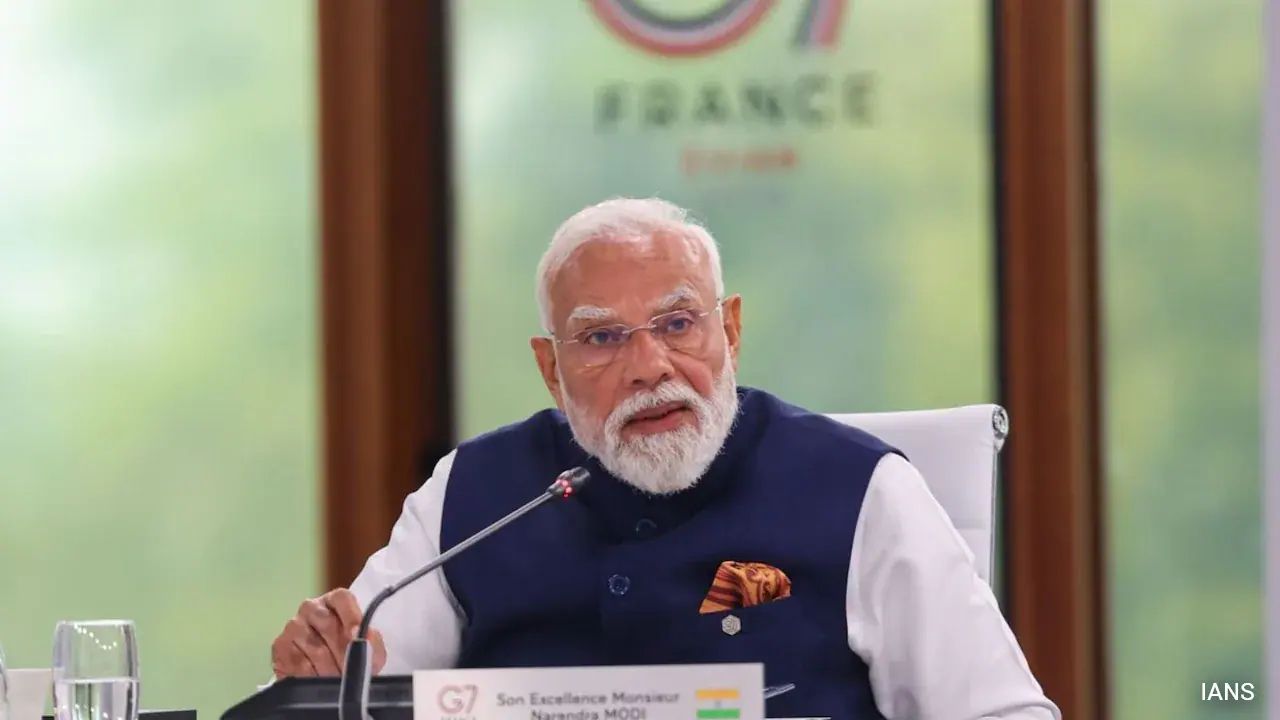
Despite holding no formal membership, India emerged as an indispensable anchor at the 52nd G7 Summit in France. Driven by a $4 trillion economy and its leadership of the Global South, India utilized the summit to advance critical multi-billion dollar trade, energy, and AI partnerships with Western allies.
ÉVIAN-LES-BAINS, France — As the heads of the world’s most advanced Western economies gathered in this French resort town for the 52nd G7 Summit, one of the most vital figures at the table represented a nation that is not even a formal member of the group.
Indian Prime Minister Narendra Modi arrived in Évian for a high-profile two-day visit, marking India's 13th participation overall and its eighth consecutive appearance at the elite forum. The recurring invitation underscores a shifting geopolitical reality: the Group of Seven can no longer independently steer global governance, and India has built an undeniable seat at the table through pure economic momentum and its self-governed mandate as the leader of the developing world.
Shifting Global Scales Dilute Western Economic Monopoly
The structural composition of the G7—comprising Canada, France, Germany, Italy, Japan, the United Kingdom, the United States, and the European Union—faces an existential demographic and economic math problem. While the bloc represented roughly 64% of global nominal Gross Domestic Product (GDP) two decades ago, its collective share has contracted to approximately 43%.
Conversely, India has seen its nominal GDP surge seven-fold over the same period, establishing itself as a $4 trillion powerhouse and the world’s fastest-growing major economy. Western powers increasingly recognize that isolating an economic engine of this scale neutralizes the efficacy of any global policy coordination on supply chains, international trade corridors, or green energy transitions.
Bridging the Gap as the Chair of the Global South
Beyond its domestic economic metrics, India's presence is heavily driven by its unique diplomatic positioning. Serving simultaneously as a primary bridge between the West and non-aligned blocs, New Delhi has stepped into the role of the chief advocate for the Global South.
According to data presented at the summit's special outreach tracks, the G7 represents only 10% of the human population. To prevent the forum from being dismissed as an archaic, exclusionary rich-man's club, host nations have systematically utilized "Outreach Sessions." India uses these platforms to shift the traditional donor-recipient paradigm into bilateral pacts rooted in equal equity and technical collaboration.
High-Stakes Sidelines and Deepening Bilateral Pacts
The real diplomatic heavy lifting occurred on the sidelines of the main summit halls. Prime Minister Modi engaged in crucial bilateral talks with prominent world leaders, including US President Donald Trump, British Prime Minister Keir Starmer, and Canadian Prime Minister Mark Carney.
The discussions yielded immediate, actionable economic frameworks. India and Canada advanced their Security Energy Partnership via a major CAD $2.6 billion commercial contract between Canada’s Cameco and India’s Department of Atomic Energy to secure long-term uranium supplies running through 2035. Concurrently, Indian negotiators accelerated timelines with the UK under the "Vision 2035" framework to implement a Comprehensive Economic and Trade Agreement (CETA) focused heavily on defense engineering and technology transfer.
Official Sources Section
Bilateral framework details, economic statistics, and state statements are verified via diplomatic briefs published directly by the Ministry of External Affairs, India (MEA) and the official host press registry of the [suspicious link removed].
Quote Section
"The G7, if it ever did run the world, no longer runs the world or pretends to," stated Canadian Prime Minister Mark Carney during a policy address detailing the inclusion of outreach partners like India and Brazil. "Today's global challenges can no longer be addressed by a small group of advanced economies alone."
Prior to his arrival in France, Prime Minister Narendra Modi released an official departure statement emphasizing India's dual mandate at the summit:
"India's presence at the G7 reflects the trust our partners place in us and our growing global profile. At the G7, India will not only speak for itself, but it will also give voice to the aspirations of the Global South."
Why It Matters
For regular citizens, businesses, and global markets, India’s anchor role at the G7 stabilizes volatile supply networks. As international conflicts disrupt historic shipping and energy channels, India acts as a geopolitical ballast.
Its integration into Western tech frameworks directly impacts consumer electronics pricing, artificial intelligence guardrails, and international labor migration—ensuring that the rules of the future global economy are not drafted solely by Western capitals.
Key Facts at a Glance
Unprecedented Continuity: The 2026 event marks India's eighth consecutive invitation to the G7 Summit, highlighting its institutionalized presence despite non-member status.
Economic Leverage: The G7’s collective share of global GDP has dropped to 43%, making the inclusion of India’s $4 trillion economy essential for realistic global policy enforcement.
Energy Security Lock: India solidified a CAD $2.6 billion uranium supply agreement with Canada during the summit sidelines to fuel its domestic nuclear energy transition.
Voice of the Majority: India used the Évian Outreach platform to directly represent the infrastructure, financial equity, and food security requirements of developing nations.
FAQ Section
1. Why is India not an official, permanent member of the G7?
The G7 was originally formed in the 1970s as an alliance of the world's highest-income, industrialized democratic economies. While India is a major democracy and a massive economy, its per-capita GDP remains lower than the foundational threshold of the original members, keeping it in an active "Outreach Partner" capacity.
2. What specific topics did India lead on during the 2026 Évian Summit?
India focused on establishing international frameworks for artificial intelligence (AI) sovereignty, resolving global trust deficits in multilateral institutions, and reforming supply chains to insulate developing countries from energy and food price hikes caused by Western conflicts.
3. How do India's G7 appearances align with its membership in BRICS?
India pursues a policy of multi-alignment. By maintaining a lead role in BRICS while anchoring the G7 outreach tracks, New Delhi successfully acts as a diplomatic bridge, ensuring it maintains critical economic and strategic leverage across both Western and emerging-market coalitions.
Source: Official transcript registries and diplomatic data archives maintained by the Ministry of External Affairs, India (MEA).