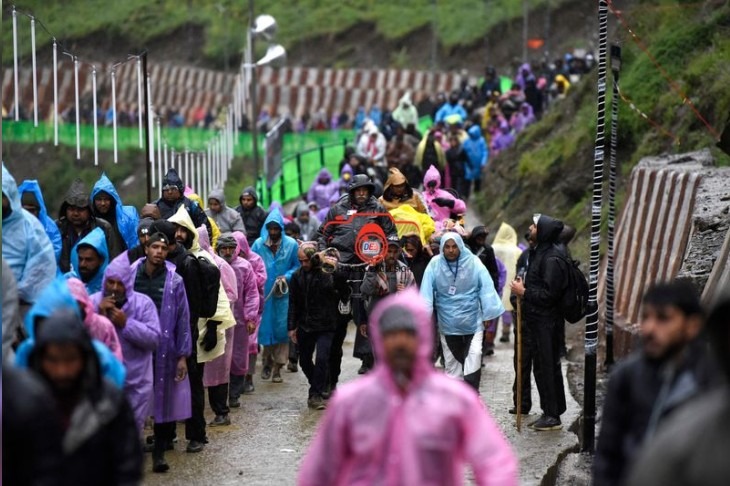
The second batch of 3,865 Amarnath Yatra pilgrims has left the Jammu base camp for the holy cave shrine in Kashmir. Escorted by multi-layer security forces in a 201-vehicle convoy, the group was divided between the traditional Pahalgam route and the shorter Baltal track to begin the 57-day pilgrimage.
JAMMU — The second batch of more than 3,800 pilgrims departed from the Bhagwati Nagar base camp early Friday morning to join the annual 57-day Amarnath Yatra pilgrimage in the South Kashmir Himalayas. Moving in a heavily guarded motorized convoy of 201 vehicles, a total of 3,865 devotees left Jammu for the twin transit bases of Pahalgam and Baltal. The fresh departure brings the total number of pilgrims dispatched from the Jammu base camp to 8,687 within the first 48 hours of the high-security event, following the formal flag-off of the inaugural batch by Jammu and Kashmir Lieutenant Governor Manoj Sinha on Thursday.
Elaborate Transport and Route Demographics Activated
The deployment plan executed by transport and security administrators split the second batch into separate streams to balance foot traffic across the two designated mountain corridors. The convoy split included 83 large buses, 14 medium motor vehicles, and 104 light motor vehicles:
The Baltal Route: A contingent of 1,735 pilgrims, operating in 115 vehicles, departed the base camp at 3:13 a.m. local time. They are tracking the shorter but significantly steeper 14-kilometer northern route in the Ganderbal district.
The Pahalgam Route: A larger contingent of 2,130 pilgrims, utilizing 86 vehicles, departed shortly after at 3:38 a.m.. This group is moving via the traditional, longer 48-kilometer Nunwan-Pahalgam mountain track located in the Anantnag district.
According to formal registration data logged by the Zonal Police Control Room in Jammu, the current batch consists of 2,965 men, 618 women, 230 sadhus, 48 sadhvis, and four children.
Multi-Layer Security Perimeter Along National Highway
To shield the massive moving columns from potential logistical vulnerabilities or security disruptions, federal and regional law enforcement agencies have activated an extensive, multi-layered defensive grid. Armored tactical vehicles and armed personnel from the Jammu and Kashmir Police, traffic units, and the Central Armed Police Forces (CAPFs) are providing continuous rolling escorts for the pilgrim buses along the volatile Jammu-Srinagar National Highway.
The security architecture extends to designated highway transit nodes. The Baltal-bound convoy moved under strict supervision through the Nashri Tunnel into Ramban district, halting for institutional breakfast and basic amenities at the Lambar Ground facility in Banihal. Concurrently, the Pahalgam-bound travelers completed their mandatory morning transit stops at the designated Chanderkoot Langar sites within the Ramban administrative sector.
Official Sources Section
According to official administrative circulars issued via the Shri Amarnathji Shrine Board (SASB), the annual 57-day pilgrimage to the 3,880-metre-high holy cave shrine is strictly scheduled to conclude on August 28, 2026, coinciding with the festival of Raksha Bandhan. Prime Minister Narendra Modi, through an official communication shared by the Press Information Bureau (PIB) India, has urged all participants to follow safety protocols and maintain environmental cleanliness along the fragile Himalayan eco-tracks.
Quote Section
The atmosphere inside the base facilities remained intensely devotional as the convoy prepared to cross out of Jammu's municipal boundaries.
According to officials and base managers supervising the early morning departures:
"The atmosphere at the Bhagwati Nagar base camp was charged with devotion as pilgrims chanted traditional slogans before embarking on their journey. Devotees expressed high satisfaction over the extensive logistics, transit management, and security infrastructure deployed this year."
Lieutenant Governor Manoj Sinha highlighted the cultural and spiritual scale of the event in a statement shared on social media:
"The sacred journey to the holy abode of Baba Barfani begins! We extend our warmest wishes for a safe and spiritually fulfilling journey for all devotees. The administration and security forces are working in complete coordination to ensure a smooth pilgrimage."
Why It Matters
Ensuring the safe transit of thousands of domestic pilgrims across difficult mountainous routes is a major operational victory for regional safety, intelligence, and tourism boards. The successful movement of large batches down the Jammu-Srinagar National Highway stabilizes local transit networks, boosts trust in the region's hospitality economy, and demonstrates India's capacity to host large-scale, logistically complex religious gatherings in sensitive border terrains.
Key Facts at a Glance
The Sowing Batch: 3,865 registered pilgrims departed Jammu on Friday as the second official wave of the 2026 cycle.
Cumulative Traffic: A total of 8,687 devotees have successfully cleared the Jammu base camp within the first two days of operations.
Twin Axis Split: 2,130 pilgrims are traveling via the traditional Pahalgam route, while 1,735 are tracking the shorter Baltal axis.
Timeline Mandate: The annual high-altitude pilgrimage will run for a duration of 57 days, officially concluding on August 28, 2026.
FAQ Section
Q: What are the two primary routes used to reach the Amarnath cave shrine?
A: Pilgrims can choose between the traditional, longer 48-km Nunwan-Pahalgam route in Anantnag district or the shorter, steeper 14-km Baltal route in Ganderbal district.
Q: How long will the 2026 Amarnath Yatra continue?
A: The pilgrimage is scheduled to span 57 days, having commenced on early July and set to conclude on August 28, 2026, matching the Raksha Bandhan festival.
Q: What security measures are in place along the transit route?
A: A multi-tier security setup involving the local police, specialized traffic units, and the Central Armed Police Forces (CAPFs) provides constant armored convoy escorts along highways and transit bases.
Source: Official deployment logs from the Zonal Police Control Room Jammu, statistical releases from the Shri Amarnathji Shrine Board (SASB), and media briefs published by the Press Information Bureau (PIB) on behalf of the Jammu & Kashmir Administration.