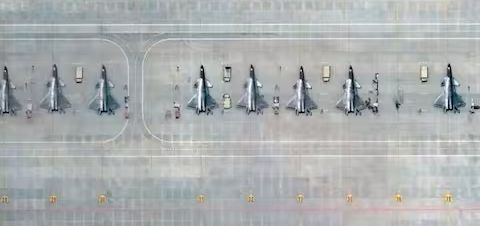
Commercial satellite imagery reveals China has positioned at least 12 advanced J-20 stealth fighters at the Hotan and Damxung airbases near the Indian border. The deployment marks a significant airpower concentration along the Line of Actual Control, intensifying strategic focus on regional defense readiness and bilateral security dynamics.
Recent satellite intelligence reveals a notable deployment of advanced fifth-generation fighters along the Himalayan border, altering regional air-defense calculations.
Amid ongoing diplomatic and military friction along the disputed frontier, new intelligence disclosures have highlighted a significant escalation in regional air posture. According to commercial satellite data and defense analyses published in late July 2026, the People’s Liberation Army Air Force (PLAAF) has stationed at least 12 Chengdu J-20 "Mighty Dragon" stealth fighter jets across two primary airbases facing India. The high-resolution imagery captured by commercial provider Vantor documents eight J-20 aircraft at the dual-use Hotan airbase in Xinjiang and four additional units at the Damxung airbase in Tibet, marking one of the most substantial visible concentrations of fifth-generation combat aircraft near the Line of Actual Control (LAC) to date.
Strategic Airbase Positioning and Operational Proximity
The selection of forward operating locations underscores Beijing’s long-term efforts to upgrade military infrastructure across high-altitude plateaus. The deployment positions advanced low-observable assets within immediate striking distance of sensitive Indian sectors:
Hotan Airbase (Xinjiang): Located approximately 245 kilometers from the Indian Air Force's forward airbase at Daulat Beg Oldie in northern Ladakh, imagery from July 9 confirmed eight J-20 fighters parked on the tarmac.
Damxung Airbase (Tibet): Situated roughly 344 kilometers northwest of Tawang in Arunachal Pradesh, satellite records from June 25 captured four J-20 units stationed beneath protective canopy shelters.
High-Altitude Adaptation: Sustained deployments at these elevations allow PLA crews to accumulate crucial operational data regarding engine performance, avionics cooling, and maintenance cycles in thin-air environments.
Deterrence and Defense Balance: Military analysts note that while satellite imagery cannot confirm immediate offensive intent or weapons loads, the persistent presence of fifth-generation platforms alters long-term air defense planning for regional command structures.
Impact on Defense Planners, Regional Security, and Procurement
For Indian defense planners, the visible consolidation of Chinese stealth assets near the border reinforces concerns regarding the evolving technological asymmetry along the Himalayas. With the Indian Air Force continuing to manage legacy fleet retirements alongside delayed domestic procurement timelines for advanced multi-role aircraft, military experts emphasize the growing urgency to accelerate indigenous fighter programs and upgrade ground-based radar detection networks.
Why It Matters
For military strategists and regional observers, tracking the deployment of advanced stealth aircraft provides vital insight into shifting power balances along contested borders. Recognizing these shifts helps policymakers calibrate defense preparedness, modernize surveillance infrastructure, and maintain regional deterrence stability.
Key Facts at a Glance
Aircraft Deployed: Chengdu J-20 "Mighty Dragon" fifth-generation stealth fighters.
Total Count: At least 12 aircraft identified across two airbases.
Locations: Hotan (Xinjiang) and Damxung (Tibet) near the Line of Actual Control (LAC).
Significance: Represents one of the largest concentrations of low-observable fighters observed opposite India.
FAQ Section
What do the latest satellite images reveal about China's border deployment?
Commercial satellite imagery shows that China has stationed at least 12 J-20 stealth fighter jets across the Hotan and Damxung airbases near the Indian border.
How close are these airbases to the Indian frontier?
Hotan airbase is situated roughly 245 kilometers from Daulat Beg Oldie in northern Ladakh, while Damxung airbase lies about 344 kilometers northwest of Tawang in Arunachal Pradesh.
Why is the J-20 deployment considered a significant strategic development?
The J-20 is a fifth-generation low-observable aircraft designed to evade radar detection, and its sustained presence near the border impacts long-term air defense and deterrence planning.
Where can official intelligence updates and imagery reports be accessed?
Detailed analytical reports and imagery breakdowns are available through India Today and Defence Security Asia.
Source: India Today, Defence Security Asia, Dainik Bhaskar