Indian spacetech company Skyroot Aerospace has projected an estimated revenue of ₹977 crore for FY27, marking an exponential jump from its FY26 revenue of ₹100.6 crore. The company's expansion is driven by its specialized space systems manufacturing business and the upcoming maiden orbital launch of its Vikram-1 rocket.
HYDERABAD — Indian spacetech pioneer Skyroot Aerospace has projected a sharp revenue surge to ₹977 crore for the 2026–2027 fiscal year (FY27), according to a newly disclosed valuation report compiled by financial advisory firm KPMG. The financial forecast comes as the Hyderabad-based startup finishes its final technical verifications ahead of the historic maiden orbital launch of its Vikram-1 rocket from the Satish Dhawan Space Centre in Sriharikota.
This development marks a vital transition for the domestic aerospace landscape, establishing the firm as a leading private commercial entity capable of monetizing complex space infrastructure.
Multiple Revenue Streams Power Skyroot's Financial Projections
The ₹977 crore revenue forecast for FY27 relies on two distinct operational divisions within the aerospace company. Skyroot’s newly monetized Space Systems division is projected to generate the largest share, bringing in ₹633 crore. This sector focuses on manufacturing composite satellite structures, payload adaptors, propulsion systems, and advanced 3D-printed rocket engines for global clients.
The remaining ₹345 crore will come from the commercial launch services division, activated by the scheduled deployment of the Vikram-1 orbital launch vehicle.
Long-Term Market Projections and Capital Infusion
According to Skyroot's provisional financial statements, the company successfully generated its first meaningful revenue in the 2025–2026 fiscal year (FY26), recording ₹100.6 crore entirely through component manufacturing and space system sales. Prior to this period, the startup remained in a capital-intensive, pre-revenue research phase.
Looking further ahead, the KPMG evaluation details an aggressive growth trajectory, predicting company revenues will expand to ₹2,039 crore in FY28 and climb to ₹13,205 crore by FY32 as its full family of launch vehicles—including Vikram-1, Vikram-2, and reusable rocket platforms—reaches steady commercial cadence.
The firm expects to achieve positive EBITDA status by FY29, targeting ₹285 crore compared to an operational EBITDA loss of ₹130.3 crore logged during the FY26 development cycle. The expansion is backed by a recent $60 million funding round led by global institutional investors GIC and Sherpalo Ventures, which pushed Skyroot's post-money valuation to $1.16 billion, cementing its position as India’s premier spacetech unicorn.
Vikram-1 Rocket Reaches Sriharikota Spaceport for Launch Integration
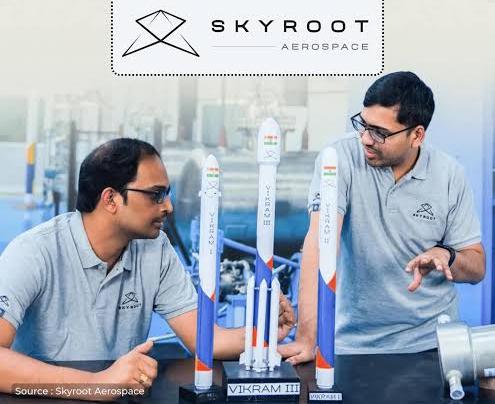
The commercial projections are backed by concrete engineering milestones at the launchpad. In late April 2026, Telangana Chief Minister A. Revanth Reddy officially flagged off the primary flight hardware for the Vikram-1 rocket from Skyroot's specialized manufacturing facility in Hyderabad. Over 70% of the vehicle components have successfully arrived at the spaceport facility on India's eastern coast.
The vehicle is a three-stage, carbon-composite orbital launch vehicle engineered to carry payloads up to 300–350 kilograms into low Earth orbit (LEO). Engineering crews are presently working alongside the Indian Space Research Organisation (ISRO) and the Indian National Space Promotion and Authorisation Centre (IN-SPACe) to complete structural stage integration, electrical checkout routines, and countdown simulations.
Impact on Global Satellite Operators and Private Businesses
The initiation of private orbital flights introduces an affordable alternative for international satellite builders. Operating similarly to a tailored "space taxi," the customized vehicle allows commercial enterprises to deploy micro-satellite constellations without waiting for slots on larger government rockets.
The company disclosed that it currently holds over ₹252 crore in advance customer deposits alongside a forward order book valued at ₹605.4 crore, driven heavily by earth-observation and telecom enterprises across the United States, Europe, and Southeast Asia.
Official Sources Section
Skyroot's strategic economic projections and operational metrics were evaluated and detailed via a comprehensive corporate valuation report published by KPMG. The real-time milestones of the launch preparation campaigns were formally corroborated through official administrative press briefings issued by IN-SPACe and statutory development updates archived by the Indian Space Research Organisation (ISRO).
Quote Section
"We will be conducting initial launches and demonstrating the capability to reach orbit consistently. Once that happens, the contract book is expected to build up strongly," stated Pawan Kumar Chandana, Chief Executive Officer and Co-Founder of Skyroot Aerospace, in an investor brief regarding the upcoming flight. "Even with the launch production capacity we are planning, we may not be able to fully meet the global demand right now."
Why It Matters
For international telecommunication networks, defense businesses, and institutional research bodies, the arrival of a reliable private launch provider helps clear the global backlog of stranded payloads waiting for orbit access. Proving that an independent Indian firm can launch rockets efficiently allows international commercial clients to take advantage of India's highly cost-competitive manufacturing ecosystem, lowering the cost of deploying satellite constellations worldwide.
Key Facts at a Glance
Revenue Growth Target: Skyroot Aerospace projects its revenue to jump to ₹977 crore in FY27, up from ₹100.6 crore in FY26.
Dual Business Drivers: The financial forecast relies on ₹633 crore from technical component manufacturing and ₹345 crore from satellite launch fees.
Upcoming Mission: Flight hardware for the Vikram-1 rocket has been delivered to Sriharikota for its inaugural orbital test flight.
Corporate Financial Backing: The firm maintains a valuation of $1.16 billion following a successful $60 million funding round led by GIC and Sherpalo Ventures.
Customer Backlog: Advance deposits from global satellite operators have surpassed ₹252 crore as of mid-2026.
Frequently Asked Questions
What is driving Skyroot Aerospace's revenue before its first rocket launch?
Skyroot generates substantial income through its Space Systems manufacturing arm, which supplies composite satellite enclosures, communication adaptors, and specialized propulsion hardware to global defense and tech clients.
What are the payload capabilities of the Vikram-1 orbital rocket?
Vikram-1 is a highly specialized small-satellite launch vehicle constructed from advanced carbon composites, designed to deliver payloads weighing up to 300–350 kg directly into low Earth orbit.
When is the official launch window scheduled for the Vikram-1 rocket?
The flight hardware has completed preliminary qualification checks and is at Sriharikota, with the launch window expected to open in mid-2026 pending final regulatory clearances from ISRO and IN-SPACe.
Source: Indian Space Research Organisation (ISRO), IN-SPACe Regulatory Portal, Skyroot Aerospace Investor Relations.