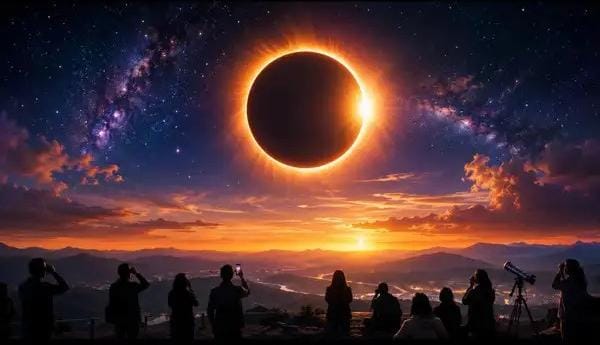
The total Solar Eclipse 12 August 2026 will not be visible in India, as the celestial event occurs during night hours locally. While totality will sweep across Arctic regions, Greenland, Iceland, and Spain, viewers in South Asia can follow the rare eclipse through official live broadcasts online.
NEW DELHI — Skywatchers across India will be unable to view the rare Solar Eclipse 12 August 2026, as the astronomical event occurs during nighttime hours across the region. According to eclipse tracking data from the National Aeronautics and Space Administration (NASA) and the India Meteorological Department (IMD), the alignment begins globally at 15:35 UTC (9:05 PM IST) on Wednesday, August 12, and concludes at 19:59 UTC (1:29 AM IST on August 13). Because the Sun remains below the horizon throughout the entire duration in South Asia, major cities including New Delhi, Mumbai, Bengaluru, Kolkata, and Chennai will miss the spectacle entirely.
Geographical Path and Visibility Details
While the Solar Eclipse 12 August 2026 will not be visible from India, Sri Lanka, Nepal, or Bangladesh, the path of totality covers several regions in the Northern Hemisphere. The Moon’s shadow will first strike the remote Arctic regions before sweeping across Greenland, western Iceland, and northern Spain, ending near the Balearic Islands in the Mediterranean Sea. A narrow slice of northwestern Portugal will also witness brief totality.
Path of Totality: Regions inside the corridor will experience complete coverage of the Sun's disk, revealing the solar corona for up to 2 minutes and 18 seconds. Key locations inside the path include Reykjavík in Iceland, alongside Santander, Bilbao, Zaragoza, and Palma de Mallorca in Spain.
Partial Eclipse Zones: Areas surrounding the path of totality—including broader Europe, northwestern Africa, parts of eastern North America, and vast stretches of the Atlantic and Arctic Oceans—will observe a partial solar eclipse.
Indian Subcontinent Exclusion: The Solar Eclipse 12 August 2026 falls entirely during night hours in India, placing the country outside both the total darkness corridor and the partial penumbral shadow.
Impact on Citizens, Travelers, and Astronomy Enthusiasts
The total solar eclipse on August 12, 2026, marks the first total solar eclipse visible in mainland Europe since 1999, attracting international travelers and eclipse chasers to primary viewing destinations in Spain and Iceland.
For Indian residents and astronomy enthusiasts, observation of the Solar Eclipse 12 August 2026 will be restricted to digital broadcasts and official live feeds from space agencies. Traditional astronomical and astrological observances, such as Sutak periods—which dictate specific guidelines during visible eclipses in India—do not apply for this event since the eclipse remains unobservable across the country.
Official Sources Section
According to official releases from the India Meteorological Department (IMD) and NASA Science directives:
The India Meteorological Department confirmed that the Solar Eclipse 12 August 2026 is strictly invisible from Indian landmasses.
NASA announced extensive scientific monitoring programs using ground observatories, space telescopes, and high-altitude research aircraft to capture solar corona measurements during totality.
International astronomical associations have emphasized safety protocols, advising viewers within European partial and total zones to use ISO-certified solar viewing glasses.
Quote Section
According to officials at NASA's Heliophysics Division:
"A total solar eclipse provides an exceptional scientific opportunity to study the outer solar atmosphere, or corona, which is normally obscured by the intense brightness of the Sun's surface. While observers inside the narrow path will witness day turn to night, international audiences outside the viewing area can follow real-time observational data streamed online."
Organizers and tourism desks in Spain and Iceland noted that hotel accommodations and flights into major path-of-totality hubs were booked out months in advance due to high demand for Europe's first total solar eclipse in over 25 years.
Why It Matters
This celestial event represents Europe’s first total solar eclipse in more than two decades, drawing global scientific and economic focus to Spain and Iceland. For the scientific community, totality allows unique access to observe solar flare dynamics and coronal mass ejections. For skywatchers in India, understanding the astronomical orbital mechanics helps clarify why solar eclipses occur selectively across different global longitudes.
Key Facts at a Glance
Event Date: Wednesday, August 12, 2026.
Maximum Duration of Totality: 2 minutes and 18 seconds.
Visibility in India: Not visible from any part of India or neighboring South Asian countries.
Peak Timing in IST: Greatest eclipse occurs around 11:17 PM IST on August 12.
Next India Total Eclipse: The next total solar eclipse visible from parts of India is scheduled for March 20, 2034.
FAQ Section
Q1: Will the Solar Eclipse 12 August 2026 be visible from New Delhi, Mumbai, or Bengaluru?
No. The Solar Eclipse 12 August 2026 will not be visible from New Delhi, Mumbai, Bengaluru, or any other city in India because it occurs during nighttime in the region.
Q2: Which countries can see the total solar eclipse on August 12, 2026?
Totality will pass over parts of Russia, Greenland, Iceland, Spain, and a small area of northwestern Portugal.
Q3: Are Sutak rules applicable in India for this solar eclipse?
No. Because the eclipse is not visible anywhere in India, traditional Sutak rules and observational restrictions do not apply.
Q4: How can people in India watch the Solar Eclipse 12 August 2026?
Indian residents can watch live video streams provided online by space agencies like NASA and various astronomical observatories in Europe.
Q5: When will the next total solar eclipse be visible in India?
The next total solar eclipse visible from parts of India will take place on March 20, 2034.
Sources: India Meteorological Department (IMD), NASA Science - Eclipses, The Indian Express Science Desk