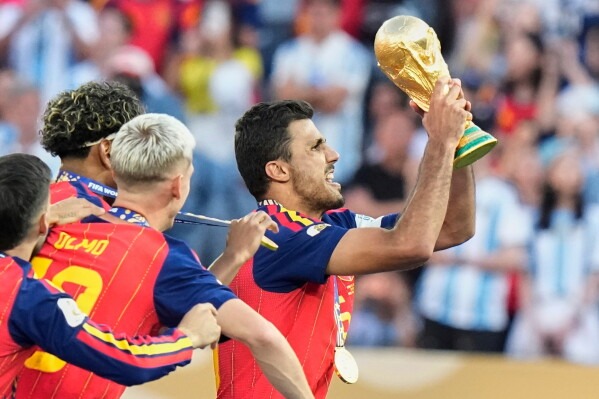
Spain defeated Argentina 1-0 at MetLife Stadium to win the FIFA World Cup 2026 title. Substitute Ferran Torres struck the winning goal in the 106th minute of extra time against a 10-man Argentine squad, following an algorithmic defensive masterclass that limited Lionel Messi's side to zero regular shots.
EAST RUTHERFORD, United States — Spain has officially reclaimed the pinnacle of international football, defeating defending champions Argentina 1-0 in a grueling, dramatic FIFA World Cup 2026 final.
Substitute forward Ferran Torres scored the historic winner in the 106th minute of extra time at the packed MetLife Stadium (New York New Jersey Stadium), ending Argentina's reign and denying Lionel Messi a fairytale back-to-back title in what is expected to be his final World Cup match. The high-stakes clash completely turned on a late red card in second-half stoppage time, forcing South America's champions to play the entire extra periods with only 10 men.
Directing Tactical Dominance Against Resolute Defense
From the initial whistle, Luis de la Fuente’s European champions seized command of the midfield using their hallmark short-passing sequences, keeping Lionel Scaloni’s side pegged deep. Teen prodigy Lamine Yamal forced a quick low block from Argentina goalkeeper Emiliano "Dibu" Martínez just five minutes in, setting a tone of absolute territorial domination.
Despite Spain controlling the tempo, Argentina’s veteran defensive pairing of Lisandro Martínez and Cristian Romero held firm under heavy pressure. However, physical breakdowns complicated Scaloni's game plan, as both starting center-backs had to be substituted due to sudden mid-game injuries. Martínez made way for Nicolás Otamendi just before the interval, and Romero was replaced by Facundo Medina in the 70th minute.
Remarkably, Spain’s tactical chokehold was so complete that Argentina failed to register a single shot attempt across the entire 90 minutes of normal regulation time. Martínez single-handedly kept the Albiceleste alive, logging 12 spectacular saves—including a flying stop to deny a late Yamal free-kick—to push the final into extra time.
The Stoppage-Time Red Card and Extra-Time Breakthrough
The match reached its ultimate boiling point three minutes into second-half added time. Argentina midfielder Enzo Fernández lunged into a reckless challenge on 19-year-old Spanish defender Pau Cubarsí, prompting referee Slavko Vincic to instantly brandish a second yellow card, followed by a mandatory expulsion.
Down to 10 men, Argentina found themselves completely overrun during extra time as Spain weaponized their numerical advantage. Though La Roja had two goals disallowed for marginal infractions, the defining breakthrough materialized in the 106th minute. Right-back Pedro Porro delivered a sweeping cross to the far post, which Nico Williams expertly nodded down into the path of Ferran Torres. The Barcelona forward made no mistake, burying a first-time shot into the roof of the net to spark wild celebrations.
Argentina mounted a desperate late charge, nearly leveling the score with four minutes left when reserve forward Giuliano Simeone latched onto a deflected corner kick, only to fire his effort high over the crossbar.
Historic Records Shattered in New Jersey
This triumph cements Spain’s name in the sport's history books through several remarkable statistics. La Roja has set an all-time FIFA World Cup record by winning the tournament while conceding only one single goal across their entire campaign. Furthermore, Spain remains the only nation to win a European Championship and a World Cup in successive tournament cycles, repeating the legendary double achieved by their 2008–2010 golden generation.
At 65 years and 28 days old, Luis de la Fuente officially became the oldest coach ever to win a World Cup title, narrowly eclipsing his iconic compatriot Vicente del Bosque’s record from 2010.
Official Sources Section
According to official match reports compiled by the FIFA Match Administration, Spain secured the tournament victory on July 19, 2026, outshooting their opponents 20 to 0 in active attempts during normal time, with full compliance verified by VAR over the decisive extra-time goal.
Managers' Verdicts
"There is sadness, but also the knowledge that we gave it our all," stated Argentina coach Lionel Scaloni in his post-match address. "I am eternally grateful to these guys; they competed right to the end. The other team was better. We must be gracious in defeat."
"I think the game should have been decided earlier," remarked Spain manager Luis de la Fuente. "Dibu's great saves prevented us from winning sooner, but it is a World Cup final and, even with ten players at the end, you have to suffer. It was together we reached this stage, and I feel so much pride for this generation."
Why It Matters
For football fans and sports business operators, this result marks a definitive shift in the global order. Spain's high-pressing, youth-driven system led by teenagers Lamine Yamal and Pau Cubarsí has proven it can dismantle the most experienced defensive blocks in the world. The conclusion of Argentina's multi-tournament winning streak opens up a highly competitive landscape heading into the next international cycles, while establishing New Jersey's MetLife Stadium as a historic venue for grand-scale sporting drama.
Key Facts at a Glance
The Decisive Strike: Substitute Ferran Torres scored the match's only goal in the 106th minute of extra time.
Defensive History: Spain became the first champion in history to win the World Cup while conceding only one goal all tournament.
Disciplinary Blow: Argentina played the extra-time periods short-handed after Enzo Fernández picked up a red card at 90+3'.
Age Record: At 65, Luis de la Fuente is the oldest manager to ever hoist the FIFA World Cup trophy.
FAQ Section
Who scored the winning goal in the World Cup 2026 final?
Ferran Torres scored the match-winning goal in the 106th minute of extra time after coming off the bench as a substitute.
Why was Enzo Fernández sent off during the match?
The Argentine midfielder received a direct second yellow card in stoppage time for a reckless challenge on Spanish defender Pau Cubarsí.
Where can fans view the official tournament highlights?
The full match logs, official photography, and tactical breakdowns are published on the digital tournament database of FIFA.
Source: FIFA World Cup Official Match Center, Associated Press Sports Desk, Reuters Football News Archive.