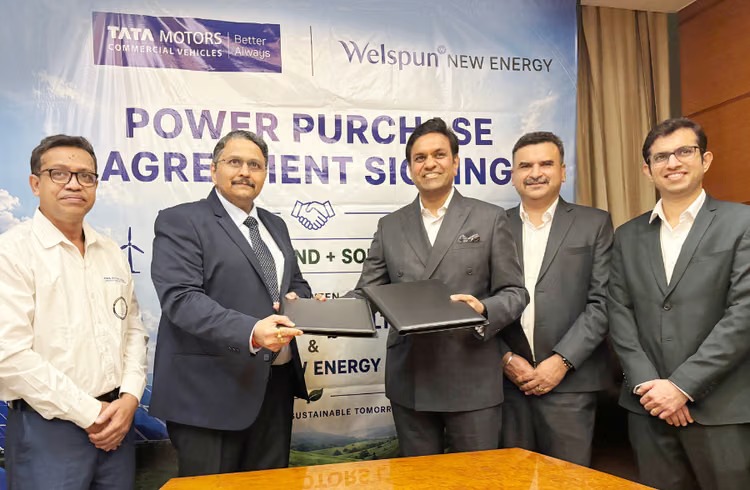
Tata Motors has signed an 86 MW wind-solar hybrid project agreement with Welspun Renewable Energy to power four of its manufacturing plants in India. Expected to generate 200 million units of clean energy annually, the initiative supports the automaker’s goal of reaching 100% renewable energy usage by 2030.
MUMBAI — Tata Motors has officially entered into a Power Purchase Agreement (PPA) with Welspun Renewable Energy Private Limited (WREPL) to develop an 86 MW wind-solar hybrid renewable energy project. The partnership, announced on Friday, July 3, 2026, marks a significant expansion in the automaker's efforts to decarbonize its manufacturing operations across India.
The project is designed to provide a steady supply of green electricity to four of Tata Motors' critical manufacturing facilities located in Jharkhand, Uttar Pradesh, Uttarakhand, and Karnataka. This initiative is a central component of the company's broader sustainability roadmap, aimed at achieving net-zero emissions in its manufacturing processes.
Scaling Renewable Energy Integration
The hybrid project, which combines solar and wind power generation, is expected to produce approximately 200 million units of renewable electricity annually. By integrating this clean energy into its production lines, Tata Motors estimates an annual reduction of more than 1.4 lakh tonnes of carbon dioxide emissions.
According to company statements, the energy generated through this project will be used exclusively to support commercial vehicle production. This model allows the manufacturer to bypass traditional grid dependency for a significant portion of its power requirements, ensuring greater energy security while stabilizing long-term energy costs.
Aligning with Global Sustainability Goals
This collaboration aligns with Tata Motors’ commitment as an RE100 signatory, a global corporate initiative bringing together businesses committed to sourcing 100% of their electricity from renewable sources by 2030. The choice of a wind-solar hybrid model is strategic; it provides a more consistent power output compared to standalone solar or wind projects, which can be subject to diurnal and seasonal fluctuations.
"According to officials at Tata Motors, this project reflects the company's continued focus on building greener and more energy-efficient manufacturing operations. The scale and integrated nature of this wind-solar hybrid solution will help secure a reliable supply of renewable energy for key commercial vehicle manufacturing facilities, while meaningfully reducing carbon emissions across operations on a sustained basis."
Impact on Operations and Manufacturing
For the automotive sector in India, the transition to green manufacturing is becoming increasingly vital as global supply chains enforce stricter environmental standards. By investing in co-developed renewable assets with partners like Welspun Renewable Energy, Tata Motors is insulating its production facilities from potential grid-related power volatility and rising traditional energy prices.
The move follows several other similar initiatives by the company, which has been systematically ramping up its renewable energy footprint through group-captive models. As of July 2026, these efforts are becoming essential to the firm's competitive strategy, particularly as demand for low-carbon manufacturing rises among both commercial fleet operators and passenger vehicle consumers.
Key Facts at a Glance
Project Capacity: 86 MW Wind-Solar Hybrid.
Energy Generation: Approximately 200 million units annually.
Environmental Impact: Reduction of over 1.4 lakh tonnes of $CO_2$ emissions per year.
Target Facilities: Manufacturing plants in Jharkhand, Uttar Pradesh, Uttarakhand, and Karnataka.
Strategic Goal: Support for RE100 2030 commitment and net-zero manufacturing.
FAQ
What is a wind-solar hybrid project?
It is an energy generation system that integrates both solar and wind technologies at a single location, allowing for more consistent electricity production by balancing the strengths of both sources.
Why is Tata Motors investing in this project?
The project aims to meet the company's RE100 commitment, which targets 100% renewable energy use by 2030, and helps reduce the carbon footprint of its vehicle manufacturing operations.
How will this impact the manufacturing plants?
The four designated plants will receive a reliable, cost-effective, and sustainable supply of power, which supports the production of commercial vehicles.
Who is the energy partner?
The project is being developed in partnership with Welspun Renewable Energy Private Limited (WREPL), which specializes in large-scale renewable energy infrastructure.
Source: Autocar Professional, Reuters, TradingView