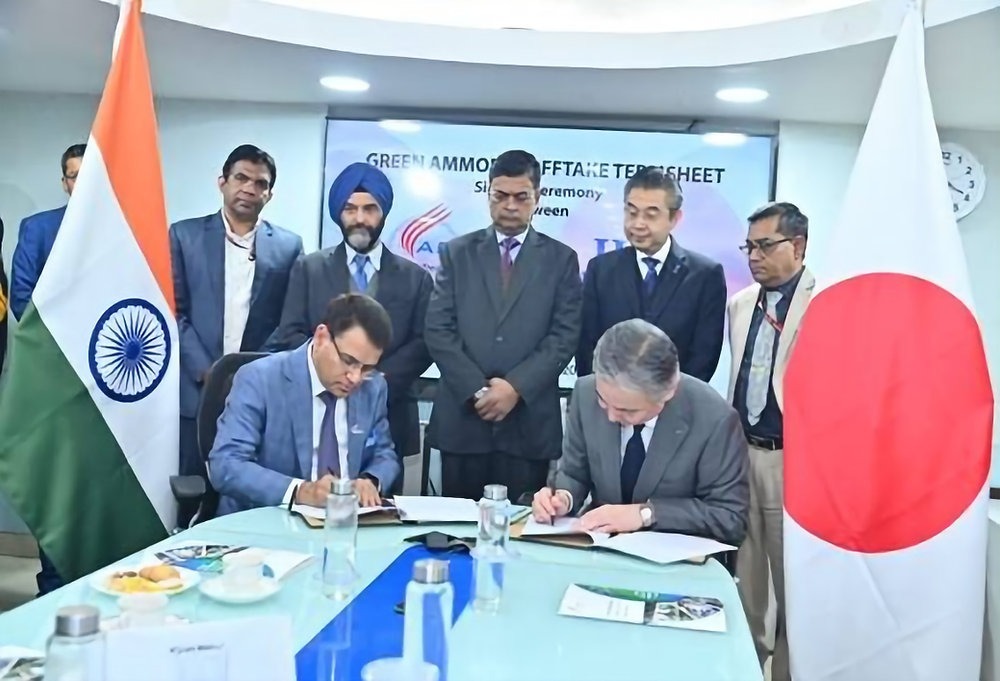
The Odisha state government, in partnership with ACME Group and Japan's IHI Corporation, has launched green energy projects worth ₹670 billion. Focused on green ammonia and methanol production, the initiative is backed by $5 billion in Japanese subsidies and aims to position India as a global clean energy hub.
BHUBANESWAR – In a move set to transform India’s industrial landscape, the Odisha state government has entered into a strategic collaboration with ACME Group and Japan’s IHI Corporation for clean energy projects valued at approximately ₹670 billion. This investment, formalized through a series of landmark agreements, marks a significant step forward in the country's National Green Hydrogen Mission, positioning Odisha as a global hub for green ammonia and green methanol production.
The collaboration, which encompasses projects in Gopalpur and Paradip, is designed to fuel Japan’s decarbonization efforts while strengthening India’s domestic manufacturing capabilities. By leveraging India’s vast renewable energy potential, the joint venture aims to produce low-carbon fuels that meet stringent international maritime and industrial standards.
Expanding the Green Energy Corridor
The core of this partnership is the development of world-scale production facilities in Odisha. The ACME-IHI joint venture is currently establishing a major green ammonia facility at the Tata Steel SEZ Industrial Park in Gopalpur. This site is expected to be commissioned by July 2030, with an annual capacity of 405,000 tonnes.
Parallel to the Gopalpur facility, ACME Group is advancing an 800,000 tonnes-per-annum (TPA) green ammonia plant in Paradip. These facilities are not merely domestic projects; they are integrated into a robust export-oriented ecosystem supported by long-term offtake agreements with Japanese industrial majors, including Mitsubishi Gas Chemical Company.
International Financial Support
The projects have gained significant momentum following their selection for Japan’s prestigious Contract for Difference (CfD) subsidy program. According to official reports, the Japanese government is providing approximately $3 billion in price support to bridge the cost gap between conventional "grey" ammonia and cleaner alternatives. An additional $2 billion has been secured under Japan’s Long-Term Decarbonized Power Source Auction (LTDA), ensuring long-term revenue visibility and project bankability.
Official Sources
The agreements were finalized in the presence of representatives from the Indian Ministry of New and Renewable Energy (MNRE), the Japanese Ministry of Economy, Trade and Industry (METI), and leadership from the Odisha state government. Officials highlighted that these projects reflect "growing global confidence in India’s green hydrogen ecosystem."
Why It Matters
For India, these agreements are critical to achieving the goals of the National Green Hydrogen Mission, which aims to make the country a leading exporter of clean fuels. For global markets, particularly Japan, the supply of green ammonia is essential for decarbonizing heavy industries and coal-fired power plants, where ammonia is increasingly being used as a co-firing fuel. The development also sets a precedent for compliance with international standards such as the Renewable Fuels of Non-Biological Origin (RFNBO).
Key Facts at a Glance
Total Investment: Projects valued at approximately ₹670 billion.
Production Targets: 405,000 TPA of green ammonia in Gopalpur and 800,000 TPA in Paradip.
Key Partners: Odisha Government, ACME Group, IHI Corporation, and Mitsubishi Gas Chemical.
Global Support: Supported by Japan's $5 billion CfD and LTDA funding packages.
Strategic Goal: Aligning with India’s National Green Hydrogen Mission and international decarbonization mandates.
FAQ
Q: What is the significance of green ammonia in these projects?
A: Green ammonia acts as a carrier for green hydrogen, making it easier to transport and store. It is used as a low-carbon fuel for power generation and as a feedstock for chemical industries.
Q: When will these projects become operational?
A: The Gopalpur plant is expected to be commissioned by July 2030, while the Paradip facility is slated for completion in 2029.
Q: How does the Japanese subsidy program work?
A: The Contract for Difference (CfD) program compensates producers for the price difference between expensive green fuels and cheaper conventional fossil-fuel-based alternatives, ensuring the commercial viability of the projects.
Source: Ministry of New and Renewable Energy (MNRE), ACME Group, The Economic Times, Livemint