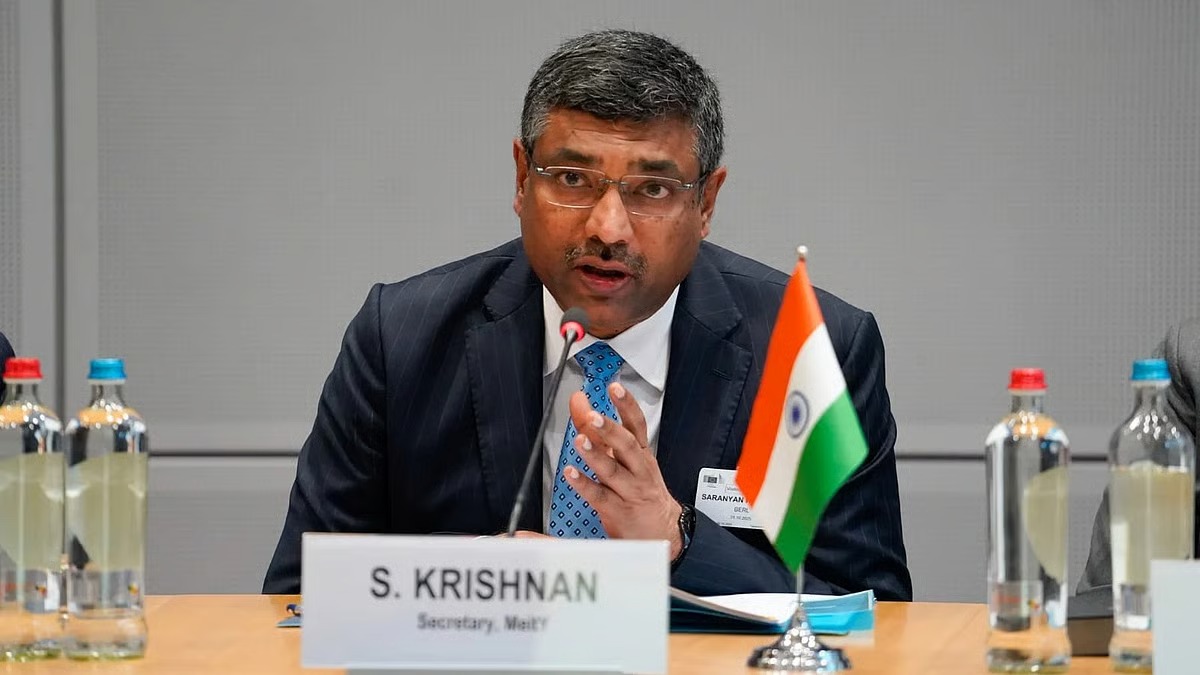
MeitY Secretary S. Krishnan announced that India is moving to draft a dedicated legal framework for artificial intelligence, marking a major departure from its light-touch approach. The standalone law aims to tackle surging deepfake and algorithmic risks while systematically balancing technological innovation with binding public safety safeguards.
NEW DELHI — The Indian government is preparing to abandon its long-standing "light-touch" regulatory approach toward artificial intelligence (AI) in favor of a dedicated legal framework. S. Krishnan, Secretary of the Ministry of Electronics and Information Technology (MeitY), announced on Friday, July 3, 2026, that "the time has come to look at a separate legislation" specifically tailored to handle the rapid expansion of AI systems. Speaking on the sidelines of a Confederation of Indian Industry (CII) national tech conference, Krishnan indicated that while existing laws have stabilized early platform challenges, the complexity of generative tech requires a standalone statute to balance industrial innovation with explicit public safety safeguards.
Escalating Risks Prompt Standalone Legal Shift
The announcement marks a fundamental pivot for India's digital sector. For years, the Centre maintained that rushed, heavy-handed software laws could stifle local engineering talent and slow the rollout of the ₹10,372-crore IndiaAI Mission. Instead, regulators relied on a combination of technology-neutral legacy acts to address digital misbehavior.
However, the explosive proliferation of synthetic media and deepfakes has placed unprecedented pressure on these traditional legal boundaries. While MeitY successfully utilized targeted updates to the Information Technology Intermediary Rules to force social networks like X and Instagram to purge flagged deepfakes within three hours, officials acknowledge that basic platform moderation cannot stop deeper systemic threats. Emerging challenges surrounding automated financial fraud, algorithmic bias in employment, copyright infringements during model training, and autonomous code execution require comprehensive statutory definitions that legacy acts simply do not possess.
Phased Regulatory Drafting and Global Alignments
According to official briefings from the Ministry of Electronics and Information Technology (MeitY), the administrative desk has commenced initial high-level industry consultations to shape the upcoming legislative proposal. The draft framework will seek to mirror the "Seven Sutras" (principles) outlined in the country’s recent AI Governance Guidelines, prioritizing trust, human-centric design, and transparency.
As MeitY builds its domestic text, Indian lawmakers are closely analyzing the diverse regulatory models currently deployed across the global digital economy:
The European Union: Operating under the strict, risk-categorized architectures of the EU AI Act, which enforces blanket bans on certain cognitive applications.
The United Kingdom: Using a highly decentralized, principles-based framework that delegates enforcement directly to existing sector-specific watchdogs.
The United States: Relying heavily on voluntary executive orders, multi-company consensus safety pacts, and targeted export controls.
The People's Republic of China: Deploying highly targeted, fast-acting administrative rules focused tightly on generative algorithms and deep synthesis technologies.
Easing Export Curbs on Advanced Frontier Models
In a parallel development indicating deepening international tech integration, Secretary Krishnan confirmed that international export restrictions on Anthropic’s "Mythos" advanced language model have been successfully eased for domestic developers. India is currently locked in active regulatory negotiations with the United States government to secure inclusion in an elite "trusted group" of fifteen nations.
Gaining this verified clearance will grant Indian research institutions, corporate labs, and defense data centers unhindered access to top-tier proprietary foundation models, accelerating local enterprise AI applications while negotiations for next-generation models continue.
Official Sources Section
The administrative declarations, legal rationales, and international technology data points utilized across this report are sourced directly from official convention transcripts published by the Ministry of Electronics and Information Technology (MeitY), ministerial policy portfolios archived by the Press Information Bureau (PIB) India, and statutory compliance guidelines managed under the Information Technology Act framework.
Quote Section
The administration has made it clear that while draft legislation is actively moving to the drawing board, a structured, democratic consultative loop will dictate the eventual timeline.
According to official statements delivered by MeitY Secretary S. Krishnan during the CII conference:
"We have used the IT rules, and other provisions of existing law to address various concerns that AI raises, but now, probably the time has come to look at a separate legislation. It is a conversation which has commenced, and my Minister [Ashwini Vaishnaw] and I have both been on record earlier that we will look at AI regulation when the time is right, and it appears that the time is getting right."
Union IT Minister Ashwini Vaishnaw echoed the regulatory necessity during a recent policy review:
"The current information technology law was framed much before the rapid emergence of Artificial Intelligence, and a new legal framework may be required to deal with the changing landscape. The government will seek to strike a balance between innovation and regulation."
Why It Matters
The transition toward an AI-specific law carries massive practical implications for corporate software developers, venture capital firms, and everyday digital consumers. For international tech investors, a definitive, standalone act replaces unpredictable ad-hoc government advisories with clear, long-term regulatory compliance standards. While tech startups may face compliance overhead regarding data curation, auditing, and algorithmic accountability, everyday citizens gain vital statutory protections against non-consensual deepfakes, automated bias, and digital identity theft, securing India's position as a safe, highly structured market for digital innovation.
Key Facts at a Glance
The Policy Shift: India is officially preparing to draft a standalone legal framework to govern artificial intelligence, moving away from patchwork legacy laws.
The Catalyst: The rapid surge in deepfakes, synthetic media generation, and automated algorithmic risks breached existing IT Act protections.
Draft Alignment: The upcoming statute will prioritize graded liability models, structural transparency, and data minimization frameworks.
Global Tech Access: Easing export restrictions has cleared the path for Indian developers to access Anthropic's advanced "Mythos" model amid ongoing US alignment talks.
FAQ Section
Q: Why are India's current IT laws considered insufficient for AI?
A: The foundational Information Technology Act was enacted in 2000, decades before the arrival of generative neural networks, deepfakes, and automated machine learning decision systems, leaving severe gaps in product liability and algorithmic accountability.
Q: Will the new law completely ban certain AI applications like the EU AI Act?
A: While specific boundaries have not been finalized, official policy roadmaps indicate that India prefers a pro-innovation, risk-based techno-legal model that targets malicious use cases rather than placing outright bans on foundational code.
Q: What is the estimated timeline for the introduction of the new AI law?
A: MeitY officials confirmed that the ministry is actively drafting the legislative proposal, though the final timeline for parliamentary introduction depends on extensive industry consultations and cabinet clearances.
Source: Official strategy briefings and conference releases from the Ministry of Electronics and Information Technology (MeitY) India, policy briefs from the Press Information Bureau (PIB), and public law publications tracking the Digital India Act parameters.