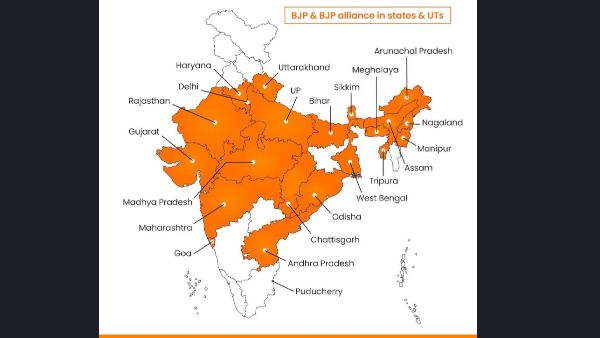
After the 2026 assembly elections, the BJP-led NDA now governs or shares power in 22 of India’s 36 states and Union Territories, turning vast swathes of the political map saffron, from the Northeast to the western frontier, even as pockets like Tamil Nadu and Kerala continue to resist its advance.
A decade of electoral gains has culminated in a striking 2026 “saffron map” in which the BJP-NDA dominates north, west, central and much of northeast India, and cracks open key bastions in the east. West Bengal’s latest result is being seen as the pivotal breakthrough that completes a near-contiguous BJP belt.
Where Saffron Rules
From Seven To Twenty-Two States
In 2014, the BJP was in power in just seven states; by 2026, it has expanded its footprint to 22 states and UTs, while Congress and its allies are down to around six, and other regional formations control only a handful.
A voter can now drive from India’s border with China in the Northeast to the border with Pakistan in the west without leaving BJP- or NDA-ruled territory, underscoring how geography now mirrors the party’s national dominance.
Eastward Expansion
Why Bengal Is The Turning Point
The real psychological shift came with West Bengal, where the BJP crossed the majority mark of 148 seats in early trends and moved from being an opposition force to a ruling party contender.
This win plugs one of the last big gaps on the eastern seaboard, linking the BJP’s strongholds in Assam and the Northeast with its presence further south and west.
Limits To The Wave
Southern Red Lines
Tamil Nadu continues to chart a different course, with outfits like TVK emerging as key forces and regional Dravidian politics limiting saffron gains; Kerala similarly remains a Congress–UDF bastion that has held off a BJP breakthrough.
These southern pockets highlight that the saffron wave is powerful but not uniform, relying more heavily on alliances or incremental growth in some states.
What It Means Nationally
A New Centre Of Gravity
The BJP-NDA now sets the broad policy direction across large, connected parts of India, shaping debates on welfare, nationalism, economic reform and federal relations from a position of numeric strength.
Yet, its map also reveals vulnerabilities—states where it governs via coalitions, regions where it is still converting “presence into power,” and opposition pockets that could anchor future resistance.
Political Map Highlights
Saffron Wave Insights
- NDA now in power or sharing power in 22 of 36 states/UTs
- Continuous BJP-NDA belt from Northeast border with China to western border with Pakistan
- West Bengal win closes a key gap in the east, extending saffron presence
- Tamil Nadu and Kerala remain major non-BJP bastions despite national trend
Sources: OneIndia, Times of India