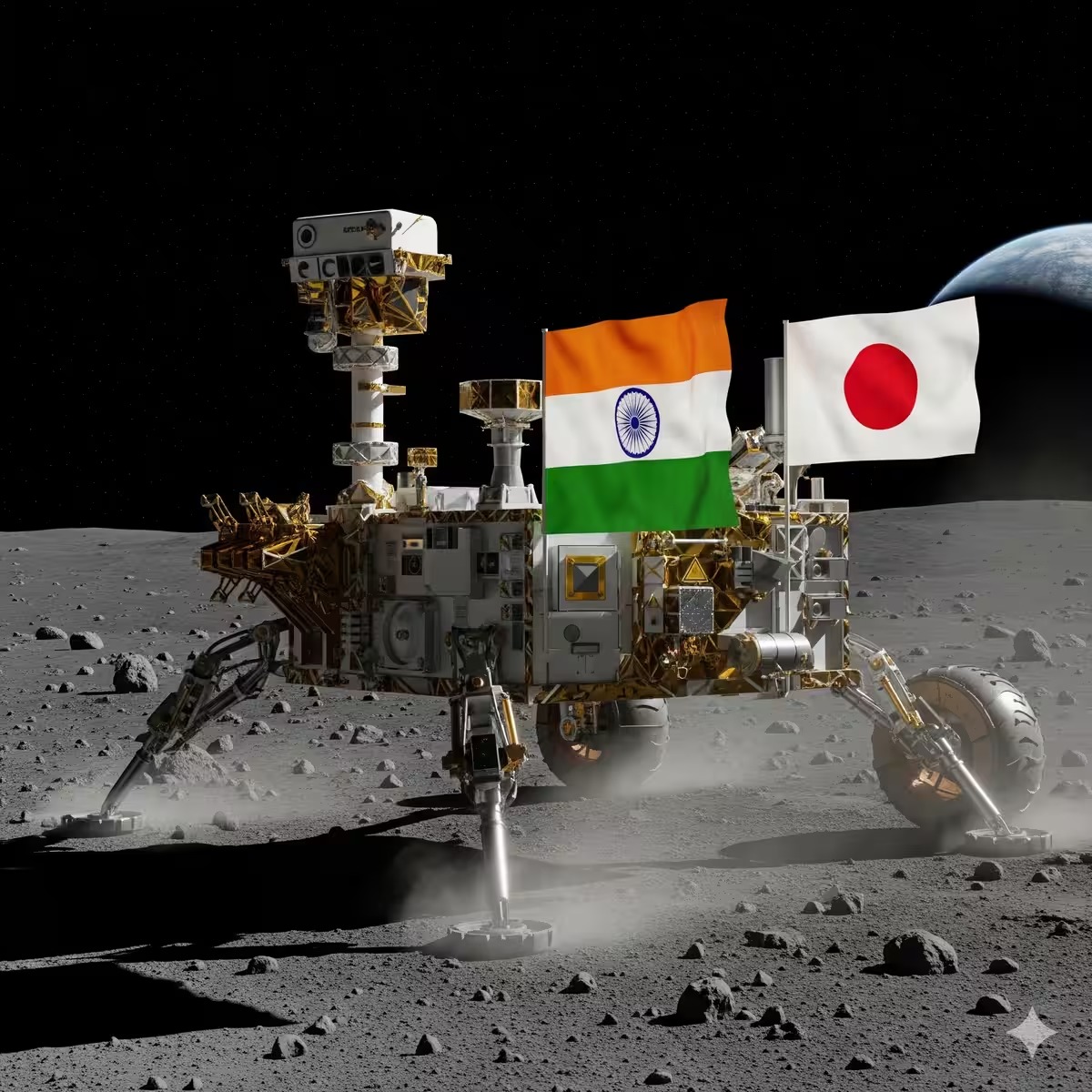
Scientists from the Indian Space Research Organisation and the Japan Aerospace Exploration Agency met to review technical coordination for Chandrayaan-5, officially known as the Lunar Polar Exploration mission. The joint initiative aims to explore water-ice in the Moon's south pole region using a Japanese H3 rocket, a 350 kg rover, and an Indian-built lunar lander.
BENGALURU, India — Senior scientists from the Indian Space Research Organisation (ISRO) and the Japan Aerospace Exploration Agency (JAXA) convened on July 29, 2026, to review technical preparations for Chandrayaan-5, officially designated as the Lunar Polar Exploration (LUPEX) mission. The bilateral review focused on establishing inter-spacecraft communication protocols, evaluating onboard scientific payloads, and finalizing technical interfaces ahead of a planned 2028 launch window.
This technical review marks an important milestone in the joint program, which builds upon India’s soft landing near the lunar south pole during the Chandrayaan-3 mission in 2023.
Technical Coordination and Simulation Progress
During the bilateral sessions, engineering teams evaluated inter-spacecraft communication systems required to maintain continuous telemetry and data transmission between the lunar lander, rover, and ground stations.
The review followed JAXA’s completion of its second Payload Operations Simulation at the Tsukuba Space Center in Japan. The simulation evaluated complex operational scenarios involving simultaneous command and control of the spacecraft bus and scientific instrumentation.
Under the division of responsibilities:
JAXA is tasked with providing the heavy-class H3 launch vehicle and a 350-kilogram lunar rover equipped with subsurface drilling apparatus.
ISRO is developing a high-capacity lunar lander powered by a newly designed 3.1 kN liquid-fuel L9 engine produced by the Liquid Propulsion Systems Centre (LPSC).
Scientific Scope and Lunar South Pole Exploration
Chandrayaan-5 is designed to operate for a minimum of 100 days on the lunar surface, significantly exceeding the 14-day surface operational lifespan of Chandrayaan-3.
The mission targets permanently shadowed regions (PSRs) near the Moon's south pole to analyze the distribution, quantity, and volatile quality of water-ice. Ground-penetrating radar, spectrometers, and a 1.5-meter sampling drill will extract and analyze subsurface regolith to evaluate lunar water resources for potential future sustained presence.
In addition to primary Indian and Japanese payloads, scientific instruments provided by the National Aeronautics and Space Administration (NASA) and the European Space Agency (ESA) are scheduled to fly aboard the mission.
Official Sources Section
Information regarding the mission status and review outcomes was compiled according to official updates and technical documentation from:
Quote Section
"According to officials from ISRO and JAXA, the joint technical review confirmed satisfactory alignment across payload interfaces and communication protocols, keeping the project on schedule for launch window assessments targeted for 2028."
Why It Matters
Determining the exact depth, purity, and accessibility of lunar water-ice is critical for international space exploration programs. Water ice on the Moon can be processed into breathable oxygen and hydrogen rocket fuel, drastically reducing the mass requirements and costs of deep-space voyages. Chandrayaan-5 represents one of the most comprehensive scientific surveys planned for the lunar polar terrain, establishing foundational data for international lunar research architectures.
Key Facts at a Glance
Mission Name: Chandrayaan-5 / Lunar Polar Exploration Mission (LUPEX).
Partner Agencies: Indian Space Research Organisation (ISRO) and Japan Aerospace Exploration Agency (JAXA).
Target Launch Date: Targeted for 2028 via Japan's H3 rocket.
Operational Duration: Planned 100-day surface mission in lunar south pole regions.
Key Equipment: 350 kg Japanese rover with a 1.5-meter drill and an Indian-built high-capacity lander.
Frequently Asked Questions (FAQs)
What is Chandrayaan-5?
Chandrayaan-5, also known as LUPEX, is a joint robotic lunar mission between India's ISRO and Japan's JAXA designed to study lunar water-ice at the Moon's south pole.
How does Chandrayaan-5 differ from Chandrayaan-3 and Chandrayaan-4?
Chandrayaan-3 demonstrated soft-landing capabilities near the lunar south pole in 2023. Chandrayaan-4 is designed as a lunar sample return mission, while Chandrayaan-5 is a joint international deep-exploration mission featuring a heavy 350 kg drill-equipped rover to study subsurface water ice for 100 days.
Who is manufacturing the rocket and lander for Chandrayaan-5?
JAXA will provide the H3 launch vehicle and the lunar rover, while ISRO is developing the lunar lander spacecraft.
Source: Official project documentation from the Indian Space Research Organisation, mission updates from the Japan Aerospace Exploration Agency, and updates released by the Ministry of Science and Technology.