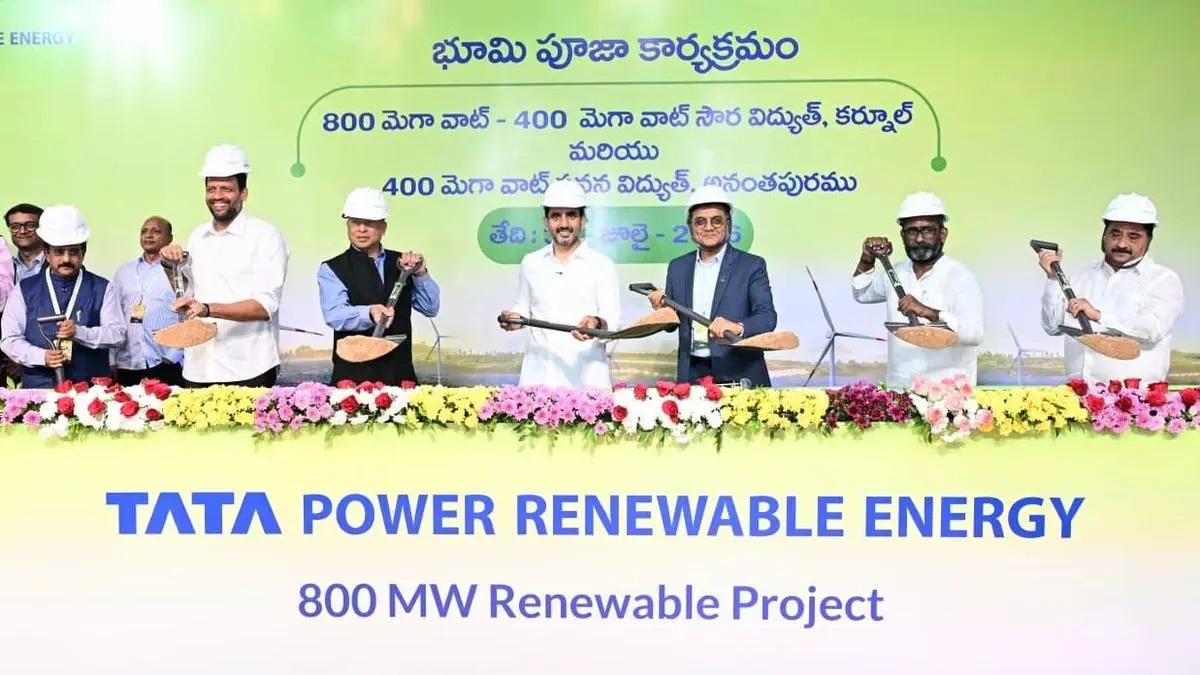
Tata Power Renewable Energy Limited has officially broken ground on an 800-MW hybrid wind-solar project in Andhra Pradesh, representing an investment of ₹5,750 crore. The complex combines 400 MW of solar and 400 MW of wind power across Kurnool and Anantapur districts, integrating battery storage to support grid stability.
KURNOOL, India — Tata Power Renewable Energy Limited (TPREL), a subsidiary of Tata Power Company Ltd, officially initiated construction on an 800-megawatt (MW) hybrid wind-solar project in Andhra Pradesh on July 30, 2026. The ₹5,750 crore ($690 million) clean energy complex was launched during a ceremonial groundbreaking event attended by state government officials and corporate executives in Kurnool district. The milestone initiative accelerates India's clean energy transition by deploying large-scale dispatchable renewable power across southern grid corridors.
The ceremony was attended by Chief Guest Nara Lokesh, Minister for Information Technology, Electronics & Communications, Human Resources Development, and Real-Time Governance for the Government of Andhra Pradesh, alongside Dr. Praveer Sinha, CEO and Managing Director of Tata Power. The project supports the state's strategic goal of becoming a clean energy hub while advancing national decarbonization targets.
Dual-Location Infrastructure and Technical Architecture
The Tata Power wind-solar project in Andhra Pradesh is structured across two distinct geographical sites to optimize solar irradiation and wind speed conditions:
Solar Generation Hub: A 400-MW solar installation situated at Pattikonda in Kurnool district, covering approximately 2,700 acres of land.
Wind Generation Hub: A 400-MW onshore wind farm located at Kanekallu in Anantapur district, spanning roughly 760 acres.
Wind energy solutions provider Suzlon Energy Ltd was awarded the Engineering, Procurement, and Construction (EPC) contract for the 400-MW wind asset. Under the contract scope, Suzlon will supply, install, and commission 127 wind turbine generators, each featuring a rated capacity of 3.15 MW.
To address the intermittency inherent in renewable power, the overall framework incorporates a 200-MW Firm and Dispatchable Renewable Energy (FDRE) allocation for state-owned power utility NTPC. This component integrates a 25-MW / 50-MWh Battery Energy Storage System (BESS) designed to smooth out generation fluctuations and deliver reliable power during peak consumption hours. The remaining 200 MW of solar capacity is earmarked for future power purchase allocation.
Grid Evacuation and Economic Alignment
A critical aspect of the Tata Power wind-solar project in Andhra Pradesh is its transmission infrastructure. The complex has secured 800 MW of Inter-State Transmission System (ISTS) connectivity through the Ananthapuram II and Kurnool-4 Central Transmission Utility of India Limited (CTUIL) substations. This high-voltage link enables the evacuation and wheeling of clean electricity across the national power grid.
The development is being implemented under the Andhra Pradesh Integrated Clean Energy (ICE) Policy, a state regulatory framework designed to attract private capital, streamline land acquisition, and expand renewable generation capacity.
Project developers estimate the development will generate direct and indirect employment for approximately 4,000 workers across the engineering, procurement, construction, and operational stages.
Impact on Citizens, Businesses, and the Energy Sector
The execution of the Tata Power wind-solar project in Andhra Pradesh carries substantial practical benefits across regional and industrial sectors:
For Citizens & Communities: Local populations in Kurnool and Anantapur benefit from immediate employment creation and improved regional infrastructure stemming from road and civil works connected to the power plants.
For Industrial Consumers: The addition of 800 MW of hybrid capacity increases clean energy supply in southern India, assisting commercial and industrial buyers in fulfilling mandatory Renewable Purchase Obligations (RPO).
For Investors: The project expands Tata Power’s total clean energy portfolio—which stands at 17.7 GW including under-construction assets—supporting the company’s corporate roadmap toward 100% net-zero emissions by 2045.
Official Sources Section
Information regarding the project specification, investment values, and corporate timelines cited in this article was compiled according to official announcements and regulatory filings from:
Quote Section
"The groundbreaking of this 800 MW renewable energy project in Andhra Pradesh marks a significant step in Tata Power's mission to accelerate India's clean energy transition," stated Dr. Praveer Sinha, CEO and Managing Director of Tata Power. "By combining solar, wind, and advanced battery energy storage, this facility will supply dependable green power to the national grid while supporting industrial expansion across the region."
Why It Matters
Hybrid renewable installations integrating both solar arrays and wind turbines offer significantly higher capacity utilization factors (CUF) compared to standalone wind or solar facilities. Because wind generation typically peaks during evening hours while solar generation operates during daylight, hybrid facilities maintain a more consistent power output curve. Integrating a battery storage system further enables dispatchers to release stored energy during peak grid demand, offering a template for grid modernization across emerging markets.
Key Facts at a Glance
Project Scale: 800-MW total hybrid capacity (400 MW solar + 400 MW wind).
Total Investment: ₹5,750 crore ($690 million).
Locations: Pattikonda in Kurnool district (solar) and Kanekallu in Anantapur district (wind).
Transmission: 800-MW Inter-State Transmission System (ISTS) connection secured via CTUIL substations.
Job Creation: Expected to generate employment for approximately 4,000 local workers.
Frequently Asked Questions (FAQs)
What is the capacity of the Tata Power wind-solar project in Andhra Pradesh?
The project features a total generation capacity of 800 MW, split equally between 400 MW of solar power and 400 MW of wind power.
Who is executing the wind component of the project?
Suzlon Energy Ltd has been awarded the EPC contract to supply and install 127 wind turbine generators for the 400-MW wind asset in Anantapur district.
How does the project support grid stability?
The complex includes a 200-MW Firm and Dispatchable Renewable Energy (FDRE) allocation for NTPC, supported by a 25-MW / 50-MWh Battery Energy Storage System (BESS) that stores excess power for dispatch during peak load periods.
Sources: Tata Power Company Limited, Government of Andhra Pradesh, Suzlon Energy Limited.